

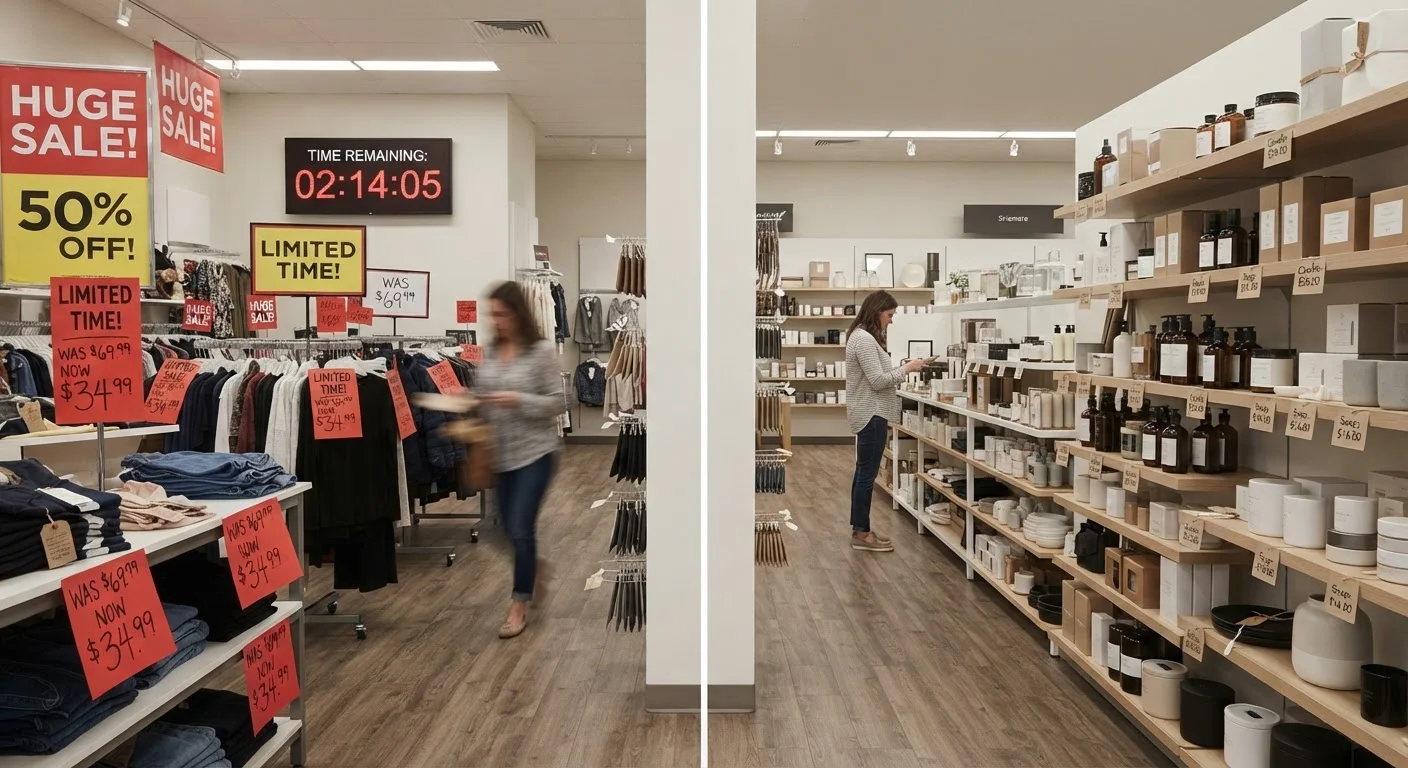
Key Takeaways
- Flash sales create urgency to drive quick purchases, which can override careful decision-making.
- Everyday low pricing removes the need to time purchases but rarely produces dramatic savings.
- A retailer's 'reference price' during a flash sale may be inflated to make discounts appear larger.
- EDLP stores compete on margin efficiency; flash sale retailers compete on perceived deal excitement.
- Price history tools are the most reliable way to evaluate whether any sale price is genuinely lower.
- Neither model guarantees the lowest price - context, category, and timing all matter.
Option A
Flash Sales
The dramatic, time-limited discount event.
Best for: Shoppers who plan ahead, monitor prices, and can act decisively when a genuine price drop appears.
Option B
Everyday Low Pricing (EDLP)
The consistent, no-event pricing model.
Best for: Shoppers who want predictability, hate the urgency game, and prefer to buy when they're ready - not when retailers tell them to.
If you want to buy without stress or strategic timing
Everyday Low Pricing (EDLP)
EDLP stores remove the pressure of timing a purchase correctly. The price you see today is close to what you'd see next week or next month.
If you're flexible on timing and willing to track prices
Flash Sales
When a flash sale price is verified against price history tools, it can represent a meaningful short-term discount on items you already intended to buy.
If you're shopping for a big-ticket item with some planning time
Flash Sales
Major discount events around recognized retail periods can surface genuine price drops on appliances, electronics, and furniture - if you've done the homework first.
If you frequently buy household staples and groceries
Everyday Low Pricing (EDLP)
EDLP is particularly effective for routine, repeat purchases where predictable pricing helps with budgeting and reduces the cognitive load of comparison shopping.
If you've spotted a flash deal on an impulse purchase
Everyday Low Pricing (EDLP)
Urgency is a retail design tool. If you didn't plan to buy the item before the sale appeared, the discount rarely justifies the unplanned spending.
What These Two Strategies Actually Are
Retail pricing doesn't happen by accident. Every price tag reflects a deliberate strategy, and the two most common ones sit at opposite ends of the spectrum: flash sales and everyday low pricing (EDLP).
Flash sales are time-limited discount events - hours, a day, or occasionally a week - designed to generate excitement and drive fast purchases. The urgency is intentional. Retailers know that a ticking clock suppresses comparison shopping and accelerates buying decisions.
Everyday low pricing takes the opposite approach. Instead of occasional dramatic markdowns, EDLP retailers set prices at a stable, competitive level year-round and don't rely on manufactured urgency. The pitch is straightforward: the price is the price, and you don't need to wait for a sale.
Understanding which model a retailer uses changes how you should approach shopping there. It also raises a more important question: within either model, is the price actually good? As our breakdown of genuine discounts explains, a low-looking price and a real deal aren't always the same thing.
| Criterion | Flash Sales | Everyday Low Pricing (EDLP) |
|---|---|---|
| Price consistency | Volatile - changes with events | Stable year-round |
| Potential savings depth | High (when genuine) | Moderate and predictable |
| Purchase timing pressure | High - urgency is by design | None - buy when ready |
| Reference price reliability | Often inflated to frame discounts | Generally reflects real market price |
| Best for planned purchases | Yes, with advance price research | Yes, no extra research needed |
| Risk of impulse overspending | Higher - urgency drives fast decisions | Lower - no artificial scarcity |
| Return policy flexibility | Often stricter during sale events | Typically standard policies apply |
The Mechanics Behind Flash Sale Psychology
Flash sales work because urgency disrupts rational evaluation. When a timer is counting down, the brain shifts from "is this a good price?" to "will I miss out?" That shift is worth money to a retailer.
One common tactic is the inflated reference price - the crossed-out "original" price shown alongside a sale price to make the discount look dramatic. But if a product has rarely or never sold at that reference price, the markdown is partially fictional. This reference pricing trick is one of the most widely documented retail pricing techniques in the U.S.
Urgency cues, countdown timers, and "limited stock" labels amplify this effect. Retailers design these signals deliberately - they're not incidental. None of this means flash sales can't produce real savings. It means you need to verify before acting, not after.
76%
Shoppers who feel urgency during flash sales
According to consumer behavior research cited by the National Retail Federation, a large majority of shoppers report feeling time pressure during limited-time sale events - a sensation retailers deliberately engineer.
~15-20%
Typical EDLP margin reduction vs. Hi-Lo retailers
Academic retail economics research estimates that EDLP retailers typically operate on narrower margins than high-low (Hi-Lo) pricing retailers, reflecting the trade-off between price stability and peak-event profitability.
3 in 5
Flash sale purchases later regretted by buyers
Consumer survey data from multiple retail research groups suggests a majority of flash sale purchases made under urgency prompts are later viewed as unnecessary or regrettable by the buyer.
The most reliable verification tool is price history data. Price tracking tools let you see what a product has actually sold for over time - which quickly reveals whether today's "50% off" reflects a genuine drop or a temporarily inflated baseline.
What EDLP Gets Right - and Where It Falls Short
Everyday low pricing has a genuine consumer benefit: predictability. If you shop at an EDLP retailer regularly, you develop a feel for what things cost, which makes it easier to recognize when a price is actually out of line - either high or low.
EDLP also reduces the cognitive tax of shopping. You don't need to track sale cycles, set price alerts, or time purchases around events. For routine purchases - groceries, household supplies, basics - this simplicity has real value, especially for budgeting.
The limitation is that EDLP prices are set to be defensible year-round, which usually means they're competitive but rarely exceptional. The retailer absorbs the margin to eliminate sales events, so the floor is stable but the ceiling isn't particularly high either. If your goal is the lowest achievable price on a specific item at a specific moment, EDLP probably isn't where you'll find it.
It's also worth noting that identical products can carry very different prices across retailers regardless of which pricing model they use. EDLP doesn't guarantee you're getting the market's lowest price - it guarantees consistency within that retailer's own pricing history.
How to Make a Smarter Decision in Either Environment
The most useful frame for evaluating any retail price - flash sale or EDLP - is to separate the presentation from the reality. A few habits help regardless of where you're shopping.
Know your baseline before you shop. If you know roughly what something should cost, you can evaluate any price on its own merits rather than relative to a retailer's chosen reference point. This is where consistent shopping habits pay off over time.
Distinguish planned purchases from reactive ones. Flash sale psychology is most effective on unplanned purchases. If you didn't intend to buy something before a sale appeared, the urgency discount is usually doing more work for the retailer than for you.
Factor in return policies. Flash sales often come with stricter return terms. "All sales final" policies are more common during discount events and can shift risk entirely to the buyer. Check before purchasing.
Compare discount structures carefully. Flash sales often layer multiple discount formats - percentage off, bundle pricing, limited-time codes - which can obscure the actual price. A clear guide to discount formats makes it easier to compare apples to apples.
And if you're genuinely on the fence about whether to wait for a better price, the answer isn't always obvious - but it's usually more calculable than it feels in the moment.