

| Percentage Off - best for | High-priced items where proportional savings are large |
| Dollar Off - best for | Low-cost items where a fixed amount represents significant savings |
| BOGO - effective discount rate | 25-50% per unit (depending on structure) |
| Bundle - key risk | Paying for items you don't need to unlock the discount |
| Most manipulable element | Reference ("original") price used to calculate discounts |
| Comparison metric to use | Effective unit price after all discounts |
The Four Discount Formats Retailers Use Most
Retailers have a toolkit of pricing structures designed to make deals feel compelling. Understanding the mechanics of each format - before you reach the checkout - puts the math back in your hands.
| Percentage Off - best for | High-priced items where proportional savings are large |
| Dollar Off - best for | Low-cost items where a fixed amount represents significant savings |
| BOGO - effective discount rate | 25-50% per unit (depending on structure) |
| Bundle - key risk | Paying for items you don't need to unlock the discount |
| Most manipulable element | Reference ("original") price used to calculate discounts |
| Comparison metric to use | Effective unit price after all discounts |
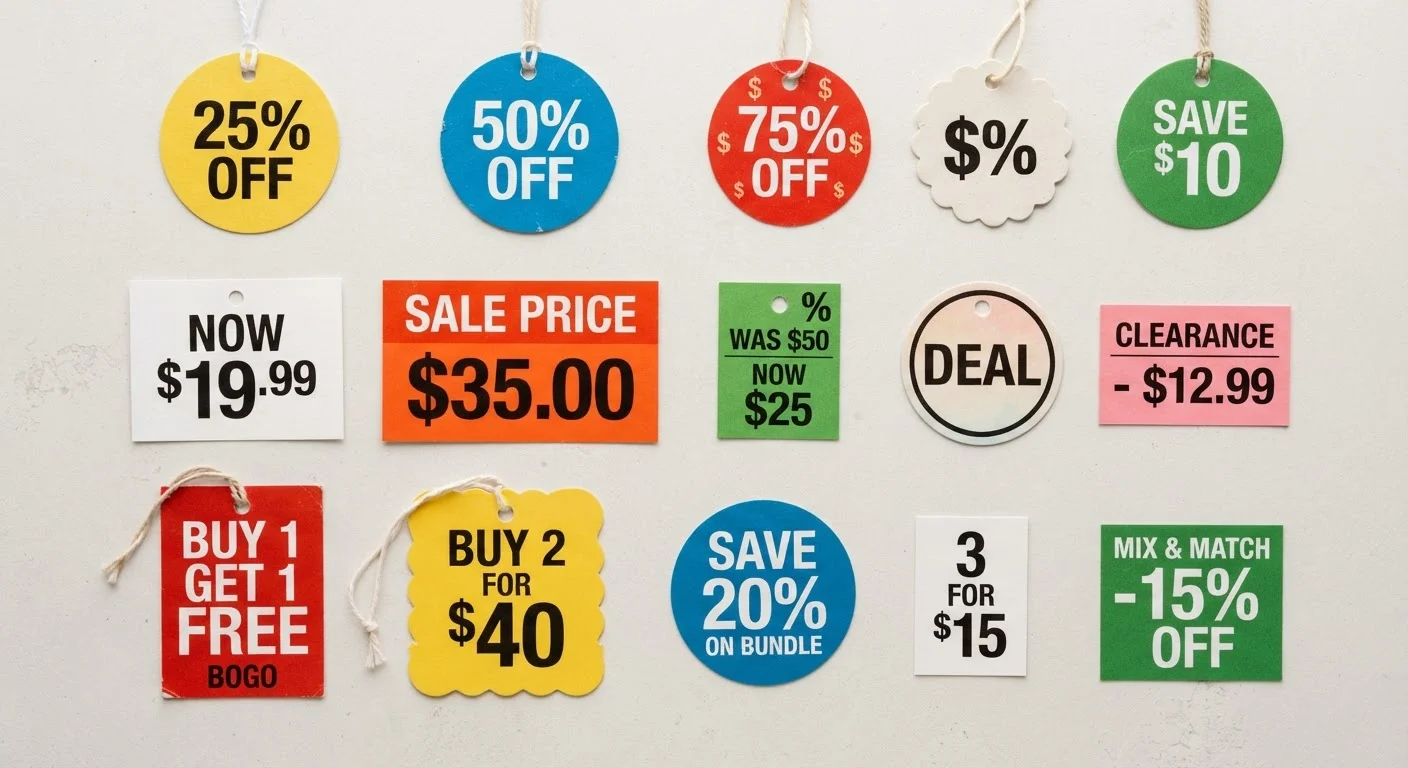
Percentage Off discounts are proportional: a 30% reduction saves more dollars on a $200 item than on a $20 one. They work in your favor on higher-priced purchases but can be misleading on cheap items. A "50% off" label on a $4 product saves you $2 - satisfying in theory, trivial in practice.
Dollar Off discounts are fixed: a $10-off offer deducts the same amount regardless of the original price. This format is most valuable when the item's base price is low enough that $10 represents a meaningful share of the total. On a $200 appliance, $10 off is just 5% - far less impressive than it sounds.
BOGO (Buy One, Get One) promotions come in two common forms: free or 50% off. A true BOGO Free deal equals 50% off per unit across two items - meaningful savings if you'll actually use both. BOGO 50% off reduces the average cost per unit to 75% of the original price, or 25% savings overall. The catch: you must want - and use - the second item, or the "deal" costs you money.
Bundle Pricing groups multiple products at a combined price below their individual totals. This can represent real value, but only if every item in the bundle is something you'd have bought anyway. Bundles that include one desirable item alongside unnecessary extras shift cost rather than reduce it.
How to Compare Formats on Equal Footing
The most reliable comparison tool across all four formats is the effective unit price - what you actually pay per item or per unit after discounts are applied. Divide the final out-of-pocket cost by the number of usable units you're receiving.
Reference Prices Aren't Always Reliable
The 'original' price used to calculate a percentage discount is only meaningful if the item actually sold at that price for a reasonable period. Some retailers inflate reference prices to make markdowns look deeper than they are. Tools that track historical pricing can help you verify whether a stated markdown reflects a genuine change. See how to identify a genuine discount for a closer look at this tactic.
For BOGO and bundle deals, also ask yourself: Would I buy this quantity at the non-discounted price? If the answer is no, the promotion is expanding your spending rather than reducing it.
Percentage Off and Dollar Off comparisons are straightforward once you do the arithmetic - convert both to a final price and compare. Where it gets tricky is when retailers display a large percentage alongside an inflated reference price. A "40% Off" badge loses meaning if the item hasn't sold at that reference price in months.
For a deeper look at related savings mechanisms, see how coupons and cashback compare - both interact with these discount formats in ways that affect your net cost. And if you're building a broader savings approach, the deal-hunting starter playbook walks through the habits that make discount-spotting consistent rather than lucky.
When a deal doesn't pass the unit-price test - or the reference price can't be verified - understanding how retailers set prices in the first place gives useful context for what you're actually comparing against.