

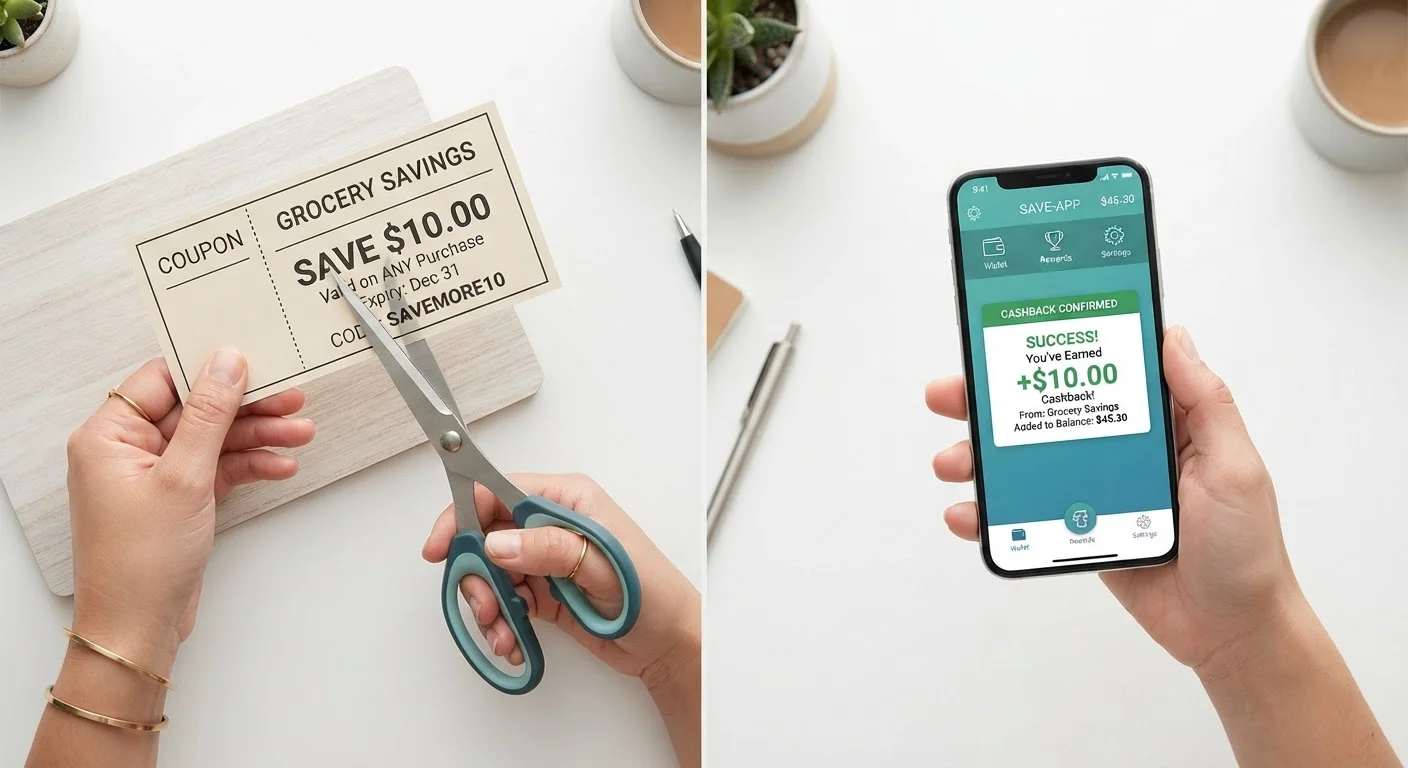
Key Takeaways
- Coupons reduce your price at the moment of purchase; cashback arrives after the transaction is complete.
- Cashback rewards often come with minimum thresholds, expiration windows, or restricted redemption options.
- Coupons can be stacked with other promotions in some stores, but retailers set their own stacking rules.
- Both mechanisms are designed partly to influence your spending behavior, not just reward it.
- Understanding each tool's structure helps you avoid spending more to save more.
Option A
Coupons
The upfront price reducer.
Best for: Shoppers who want an immediate, visible discount applied before they pay.
Option B
Cashback
The delayed reward earner.
Best for: Shoppers who can wait for a reward and want savings that accumulate passively over time.
If you want certainty about your savings before checkout
Coupons
The discount is fixed and visible - you know exactly how much you're saving before you pay, with no waiting period or redemption steps.
If you're making a large, planned purchase and don't need the savings immediately
Cashback
On higher-dollar purchases, cashback percentages can return meaningful amounts, and the passive nature requires little extra effort.
If you tend to forget about rewards or rarely hit minimum thresholds
Coupons
Coupons don't require you to track balances, meet payout minimums, or remember to redeem anything - the saving happens automatically.
If you shop frequently across many categories and retailers
Cashback
Broad cashback programs accumulate rewards across purchases without requiring you to hunt down specific coupon codes for each transaction.
How Each Mechanism Actually Works
Coupons are simple by design: they reduce the listed price of an item at the point of sale. Whether it's a paper clip-out, a digital code, or an in-app offer, the math happens before your payment clears. You see the reduced total. You pay that amount. The transaction is done.
Cashback works differently. You pay full price - or a discounted price if another deal is already applied - and then a portion of what you spent is returned to you later. That return might come as a deposit to a linked account, a statement credit on a credit card, a balance in a third-party app, or a physical check. The key word is later. How much later varies considerably by program.
That structural difference - now versus later - shapes nearly everything else about how useful each tool actually is. For a deeper look at how retailers structure deals generally, the guide to common discount formats explains how percentages, dollar-off amounts, and bundle pricing compare on equal footing.
| Criterion | Coupons | Cashback |
|---|---|---|
| When savings are received | Immediately at checkout | After purchase, sometimes weeks later |
| Visibility of savings | Shown in cart before payment | Tracked in separate account or portal |
| Redemption complexity | Low - apply code or clip | Moderate - may require minimum balance |
| Risk of not receiving savings | Low if applied correctly | Higher - thresholds, expirations, rule changes |
| Influence on purchase behavior | Strong - tied to specific items | Broader - applies across categories |
| Stackable with other deals | Sometimes, varies by retailer | Sometimes voided by coupon codes |
Where Each Tool Can Work Against You
Coupons are often criticized - fairly - for encouraging purchases you wouldn't have made otherwise. A coupon for 30% off a product you don't need isn't savings; it's a spending trigger dressed up as a reward. Retailers and manufacturers issue coupons strategically to move specific inventory and introduce shoppers to higher-margin products. That doesn't make coupons bad, but it does mean you should start with your shopping list, not the coupon stack.
Cashback programs carry their own friction. Many have minimum redemption thresholds - you can't withdraw your $3.47 balance until it reaches $10, $20, or sometimes $25. If your balance never hits that threshold, or if the program shuts down or changes terms, that money may never reach you. Some cashback offers also apply only to specific items, require activating the offer before purchase, or exclude sale-priced goods entirely.
Both tools share one common trap: they can make inflated or artificially raised prices look like genuine deals. Always compare the final after-coupon or after-cashback price against what the item typically sells for elsewhere. The fine print in loyalty and rewards programs follows the same pattern - generous-sounding numbers that shrink considerably under closer review.
~$3B
Unredeemed cashback and rewards annually
Industry estimates suggest billions in earned cashback and rewards go unredeemed each year in the U.S. due to expiration, forgotten balances, and unmet thresholds.
~50%
Coupon users who buy unplanned items
Consumer behavior research has consistently found that roughly half of coupon users report purchasing items they had not originally intended to buy as a result of seeing a coupon.
Using Both Tools Without Falling Into the Trap
The most effective approach is to treat coupons and cashback as tools you apply to purchases you already planned - not reasons to make purchases you hadn't. Before you use either, ask whether you'd buy the item at full price. If the answer is no, a discount doesn't convert a bad purchase into a good one.
When you do use them together, check the program rules first. Some cashback portals reduce or void their reward if a coupon code is applied at checkout. Others allow stacking. This isn't consistent across retailers or programs, so verifying before you check out prevents surprises.
Also pay attention to what form your cashback takes. Cash deposited to a bank account or applied as a statement credit is the most flexible. Cashback that can only be redeemed as store credit ties your reward to future spending at a specific retailer - a meaningful restriction. If you're evaluating the broader picture of how payment method affects the value you get, credit card vs. debit card buyer protections is worth understanding alongside how cashback is issued.
For readers building a more systematic approach to finding genuine savings, the Deal-Hunting Starter Playbook covers the habits and frameworks that make tools like these work consistently rather than occasionally.