

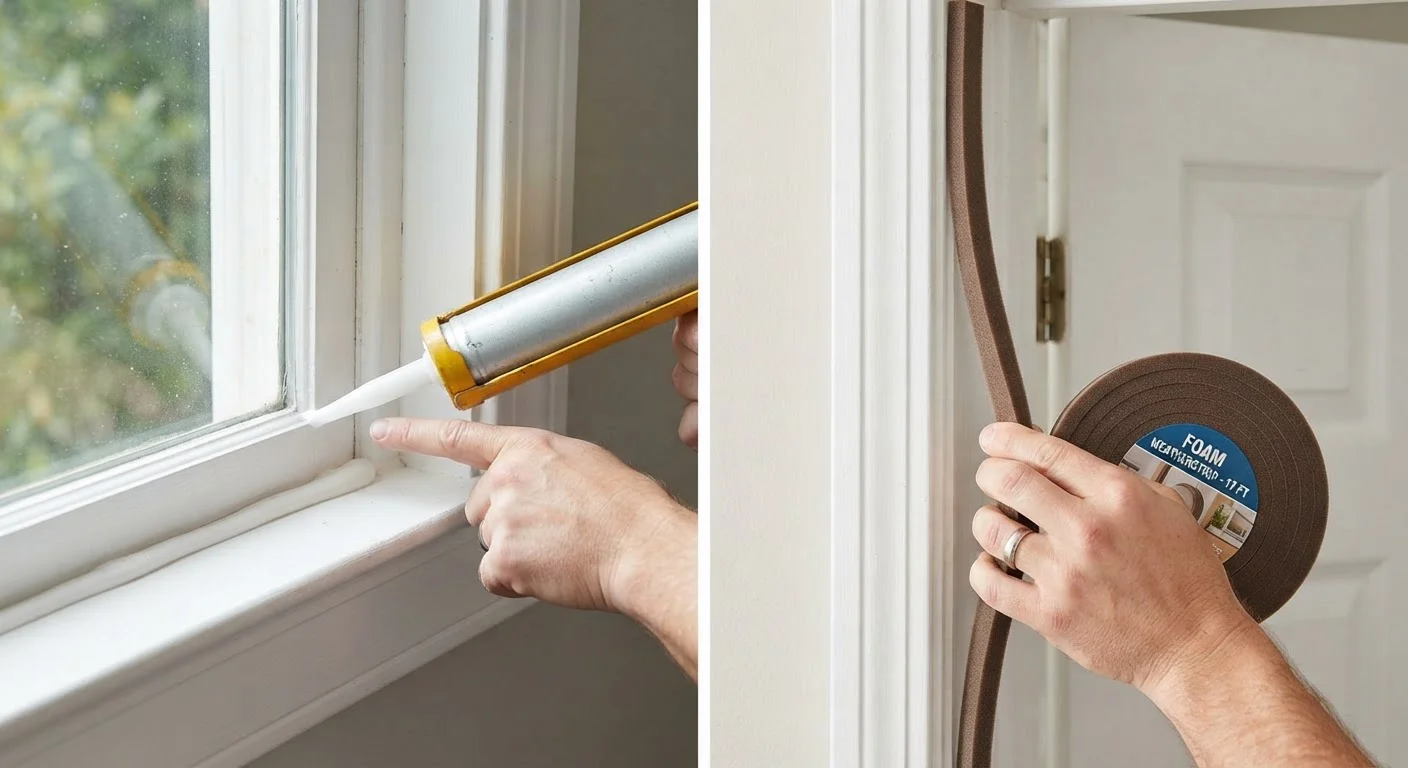
Key Takeaways
- Caulk is best for stationary gaps and cracks; weatherstripping is designed for moving parts like doors and operable windows.
- Using the wrong product in the wrong location leads to premature failure and wasted effort.
- Many homes need both products working together to achieve a thorough, energy-efficient seal.
- Weatherstripping wears out faster than caulk and should be inspected annually for compression or tearing.
- Choosing the correct caulk formula - silicone, latex, or polyurethane - matters as much as where you apply it.
Option A
Caulk
The permanent, flexible filler for stationary gaps.
Best for: Sealing fixed joints, cracks, and seams around windows, pipes, and baseboards where surfaces don't move.
Option B
Weatherstripping
The compressible seal for moving parts and openings.
Best for: Creating an airtight seal along the edges of doors and operable windows that open and close regularly.
If you're sealing a crack between a window frame and exterior siding
Caulk
This is a stationary joint that doesn't flex with use. Caulk bonds to both surfaces and fills the gap permanently, blocking drafts and water infiltration.
If you're stopping drafts around an exterior door that opens and closes daily
Weatherstripping
Door edges move with every cycle. Weatherstripping compresses to form a seal when closed and releases cleanly when opened, which rigid caulk cannot do.
If you're sealing gaps around interior plumbing or HVAC penetrations
Caulk
Pipe and duct penetrations through walls or floors are stationary and often require a fire-rated or flexible formula to handle temperature changes.
If you're addressing an older home with multiple leaky entry points
Both
Older homes typically need caulk at fixed exterior joints and fresh weatherstripping on all operable doors and windows for comprehensive air sealing.
Why Getting This Right Actually Matters
Air leaks around doors, windows, and structural penetrations account for a significant share of home energy loss. Choosing the wrong sealing product doesn't just mean the seal looks bad - it means the seal fails faster, lets in drafts and moisture, and requires you to redo the work sooner than necessary.
Caulk and weatherstripping are both widely available and inexpensive, but they're engineered for fundamentally different applications. Applying caulk where weatherstripping belongs - or vice versa - is one of the most common DIY mistakes homeowners make. Understanding the mechanical difference between the two is the starting point for any effective air-sealing project.
For a broader look at where air and moisture problems tend to hide in a home, see our guide to overlooked inspection points that home inspectors commonly flag.
| Criterion | Caulk | Weatherstripping |
|---|---|---|
| Primary use case | Stationary gaps and cracks | Moving parts: doors, operable windows |
| How it seals | Bonds and cures to fill the gap | Compresses when closed, springs back when open |
| Tolerates movement? | No - cracks under repeated flexing | Yes - designed for repeated compression |
| Typical lifespan | 5-15 years depending on location | 2-8 years depending on material and use |
| Common materials | Silicone, latex/acrylic, polyurethane | Foam tape, V-strip, rubber bulb, door sweep |
| Application skill level | Low - requires surface prep and steady hand | Very low - peel-and-stick or tack-in-place |
| Works on exterior? | Yes - with appropriate formula | Yes - most types rated for exterior use |
How Each Product Works - and Where It Belongs
Caulk is a flexible sealant that is applied as a paste, bonds to surrounding surfaces as it cures, and becomes a semi-rigid or elastomeric barrier. It's designed for stationary gaps - places where two surfaces meet but don't move relative to each other. Common applications include:
- The joint between a window or door frame and exterior siding or interior drywall
- Gaps around pipes, conduits, or wires where they penetrate walls or floors
- Cracks in siding, trim, or masonry
- Interior baseboards where they meet flooring
Different caulk formulas serve different environments. Silicone caulk excels in wet or high-movement areas; paintable latex (acrylic) caulk suits interior trim; polyurethane formulas offer exceptional durability for exterior joints. Matching the formula to the location is as important as applying it correctly. For tile and wet-area specifics, our guide to grout and caulk in wet areas covers the details.
Weatherstripping works on a different principle entirely. It's a compressible material - foam tape, V-strip vinyl, door sweeps, or rubber bulb seals - that creates a seal by being squeezed between two surfaces when a door or window closes. When that surface opens again, the material springs back. This cycle of compression and release is exactly what caulk cannot survive: bonded caulk will crack and peel under repeated movement.
25-30%
Home energy lost through air leaks
The U.S. Department of Energy estimates that air leaks around windows, doors, and penetrations account for roughly a quarter to nearly a third of heating and cooling costs in typical homes.
$0.10-$0.60
Cost per linear foot of weatherstripping
Weatherstripping is among the most cost-effective home sealing materials available, with foam tape at the lower end and reinforced rubber bulb seals at the higher end of that range.
2-4 years
Typical foam tape weatherstripping lifespan
Foam tape compresses permanently under frequent door and window cycling, making it one of the shorter-lived weatherstripping options for high-traffic entries.
Matching the Right Product to Each Location
A practical way to decide which product to use is to ask one question: Does this gap open and close? If yes, weatherstripping. If no, caulk.
Use Caulk When:
- Filling the seam between window trim and an exterior wall
- Sealing around an electrical outlet on an exterior wall (from inside)
- Closing gaps around plumbing or dryer vents that pass through walls
- Touching up cracks in exterior wood or fiber cement siding
Use Weatherstripping When:
- Sealing the top, sides, and bottom of an exterior door
- Addressing drafts around a casement or double-hung window that opens
- Replacing a worn door sweep where the door bottom meets the threshold
- Insulating an attic hatch that you access periodically
In many homes, both materials are needed in the same area. A door frame is a good example: the joint between the frame and the wall gets caulked, while the door stop - the surface the door actually presses against - gets weatherstripping. Both jobs must be done correctly for the assembly to perform well.
Maintenance and Longevity: What to Expect
Caulk applied correctly to a protected interior joint can last a decade or longer. Exterior caulk faces UV exposure, temperature swings, and moisture, and may need attention every five to ten years depending on the formula and conditions. Inspect exterior caulk lines annually for cracking, shrinkage, or separation from the surface.
Weatherstripping has a shorter service life because it undergoes physical compression thousands of times per year. Foam tape tends to compress permanently within two to four years in frequently used doorways. V-strip and rubber bulb seals generally last longer. Inspect weatherstripping each fall by closing a door or window on a strip of paper - if the paper slides out without resistance, the seal has likely failed.
Replacing weatherstripping is a straightforward task most homeowners can handle without tools beyond a tape measure and scissors. Re-caulking requires a bit more preparation - old caulk must be fully removed and the surface must be clean and dry before a new bead is applied. Neither project is technically demanding, but the prep work is what determines how long the new seal lasts.
This article is for general informational purposes. Local building codes and conditions vary; consult a qualified contractor for projects involving structural or hazardous work.