

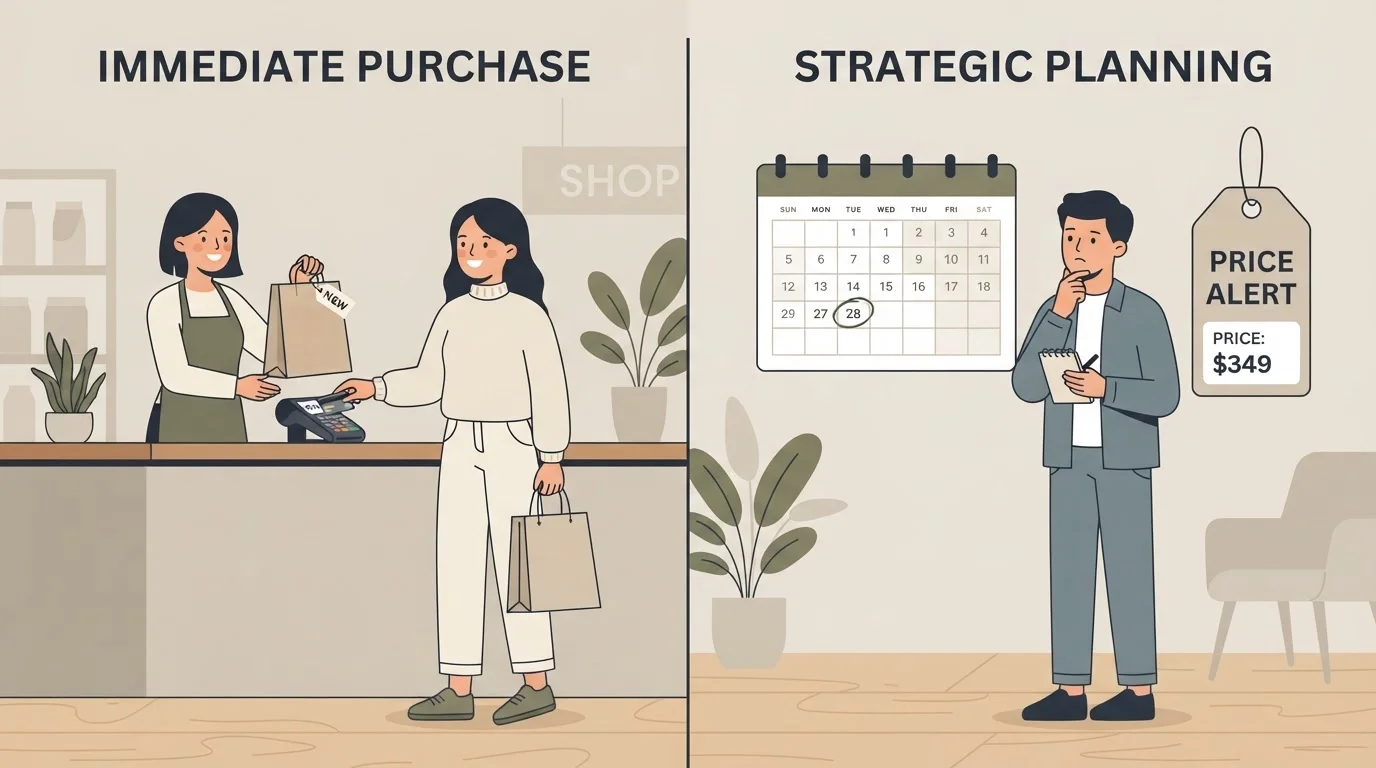
Key Takeaways
- Waiting for a lower price makes sense when a predictable sale cycle exists and the item isn't urgently needed.
- Holding off can cost you in opportunity, availability, or rising prices depending on the product category.
- Marketing tactics like artificial urgency and inflated 'original' prices often make deals look better than they are.
- A simple framework-urgency, price trajectory, and sale predictability-helps you decide whether to wait or buy now.
- Hidden costs like shipping, accessories, or compatibility issues can erode the savings you were waiting for.
Our Verdict
Waiting for a better price is a genuine strategy in some categories and a trap in others. The difference comes down to whether a real discount is predictable, whether the item holds its value, and whether delay creates costs of its own. No single rule covers every purchase-context is everything.
| Best for | Recommended |
|---|---|
| Shoppers with flexible timelines and non-urgent needs | Wait for a predictable sale cycle |
| Those facing urgent needs or limited product availability | Buy now to avoid higher future costs |
| Buyers in categories with steady or rising prices | Buy now before further price increases |
| Shoppers unsure about deal legitimacy | Research price history before deciding |
The Core Question: Is the Future Price Actually Better?
Before deciding to wait on a purchase, it helps to ask one clear question: is there a real, documented reason to believe the price will drop? Marketing creates the impression that sales are constant and savings are always around the corner. The reality is more uneven. Some product categories follow predictable discount cycles; others rarely go on meaningful sale at all.
Price history tools-browser extensions and retailer-independent tracking sites-let you check what an item has actually sold for over time. If the current price is already near or below its historical average, "waiting for a sale" may mean waiting for something that never comes, or paying more later. Understanding how retailers price products is foundational here. Flash sales and everyday low-pricing strategies work very differently, and the retailer's approach should shape your timing decision.
When Waiting Genuinely Pays Off
Patience tends to reward shoppers in specific, identifiable situations:
- Seasonal or calendar-driven discounts: Certain categories-outdoor furniture, winter clothing, large appliances-have well-established markdown seasons tied to inventory cycles, not manufactured urgency. Waiting until end-of-season is often a reliable strategy.
- New model year releases: When a manufacturer confirms an upcoming product update, current inventory frequently drops in price. This applies most clearly to consumer electronics and vehicles. For more on timing a vehicle purchase, the car-buying guidance hub covers how model-year transitions affect dealer pricing.
- Non-urgent, non-perishable purchases: If you don't need the item immediately and it won't go out of stock, waiting costs you little. Furniture, tools, and home goods often fit this profile.
How to Verify a Deal Is Real
Before trusting a sale price, look up the item's price history using a free price-tracking tool or browser extension. Compare across at least two or three retailers. If the "sale" price has been the standard price for months, the discount isn't real-and waiting for a deeper cut may be more reliable than acting on the current promotion.
The key marker of a genuine sale is a verifiable price drop from the item's typical selling price-not a discount off an inflated "original" price that rarely applied in practice.
When Waiting Costs You More Than You Save
There are real scenarios where delay makes financial or practical sense to abandon:
- Rising-price categories: Some goods trend upward over time due to supply constraints, materials costs, or demand shifts. Waiting in these markets can mean paying more, not less.
- Availability risk: If an item is selling fast, in limited supply, or being discontinued, waiting may mean missing it entirely or paying premium resale prices later.
- Carrying costs: Delayed purchases sometimes create their own expenses. A broken appliance you're living without, a car repair you're deferring-these have real costs that can exceed any eventual savings.
- Opportunity cost of money already spent elsewhere: If waiting causes you to use an inferior substitute that costs money to operate or maintain, that gap narrows your net savings.
It's also worth accounting for costs that don't show up in the sticker price. Hidden purchase costs like accessories, installation, and compatibility can quietly reduce the value of even a well-timed discount.
| Wait for a Better Price | Buy Now | |
|---|---|---|
| Best situation | Predictable sale cycle exists | Urgent need or availability risk |
| Price trend | Historically drops over time | Stable or rising over time |
| Availability risk | Low - item widely stocked | High - limited or discontinuing |
| Delay cost | Minimal - no substitute needed | Real - using costly workaround |
| Savings reliability | Verifiable via price history | N/A - current price is floor |
| Marketing risk | Low if price history checked | Higher if urgency is manufactured |
How to Spot Artificial Urgency and Inflated 'Original' Prices
Retail marketing is designed to compress decision-making time. Common tactics to recognize:
- Countdown timers on websites that reset when the timer expires-the "urgency" is manufactured.
- Crossed-out original prices that were never the standard selling price. Regulators have taken action against misleading reference pricing, but the practice persists in softer forms.
- "Only 2 left" stock warnings that don't change over days or weeks.
- Flash sale framing on prices that match the item's everyday price at other retailers.
Cross-referencing prices across multiple sellers and using price-tracking tools before acting on any "limited time" claim takes only a few minutes and eliminates most of this noise. Before completing any significant purchase, running through a pre-purchase savings checklist can catch overlooked savings and flag suspicious pricing patterns.
A Simple Framework for the Decision
Three factors give you a workable decision structure for most purchases:
- Urgency: Do you need the item now, or can you realistically wait weeks or months without meaningful cost?
- Price trajectory: Based on price history, is the item likely to be cheaper, the same, or more expensive in two to three months?
- Sale predictability: Is there a documented, recurring discount pattern for this category-or are you assuming a sale that may not materialize?
If urgency is low, the price trajectory is downward, and a sale cycle is predictable, waiting is rational. If any one of those three factors flips, the calculus changes. This same logic applies to larger financial decisions. The trade-offs between renting and buying a home follow a comparable structure: timing matters, but so do the real costs of waiting. And for ongoing product research before any major spend, the product research hub offers practical evaluation frameworks.