

Key Takeaways
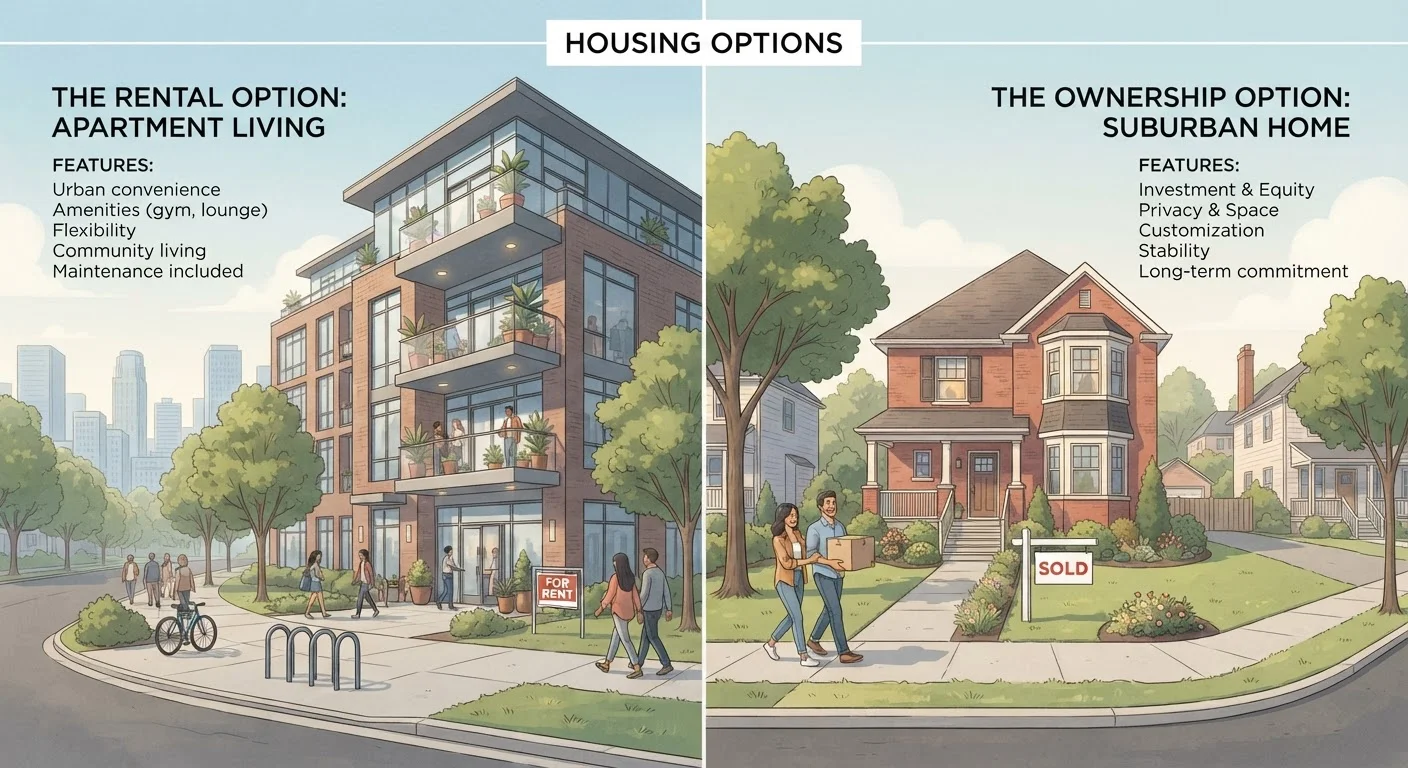
- Buying builds equity over time, but upfront and ongoing costs are significantly higher than most first-timers expect.
- Renting offers flexibility and predictable monthly costs, but provides no ownership stake in the property.
- How long you plan to stay in one place is one of the most important factors in the rent-vs-buy decision.
- Neither option is universally better - the right choice depends on your financial position, lifestyle, and local market conditions.
Builds equity with each mortgage payment
Unlike rent, mortgage payments incrementally increase your ownership stake in a real asset. Over time, this equity can be a significant component of household net worth.
Stability and control over your living space
Owners aren't subject to lease non-renewals, rent increases, or landlord decisions about the property. This stability is especially valuable for families with school-age children.
Potential for long-term appreciation
Residential real estate has historically appreciated in value over multi-decade periods in many US markets, though past performance is not a guarantee of future returns.
Freedom to customize and renovate
Homeowners can modify, renovate, or improve their property - decisions that can increase both livability and resale value without landlord approval.
Fixed-rate mortgage provides payment predictability
A fixed-rate mortgage locks in the principal and interest portion of monthly payments, providing a degree of long-term cost stability that rental markets - where rents often rise annually - typically cannot match.
High upfront costs create a significant barrier
Down payments, closing costs, inspection fees, and moving expenses can easily total tens of thousands of dollars before a buyer moves in. This liquidity requirement excludes many otherwise capable buyers.
Maintenance and repairs fall entirely on the owner
A new roof, failing HVAC system, or plumbing emergency is the homeowner's financial responsibility. These costs are unpredictable and can run into the thousands of dollars with little warning.
Reduced geographic flexibility
Selling a home involves significant transaction costs and takes time. Homeowners who need to relocate quickly for work or personal reasons may face financial losses or logistical challenges renters simply don't encounter.
Market downturns can erode equity
Home values can and do decline in certain markets and economic conditions. Buyers who purchase near a market peak with minimal down payments risk owing more than the home is worth - a position known as being "underwater" on a mortgage.
Ongoing ownership costs beyond the mortgage
Property taxes, homeowners insurance, HOA fees (where applicable), and routine maintenance create a total monthly cost of ownership that often substantially exceeds the mortgage payment alone.
Our Verdict
Buying a home can build long-term wealth and stability, but it demands financial readiness, a longer time horizon, and willingness to take on maintenance responsibilities. Renting is not simply money thrown away - it offers real advantages in flexibility, liquidity, and predictability that matter enormously in certain life stages and markets.
Buying tends to make the most sense for financially stable households planning to stay in one area for at least five to seven years; renting is often the smarter move for those with shorter timelines, uncertain income, or limited savings for upfront costs.
Why This Decision Is More Complex Than It Looks
The renting-versus-buying debate is often framed as a simple financial equation - but in practice, the decision involves layered trade-offs across money, lifestyle, and timing. For first-time homebuyers especially, cultural narratives about ownership as the default path to financial security can obscure genuinely important questions about whether buying is the right move right now.
Understanding the actual trade-offs - not just the idealized version of each path - is the starting point for making a decision that fits your real situation. For a deeper look at how broader lifestyle factors intersect with the numbers, see this breakdown of renting vs. buying for different situations.
Builds equity with each mortgage payment
Unlike rent, mortgage payments incrementally increase your ownership stake in a real asset. Over time, this equity can be a significant component of household net worth.
Stability and control over your living space
Owners aren't subject to lease non-renewals, rent increases, or landlord decisions about the property. This stability is especially valuable for families with school-age children.
Potential for long-term appreciation
Residential real estate has historically appreciated in value over multi-decade periods in many US markets, though past performance is not a guarantee of future returns.
Freedom to customize and renovate
Homeowners can modify, renovate, or improve their property - decisions that can increase both livability and resale value without landlord approval.
Fixed-rate mortgage provides payment predictability
A fixed-rate mortgage locks in the principal and interest portion of monthly payments, providing a degree of long-term cost stability that rental markets - where rents often rise annually - typically cannot match.
The Financial Case for Buying - and Its Hidden Costs
Homeownership's primary financial appeal is equity accumulation. Each mortgage payment builds ownership stake in an asset that - in many markets, over the long run - tends to appreciate in value. Mortgage interest and property taxes may also carry federal tax deductions, though the benefit depends on whether you itemize deductions.
What's easy to underestimate are the costs that don't appear in the listing price. Closing costs typically run 2-5% of the loan amount. Property taxes, homeowners insurance, and private mortgage insurance (PMI, required when the down payment is below 20%) add recurring expenses. Maintenance and repairs - a general rule of thumb is budgeting 1-2% of the home's value annually - fall entirely on the owner. These are detailed further in a full breakdown of homebuying costs beyond the purchase price.
2-5%
Typical closing cost range for home buyers
Closing costs, which include lender fees, title insurance, and prepaid expenses, generally run 2-5% of the loan amount according to the Consumer Financial Protection Bureau.
5-7 years
Common break-even threshold for buying vs. renting
Real estate economists generally estimate that buyers need to stay in a home for at least five to seven years for purchasing to become financially advantageous over renting, accounting for transaction costs.
1-2%
Annual maintenance costs as share of home value
A widely used rule of thumb in personal finance holds that homeowners should budget 1-2% of their home's value per year for maintenance and repairs.
What Renting Actually Offers
Renting is often described dismissively as "throwing money away," but that framing misses significant advantages. A renter is paying for housing - a real service - while avoiding the financial exposure that comes with ownership. Maintenance costs, property tax increases, and market downturns are the landlord's problem, not the tenant's.
Renting also preserves capital. Money not tied up in a down payment can remain invested or accessible for other goals. Geographic flexibility is another undervalued benefit: renters can relocate for work or personal reasons without the friction and transaction costs of selling a property. For those weighing lease structures, comparing month-to-month and fixed-term leases can clarify how much flexibility is realistically available to you as a renter.
High upfront costs create a significant barrier
Down payments, closing costs, inspection fees, and moving expenses can easily total tens of thousands of dollars before a buyer moves in. This liquidity requirement excludes many otherwise capable buyers.
Maintenance and repairs fall entirely on the owner
A new roof, failing HVAC system, or plumbing emergency is the homeowner's financial responsibility. These costs are unpredictable and can run into the thousands of dollars with little warning.
Reduced geographic flexibility
Selling a home involves significant transaction costs and takes time. Homeowners who need to relocate quickly for work or personal reasons may face financial losses or logistical challenges renters simply don't encounter.
Market downturns can erode equity
Home values can and do decline in certain markets and economic conditions. Buyers who purchase near a market peak with minimal down payments risk owing more than the home is worth - a position known as being "underwater" on a mortgage.
Ongoing ownership costs beyond the mortgage
Property taxes, homeowners insurance, HOA fees (where applicable), and routine maintenance create a total monthly cost of ownership that often substantially exceeds the mortgage payment alone.
The Time Horizon Question Changes Everything
Perhaps no single factor shapes the rent-vs-buy math more than how long you intend to stay. Transaction costs on both sides of a home purchase - agent commissions, closing costs, moving expenses - mean it generally takes several years of ownership before buying becomes financially advantageous over renting a comparable property. A commonly cited break-even threshold is five to seven years, though this varies considerably by local market conditions.
In high-cost markets, the calculus shifts further. When purchase prices are significantly elevated relative to rental rates, the monthly cost of owning can substantially exceed renting even before factoring in maintenance. Renting vs. buying in a high-price market explores how this plays out in expensive metros. Mortgage structure also matters: fixed-rate vs. adjustable-rate mortgages carry meaningfully different risk profiles depending on your timeline and rate environment.
Price-to-Rent Ratio: A Useful Benchmark
The price-to-rent ratio compares the cost of purchasing a home to the cost of renting a comparable one in the same area. Divide the home's purchase price by annual rent for a similar property: a ratio above 20 generally suggests renting may be more cost-effective in the short to medium term, while a ratio below 15 tends to favor buying. This is a rough guide, not a definitive rule - local market conditions, interest rates, and individual financial circumstances all affect the outcome.
Making the Call: Factors Worth Weighing
No formula produces the right answer for every household. Instead, consider these concrete factors: your current savings relative to down payment and closing cost requirements; job and income stability; how certain you are about your location over the next several years; and your local market's price-to-rent ratio - the relationship between home purchase prices and comparable annual rents.
Working with a qualified real estate professional can help translate local market data into a more personal analysis. Understanding what a buyer's agent actually does is a useful starting point for those unfamiliar with how that relationship works. Equally important is evaluating where you might buy - researching a neighborhood thoroughly before committing can reveal costs and risks that aren't visible in a listing.
This article is for general informational purposes only and does not constitute financial, legal, or real estate advice. Readers should consult qualified professionals before making housing decisions.