

Key Takeaways
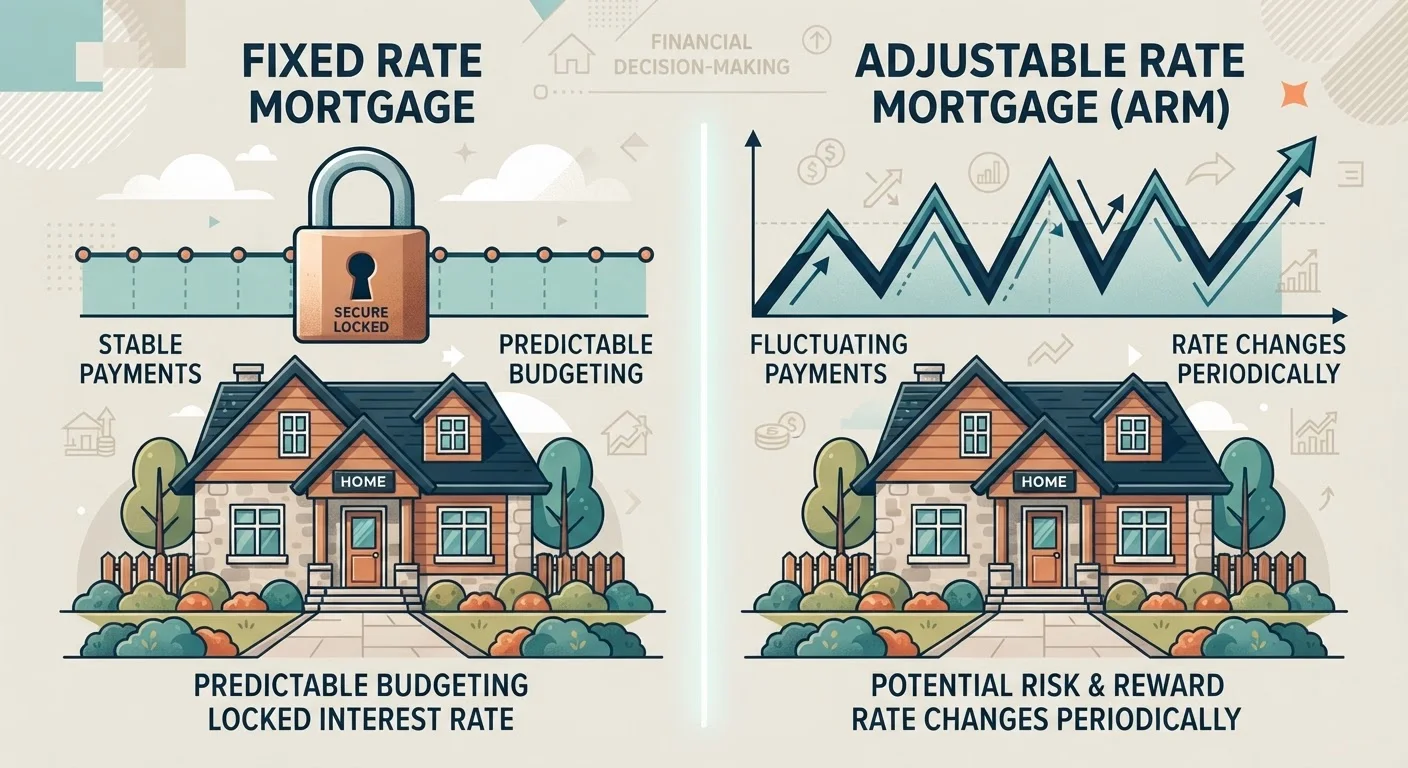
- Fixed-rate mortgages lock in your interest rate for the entire loan term, making monthly principal and interest payments predictable.
- Adjustable-rate mortgages (ARMs) start with a fixed introductory period, then reset periodically based on a market index.
- ARMs typically offer lower initial rates but carry the risk of payment increases when rates adjust.
- Your planned time in the home, risk tolerance, and current rate environment all shape which structure suits you.
- Rate caps on ARMs limit how much your rate can rise per adjustment and over the loan's lifetime.
- Consulting a licensed mortgage professional helps you evaluate both options against your specific financial picture.
Option A
Fixed-Rate Mortgage
The predictable, long-term stability choice.
Best for: Buyers planning to stay in their home long-term who want consistent monthly payments regardless of market conditions.
Option B
Adjustable-Rate Mortgage (ARM)
The flexible, lower-entry-cost alternative.
Best for: Buyers who expect to move or refinance within a few years and can manage the risk of rate changes over time.
If you plan to stay in your home for 10 or more years
Fixed-Rate Mortgage
Long-term owners benefit from rate certainty. Even if your initial rate is slightly higher, you're protected from market-driven increases over decades.
If you expect to sell or refinance within five to seven years
Adjustable-Rate Mortgage (ARM)
A 5/1 or 7/1 ARM can deliver a lower rate during the introductory period - before the first adjustment - potentially saving on interest if you exit the loan in time.
If you have a tight monthly budget and need payment stability
Fixed-Rate Mortgage
Fixed monthly principal and interest payments make long-range budgeting straightforward and remove the anxiety of potential rate resets.
If you're buying in a high-rate environment and rates are broadly expected to fall
Adjustable-Rate Mortgage (ARM)
An ARM may allow you to benefit from lower rates after the adjustment period without paying refinancing costs - though rate trajectories are never guaranteed.
How Each Mortgage Structure Works
A fixed-rate mortgage carries one interest rate for the entire repayment term - typically 15 or 30 years. Your monthly principal and interest payment is calculated at closing and remains identical whether you're in year one or year twenty-eight. What does change over time is how much of each payment goes toward principal versus interest, a process called amortization.
An adjustable-rate mortgage (ARM) has two distinct phases. The first is a fixed introductory period - commonly 3, 5, 7, or 10 years - during which the rate doesn't move. After that, the rate resets at scheduled intervals (often annually) based on a benchmark market index, such as the Secured Overnight Financing Rate (SOFR), plus a set margin determined by the lender. ARM names reflect this structure: a 5/1 ARM has a five-year fixed period, then adjusts every one year thereafter.
Rate caps are a critical ARM feature: periodic caps limit how much the rate can change at each adjustment, while lifetime caps set the maximum the rate can ever reach above the starting rate. Understanding these caps is essential before committing to an ARM. How broader interest rate movements affect home prices and affordability provides useful context on the market forces driving these benchmarks.
| Criterion | Fixed-Rate Mortgage | Adjustable-Rate Mortgage (ARM) |
|---|---|---|
| Interest Rate | Locked for entire loan term | Fixed initially, then adjusts periodically |
| Monthly Payment Stability | Fully predictable | Can rise or fall after intro period |
| Typical Initial Rate | Slightly higher | Often lower during intro period |
| Best Loan Terms Available | 15-year and 30-year most common | 3/1, 5/1, 7/1, 10/1 structures common |
| Rate Caps | Not applicable | Periodic and lifetime caps apply |
| Market Risk to Borrower | None after closing | Increases after introductory period |
| Ideal Time Horizon | Long-term (10+ years) | Shorter-term (under 7-10 years) |
The Real Trade-Offs: Stability vs. Flexibility
Fixed-rate mortgages ask borrowers to pay a small premium - in the form of a higher initial rate - in exchange for certainty. During periods when rates are low, locking in a fixed rate can be a powerful long-term financial decision. When rates are elevated at the time of purchase, some buyers may find the fixed rate harder to stomach, particularly for the first few years.
ARMs shift market risk from the lender to the borrower after the introductory period. The lower starting rate is real and meaningful - it can translate to hundreds of dollars per month in savings during the early years of the loan. The trade-off is exposure to rate increases once the fixed window closes. A borrower who took out a 5/1 ARM and remained in the home through multiple adjustment cycles could end up paying significantly more than a fixed-rate borrower over the same period, depending on market conditions.
~90%
Share of US mortgages that are fixed-rate
According to the Urban Institute and Federal Reserve data, fixed-rate loans have historically dominated the US mortgage market, particularly after the 2008 financial crisis.
0.5-1.5%
Typical ARM introductory rate discount vs. 30-year fixed
The spread between ARM introductory rates and 30-year fixed rates varies by lender and market cycle; borrowers should compare current offers directly.
5/2/5
Most common ARM cap structure
A 5/2/5 cap means the rate can rise up to 5% at first adjustment, 2% per subsequent adjustment, and no more than 5% total over the life of the loan.
The decision is also shaped by your broader financial picture. First-time buyers, in particular, should weigh their income trajectory, emergency savings, and job stability before opting for a loan structure that may produce higher payments down the road. For a grounded look at whether buying makes sense at all before tackling loan-type decisions, see the trade-offs between renting and buying a home.
Which Structure Tends to Fit Which Situation
No single mortgage structure is universally superior. Suitability depends on three intersecting factors: time horizon, risk tolerance, and the current rate environment.
Buyers who are confident they'll remain in the home for the duration of the loan - or close to it - generally benefit from the predictability of a fixed rate. For those who know they'll relocate within five to seven years for career or lifestyle reasons, an ARM's introductory period may cover the entire time they actually hold the mortgage, making the post-adjustment risk largely irrelevant to their situation.
Risk tolerance matters as much as math. Some borrowers find genuine peace of mind in knowing their payment will never change. Others are comfortable with uncertainty if the potential upside - a lower rate today - justifies it. Neither preference is irrational; they reflect different financial personalities and circumstances.
It's also worth recognizing that mortgage structure decisions share conceptual DNA with other financing choices. The tension between a stable, predictable commitment and a lower-cost but variable arrangement appears in other contexts too - as explored in the trade-offs between financing and paying cash for a vehicle. A licensed mortgage professional can model both options against your specific scenario, including how rate cap structures would affect your payments in a rising-rate environment.
This article is for general informational purposes only and does not constitute financial, legal, or mortgage advice. Mortgage products, rates, and terms vary by lender and individual circumstances. Consult a licensed mortgage professional or financial adviser before making any borrowing decisions.