

Key Takeaways
- Higher mortgage rates reduce buyer purchasing power, which can suppress demand and slow price growth.
- Lower rates increase affordability, often drawing more buyers into the market and pushing prices upward.
- Sellers may resist cutting prices even when rates rise, creating a standoff that reduces transaction volume.
- Local supply conditions can override rate-driven effects - tight inventory can keep prices elevated even as rates climb.
- Rate changes affect monthly payments immediately; home price shifts typically lag by months or longer.
Interest Rate-Home Price Relationship
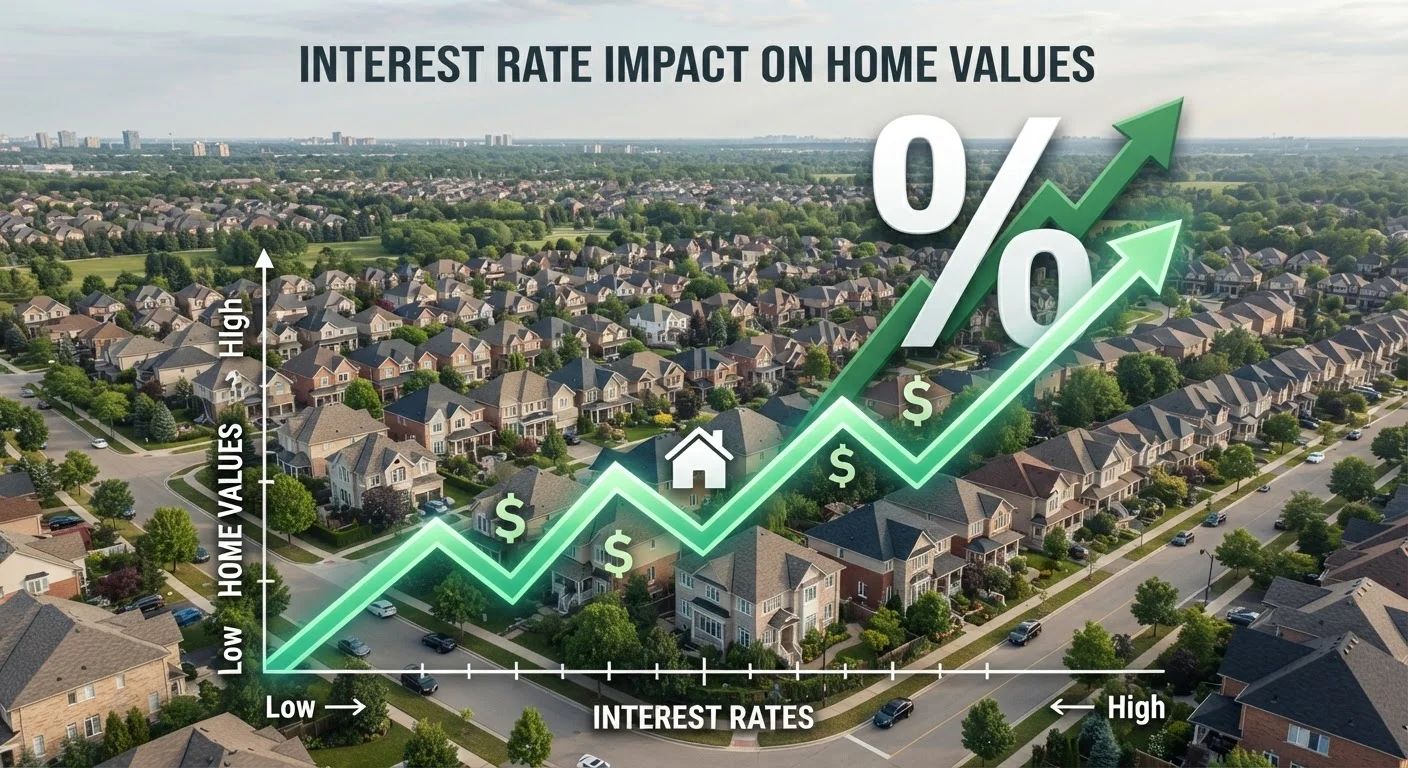
When mortgage interest rates rise, the monthly cost of borrowing increases, which reduces how much home a buyer can afford at a given income level. This reduced purchasing power tends to soften demand and put downward pressure on home prices over time. When rates fall, the opposite dynamic often unfolds: borrowing becomes cheaper, more buyers enter the market, and prices can climb.
The relationship is not perfectly inverse - local supply constraints, employment conditions, and inventory levels all moderate how strongly price movements respond to rate changes.
The Purchasing Power Mechanism
Most home purchases are financed with a mortgage, which means the interest rate on that loan directly shapes what a buyer can afford. When rates are low, a given monthly payment stretches further - covering a larger loan amount and, by extension, a more expensive home. When rates rise, that same monthly payment covers less principal, effectively shrinking the buyer's budget.
Consider a simplified illustration: at a 4% rate, a $2,000 monthly principal-and-interest payment might support a loan of roughly $418,000. At 7%, that same $2,000 payment supports only about $300,000. The buyer's income hasn't changed, their credit hasn't changed - only the rate has moved. That gap of more than $100,000 in purchasing power is what connects interest rate policy to the price a buyer is willing or able to offer on a home.
This mechanism is why rate changes ripple through housing demand so quickly. For a deeper look at how the Federal Reserve's decisions trigger these effects, see how Fed rate decisions ripple through housing.
~10%
Purchasing power lost per 1-point rate increase
A common rule of thumb among housing economists: each one-percentage-point rise in mortgage rates reduces buyer purchasing power by approximately 10% on a fixed monthly budget.
30-year
Standard U.S. mortgage term driving rate sensitivity
Because most U.S. mortgages are amortized over 30 years, even small rate changes compound into large differences in total interest paid and in the loan amount a buyer can qualify for.
Months
Typical lag before rate changes show in price data
Home price indexes reflect closed transactions, which typically take 30-60 days to settle after an offer is accepted, meaning rate effects on prices are often visible only months after rates move.
How Rate Changes Affect Seller Behavior
When rates climb, buyers pull back - but sellers do not always respond by cutting prices. Many existing homeowners locked in much lower rates in prior years, and selling means giving up that rate. Taking out a new mortgage on a replacement home at a significantly higher rate can result in a larger payment even on a less expensive property. Economists call this the rate lock-in effect, and it constrains the supply of homes on the market just as demand is falling.
The result is a market that moves slowly rather than crashing. Transaction volume drops, homes sit longer, and neither side finds the conditions ideal. Understanding this dynamic helps explain why housing markets often resist the clean price corrections that economic theory might predict. For a broader look at the structural forces involved, why home prices can rise even when the economy slows provides useful context.
Supply, Demand, and Why Location Still Matters
Interest rates move nationally, but housing markets are local. In regions with severe housing shortages - where new construction has not kept pace with population growth - rate increases may do little to bring prices down. Demand simply has fewer alternatives. Buyers who can still qualify at higher rates may continue competing for the limited homes available, sustaining prices even as affordability erodes.
Conversely, markets with ample inventory and slower job growth can see sharper price softening when rates rise because supply and demand are more balanced. This is why national statistics on home prices can obscure vastly different realities in different metro areas. Indicators like days on market and inventory levels are more informative than any single national average.
Understanding these forces also matters for the rent-or-buy decision. When rates push buying costs above the equivalent rental cost, more households choose to rent - which increases rental demand and can push rents upward as well. The trade-offs between renting and buying are directly shaped by where rates stand. Readers weighing mortgage structures should also consult our explanation of fixed-rate vs. adjustable-rate mortgages, since the type of loan chosen can affect long-term exposure to rate changes.