

Key Takeaways
- Price tracking tools show whether a product's current price is genuinely lower than its historical norm.
- A 'sale' price that appears regularly is not really a sale - price history makes this visible.
- These tools are most valuable for big-ticket purchases and items you're not in a rush to buy.
- Coverage gaps exist - not every retailer or product is tracked with equal accuracy.
- Price alerts let you set a target and stop obsessively refreshing product pages.
Price Tracking Tool
A price tracking tool is a browser extension, website, or app that monitors a product's price over time across one or more retailers. It records historical price data and alerts you when prices drop, so you can see whether a current 'deal' has actually been cheaper before. These tools pull publicly available pricing information and display it as a chart or list you can read before buying.
Most tools use automated web scrapers to periodically query product pages and log the price. Some integrate directly with retailer APIs. Data frequency varies - some tools check prices hourly, others daily - which can affect how complete the history looks.
What's Actually Happening Under the Hood
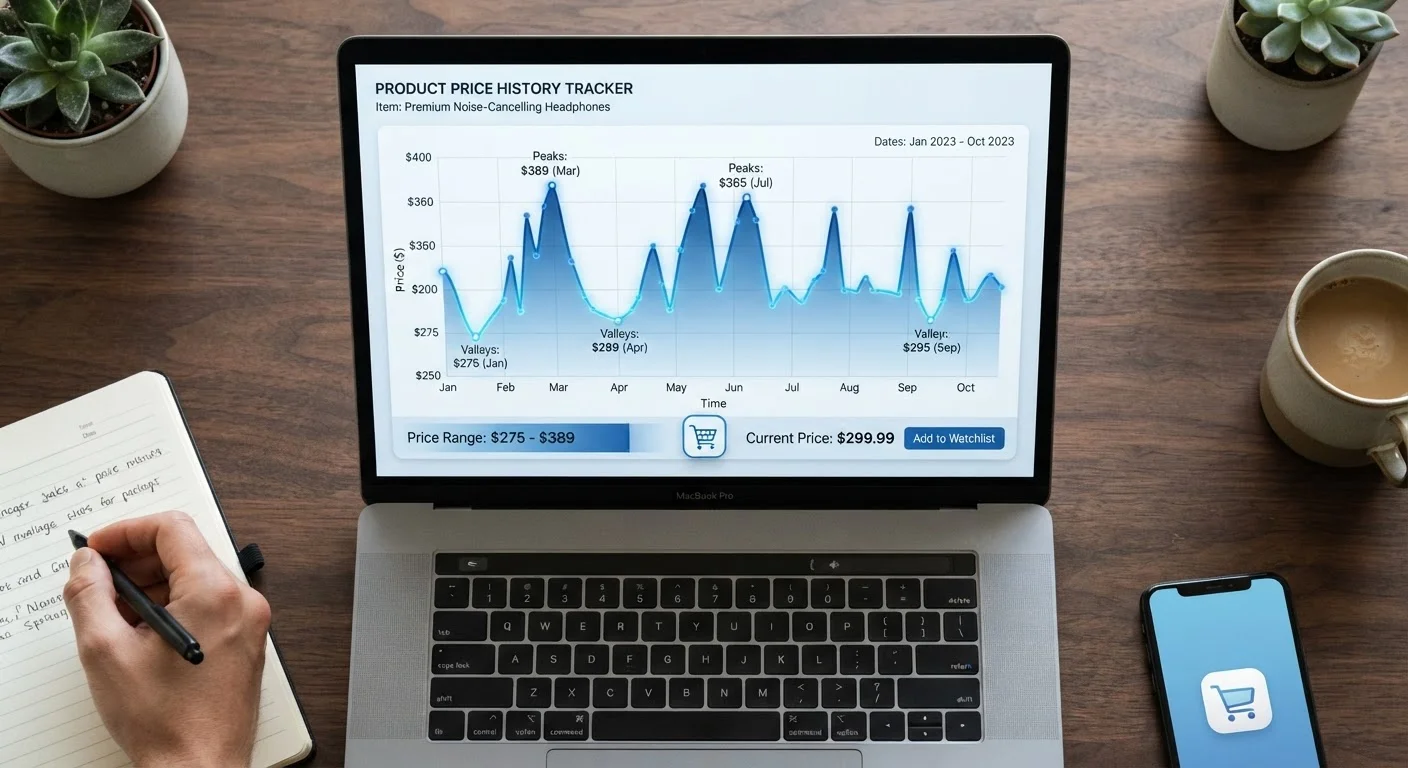
When you load a product page in a browser with a price tracking extension installed, the tool quietly logs the price it sees - the date, the product identifier, and the listed amount. Over weeks and months, those snapshots build into a timeline. That timeline is what gets displayed as the familiar price history graph.
The data is scraped from publicly visible retail pages, not from any private system. This means the tool can only record what it observed at the moment it checked. If a flash sale lasted two hours and the tool checked every 24 hours, that dip might not appear in the chart at all. Understanding this limitation helps you read graphs more critically - a flat line doesn't always mean a stable price; it might mean the tool simply wasn't looking often enough.
Some tools track prices across multiple retailers simultaneously, letting you compare where a product historically sits cheapest. Others focus on a single storefront. Either way, the underlying mechanic is the same: periodic observation, recorded and displayed chronologically.
Third-Party Sellers Can Complicate the Data
On marketplace platforms where multiple sellers list the same product, price trackers may record the lowest available offer at any given moment - which could come from different sellers over time. If seller quality, shipping speed, or return policies differ, the price history alone doesn't tell the whole story. Always check who is actually selling the item before treating the historical low as your benchmark.
Reading the Chart: What the Data Is Actually Telling You
The most important thing a price history chart reveals is the product's price floor - the lowest it has realistically sold for. If the current 'sale' price sits well above that floor, the deal may be less impressive than the percentage-off badge suggests. If the current price matches or beats the historical low, that's a meaningful signal.
Look for patterns, not just peaks. A product that drops to the same 'sale' price every few weeks is effectively always at that price - the higher listed price is the anchor, not the norm. This is one of the most common retail pricing tactics, and a chart exposes it immediately. For a deeper look at how retailers construct these kinds of markdowns, see The Anatomy of a Genuine Discount.
Also pay attention to how much history exists. A 90-day chart for a product sold for three years may be missing important context - holiday spikes, seasonal lows, or post-launch price corrections that would change your interpretation entirely.
~30%
Products where 'sale' price is the usual price
Consumer advocacy research has consistently found that a significant share of promotional prices reflect prices the item regularly sells at, rather than genuine markdowns from a sustained higher price.
24-48 hrs
Typical price check frequency for free tracker tiers
Most free price tracking services check and update product prices once every one to two days, meaning short-lived flash sale prices may not be captured in the historical record.
When These Tools Earn Their Keep - and When They Don't
Price trackers deliver the most value in specific situations. High-ticket items - electronics, appliances, furniture - tend to have more volatile price histories and larger absolute swings. A $30 difference on a $400 item is worth knowing about; the same $30 on a $35 item usually isn't worth the research time.
They're also well suited for purchases where timing is flexible. If you need a new laptop by tomorrow, history data can't help you negotiate with urgency. But if you're planning ahead, setting a price alert and waiting for a genuine dip is a practical strategy. The article When Waiting for a Better Price Actually Pays Off walks through a framework for making that call.
Where trackers lose usefulness: commodity items with genuinely stable pricing, perishables, services, and any product category where the retailer refreshes inventory constantly (making model-to-model comparisons unreliable). Also note that different retailer pricing strategies affect how useful historical data is - an everyday-low-price retailer's chart will look very different from a promotional retailer's.
Use Two Tools for High-Stakes Purchases
No single price tracking service indexes every retailer with equal depth. For purchases over $100, cross-referencing two different tracking tools takes only a few minutes and can surface gaps one tool missed. If both tools show the same price floor independently, you can have higher confidence in that figure.
Setting Alerts and Using the Data Practically
Most price tracking tools let you set a target price and receive an email or push notification when a product hits that threshold. This removes the need to monitor manually. The practical approach: decide what you'd genuinely feel good paying - not what you hope to pay - and set that as your alert threshold.
When an alert fires, don't act on it blindly. Quickly check the full chart to confirm the current price represents a real shift, not just a brief dip that will bounce back within hours. Also confirm the seller and fulfillment terms haven't changed - a lower price from a third-party marketplace seller with no return policy may not be a better deal than the retailer's normal price.
Used this way, price tracking becomes a passive, low-effort research tool rather than something you have to actively manage. Combined with general product research habits, it gives you a clearer picture of whether what you're buying is worth what you're paying - which is the only question that ultimately matters.