

Key Takeaways
- Rabbits need far more space than traditional small pet cages provide - most commercial cages sold in pet stores are too small.
- Hay should make up the majority of a rabbit's diet and double as nesting and foraging material in the habitat.
- Rabbits are social, curious animals that require daily mental stimulation and at least several hours of free-roam time.
- Both indoor and outdoor housing can work, but each carries specific safety and temperature requirements.
- Wire-bottomed enclosures can injure a rabbit's feet - solid, comfortable flooring is essential.
Rabbit Housing
Rabbit housing refers to the enclosure, environment, and surrounding setup a pet rabbit lives in day-to-day. A proper rabbit habitat goes well beyond a basic cage - it must accommodate a rabbit's instinct to run, jump, forage, and hide. Meeting these needs is directly tied to the animal's physical health and emotional wellbeing.
Domestic rabbits (Oryctolagus cuniculus) are crepuscular animals most active at dawn and dusk, which should inform how their environment is structured and when supervised free-roam time is offered.
The Space Problem Most Rabbit Owners Don't Realize They Have
Walk into most pet retailers and you'll find rabbit cages marketed as complete starter kits. The reality is that most of these enclosures are too small for a rabbit to live comfortably - they typically don't allow a rabbit to take more than a few full hops or fully stretch out flat. Rabbits are active animals that, in natural settings, cover several miles a day.
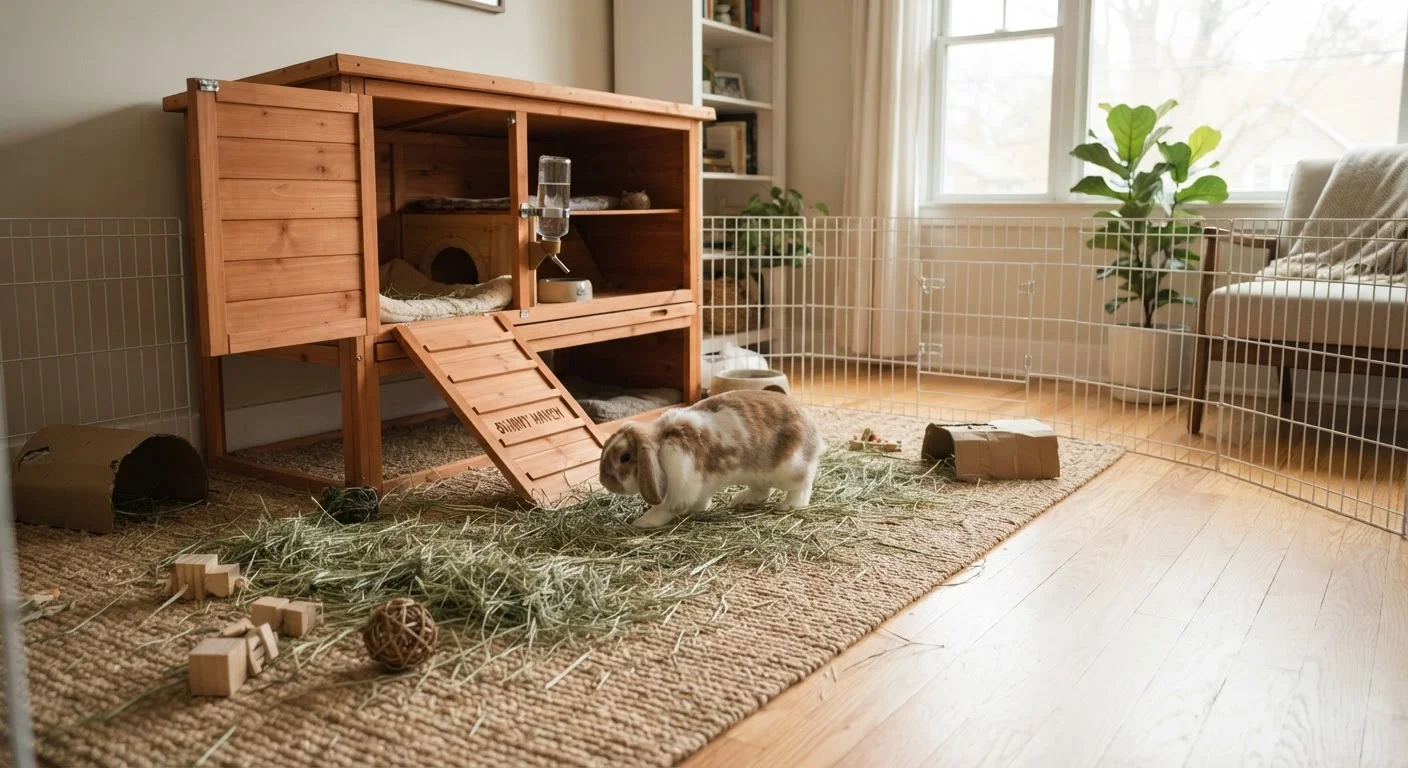
Veterinary and animal welfare organizations widely recommend a minimum of 8 square feet of enclosure space, paired with access to a larger exercise area of at least 24 square feet daily. For a medium-to-large breed rabbit, or a bonded pair, these numbers should increase further. Many experienced rabbit owners find that large exercise pens - the kind sold for small dogs - provide more practical, affordable space than traditional hutches.
The goal is an environment where the rabbit can binky (the joyful, spontaneous leaping and twisting behavior that indicates happiness), sprawl flat to rest, and move between distinct areas for eating, resting, and exploring. For a broader comparison of space demands across small pets, see our Guinea Pig vs. Rabbit comparison guide.
24 sq ft
Minimum recommended daily exercise area
The Rabbit Welfare Association and Fund recommends at least 24 square feet of exercise space in addition to the primary enclosure.
80°F
Temperature threshold for heat stroke risk
Rabbits are highly susceptible to heat stroke in environments exceeding approximately 80°F, making temperature management a critical housing factor.
70%+
Diet that should consist of hay
Veterinary nutritionists generally recommend that hay make up the vast majority of a rabbit's daily diet, underscoring its role as both food and habitat material.
Flooring, Bedding, and the Importance of Foot Health
Wire-bottomed cages are still common, but they're a significant welfare concern. Rabbits have no protective pads on their feet - just fur and skin over bone. Prolonged wire flooring contact causes a painful condition called sore hocks (ulcerative pododermatitis), where the skin on the hind feet breaks down from pressure and friction.
Solid flooring options include wood, plastic, or tile, all of which can be topped with safe bedding material. Paper-based bedding is a reliable choice: it's absorbent, dust-low, and safe to ingest in small amounts. Fleece liners work well for rabbits that are litter-trained. Avoid cedar and pine shavings - their aromatic oils have been associated with respiratory irritation and liver changes in small animals.
Hay deserves special mention. It should be available at all times, both as the primary dietary fiber source and as a foraging and nesting material within the enclosure. A dedicated hay rack or corner feeder keeps it clean and accessible without it being soiled underfoot.
Check for Toxic Houseplants Before Free-Roaming
Many common houseplants - including philodendrons, pothos, and lilies - are toxic to rabbits. Before allowing your rabbit access to any room, audit it for plants at floor level or within reach. The ASPCA maintains a searchable database of plants toxic to domestic animals that can serve as a reference.
Indoor vs. Outdoor Housing: What Each Setup Requires
Indoor housing is generally considered the safer and more enriching option by most rabbit welfare organizations. Indoor rabbits are less exposed to predator stress - even seeing or smelling a cat or dog through a hutch wall can cause acute fear responses, and in rare cases, fatal cardiac events from fright. They're also easier to monitor for health changes.
That said, outdoor hutches remain common and can work when properly designed. Outdoor setups must be:
- Predator-proof - solid latches, hardware cloth (not chicken wire) on all openings, and a secure base to prevent digging entry
- Temperature-managed - rabbits are vulnerable to heat stroke above roughly 80°F and need protection from drafts and freezing temperatures in winter
- Sheltered - positioned to avoid direct afternoon sun and prevailing wind
- Large enough - an attached run significantly expands usable space
Regardless of setup, rabbits should not live in isolation. They are social animals that benefit from regular human interaction or, ideally, the companionship of a bonded rabbit partner. For guidance on building trust with a newly homed or skittish rabbit, see our article on socializing a shy or fearful small animal.
Enrichment, Litter Training, and Setting Up for Success
A physically adequate habitat is only part of the picture. Rabbits are cognitively active animals - without mental stimulation, they can become bored, destructive, or withdrawn. Enrichment doesn't require expensive equipment:
- Cardboard boxes and tunnels for exploration and chewing
- Foraging opportunities (scattering herbs or hay to encourage searching behavior)
- Chew-safe wooden toys or apple sticks
- A consistent daily free-roam period where the rabbit can explore a bunny-proofed room
Litter training is highly achievable with rabbits and dramatically simplifies enclosure maintenance. Most rabbits naturally prefer to eliminate in a corner; placing a litter box with hay in the chosen corner is usually enough to establish the habit. Once litter-trained, many rabbit owners allow near-continuous free-roam access rather than confining the rabbit to an enclosure during the day.
Before your rabbit comes home, getting the habitat right from day one makes a significant difference. Our preparation checklist for new small pet owners covers habitat setup alongside other key first steps. For comprehensive ongoing care guidance, see Small Pet Care from Start to Finish.
Nutrition works in tandem with environment - and common misconceptions about what rabbits eat can undermine even a well-designed habitat. For clarity on diet, our article on common myths about feeding pet rabbits is a useful companion read.
This article is intended for general informational purposes. For specific health concerns about your rabbit, consult a veterinarian with experience in exotic or small animal medicine.