

Key Takeaways
- Roof ventilation moves air from soffit intakes to ridge or gable exhausts, preventing heat and moisture buildup.
- Poor ventilation accelerates shingle aging and can void manufacturer warranties on roofing materials.
- Excess attic moisture from inadequate ventilation leads to mold growth and wood rot in structural framing.
- Ventilation and insulation work together - one without the other undermines overall attic performance.
- Signs of ventilation problems include ice dams in winter, unusually high cooling bills, and peeling interior paint.
Roof Ventilation
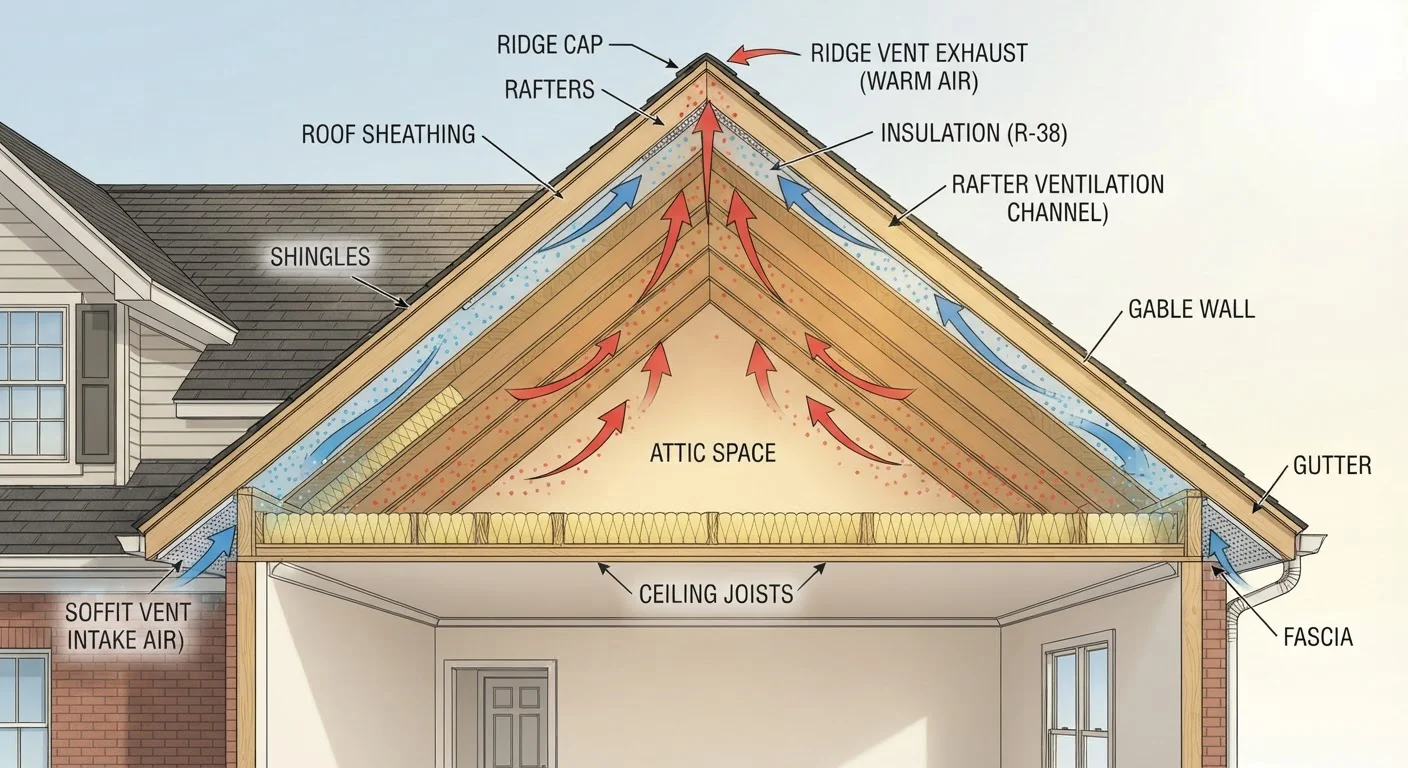
Roof ventilation is a system of intake and exhaust openings that allows outside air to flow continuously through your attic space. It works by drawing cooler air in through vents at the eaves (soffits) and pushing warmer, moisture-laden air out through vents near the roof peak. This continuous exchange prevents heat and humidity from building up in the attic, protecting the structure above and below it.
Building codes in the U.S. generally follow a 1:150 net free ventilation area ratio - meaning one square foot of vent area for every 150 square feet of attic floor space - though a balanced 1:300 ratio may apply when intake and exhaust vents are evenly split.
The Basic Mechanics of Attic Airflow
Roof ventilation relies on a simple physical principle: warm air rises. In a properly designed system, cooler outdoor air enters through intake vents located along the soffit - the underside of your roof's overhang - and travels upward through the attic space. As it warms, it carries heat and moisture toward exhaust vents positioned at or near the roof's highest point, such as a continuous ridge vent, box vents, or gable-end vents.
This continuous airflow is not a luxury feature - it is a fundamental part of how a roof assembly is designed to function. Without it, the attic becomes a trapped environment where temperature and humidity swing to damaging extremes in every season.
There are two broad categories of ventilation: passive, which relies entirely on natural air movement and thermal buoyancy, and active, which uses powered attic fans to mechanically move air. Most residential roofs use passive systems, and when correctly designed, they perform reliably without ongoing energy use or mechanical maintenance.
Spray-Foam Attics Follow Different Rules
Homes insulated with closed-cell spray foam applied directly to the roof deck create what is called an 'unvented' or 'hot roof' assembly. In this design, the attic is intentionally brought inside the thermal envelope and traditional ventilation rules do not apply. If your attic uses spray foam on the rafters rather than on the floor, consult a building professional before making any ventilation changes, as the system is designed differently from the start.
Why Ventilation Affects Your Shingles, Insulation, and Structure
Homeowners often assume the roof stops at the shingles, but what happens in the attic directly shapes how long every component above and below it lasts.
Shingle Lifespan
During summer, an unventilated attic can reach temperatures well above 150°F. That sustained heat bakes asphalt shingles from the underside, causing them to blister, curl, and granulate prematurely. Many shingle manufacturers include ventilation requirements in their warranty terms - failing to meet those specifications can void coverage even if the product was installed correctly. See our guide to roofing materials and installation to understand how material choices and system design interact.
Insulation Performance
Attic insulation is designed to slow heat transfer between your living space and the outdoors. When moisture infiltrates insulation - which happens when humid air has nowhere to escape - it compresses the material and dramatically reduces its thermal resistance. The insulation looks intact but no longer performs as rated. Our article on what R-values actually mean explains how moisture and compression affect real-world performance.
Structural Wood
Roof decking and rafters are typically kiln-dried lumber with a moisture content calibrated for structural stability. Persistent attic humidity raises wood moisture levels, encouraging mold growth and, over time, wood rot. This is one of the damage patterns that home inspectors look for specifically in the attic - a topic covered in depth in our piece on hidden weak points inspectors check.
150°F+
Peak attic temperature without adequate ventilation
Roofing industry sources commonly cite attic temperatures exceeding 150°F in summer in unventilated spaces, accelerating shingle degradation from beneath.
1:150
Standard ventilation ratio per U.S. building codes
Most U.S. model building codes require one square foot of net free vent area for every 150 square feet of attic floor space in an unbalanced system.
25%+
Potential reduction in insulation effectiveness from moisture
Industry guidance notes that wet or compressed insulation can lose a significant portion of its rated R-value, with moisture being a primary culprit in attic assemblies.
Seasonal Problems Tied to Ventilation Gaps
The consequences of poor ventilation are not limited to one time of year. Each season brings a different stress to an under-ventilated attic.
In summer, the primary problem is excess heat. Superheated attic air radiates downward into living spaces, forcing air conditioners to work harder and driving up cooling costs. Homeowners often assume their HVAC system needs upgrading when the real issue is attic heat load. See our overview of energy efficiency upgrades that change how a house performs for how ventilation fits into the larger picture.
In winter, the danger shifts to moisture and ice. Warm air escaping from the living space into a poorly insulated attic warms the roof deck unevenly. Snow on the warmer sections melts, runs toward the cold eaves, and refreezes - forming ice dams that back water under shingles and eventually into the interior walls and ceilings. Proper ventilation keeps the entire underside of the roof deck closer to outdoor temperatures, discouraging this cycle.
In spring and fall, temperature swings drive condensation. Humid air meeting cold attic surfaces deposits moisture on wood and insulation - incremental damage that adds up over years without showing obvious symptoms until rot or mold is already established.
Recognizing Signs of a Ventilation Problem
Ventilation issues rarely announce themselves dramatically. More often, they show up as patterns that are easy to attribute to other causes. Knowing what to look for helps you catch problems early.
- Ice dams along the eaves in winter, particularly on the lower edges of the roof
- Unusually high cooling bills in summer without a clear explanation
- Peeling paint or bubbling wallpaper on upper-floor walls or ceilings, caused by moisture migrating from above
- Musty odors in the attic or on upper floors
- Visible condensation, dark staining, or soft spots on attic sheathing or rafters
- Shingles that are curling, blistering, or losing granules faster than expected
If you notice any of these signs, a qualified roofing contractor or home inspector can assess your ventilation system and recommend corrections. Poor water management around the home can compound attic moisture problems - our article on gutters, downspouts, and drainage explains how the two systems interact.
Check Your Soffit Vents for Blockages
Soffit vents are the most commonly blocked intake points in residential attics. Blown-in insulation can cover them from inside, and debris or paint can seal them from outside. Before assuming a ventilation system is inadequate, inspect soffit vents for obstruction - clearing a blocked intake is one of the most cost-effective fixes available to homeowners.