

Key Takeaways
- Hamsters are solitary and will fight if housed together; gerbils thrive in same-sex pairs or small groups.
- Hamsters are naturally nocturnal, while gerbils are active in shorter bursts throughout the day and night.
- Gerbils generally live longer than hamsters, averaging 3-5 years compared to 2-3 years for most hamster species.
- Both animals require species-appropriate enclosures, diet, and enrichment - but their specific needs differ considerably.
- Neither species is ideal for very young children due to their small size and sensitivity to rough handling.
Option A
Hamster
The independent, solitary small pet for quieter households.
Best for: Owners who prefer a low-maintenance, solo-housed pet with flexible handling schedules.
Option B
Gerbil
The social, active companion best kept with a partner.
Best for: Owners who enjoy watching natural animal behavior and can commit to housing a bonded pair.
If you want a pet that fits around a daytime schedule
Gerbil
Gerbils are active in short, frequent bursts across the day, making interaction more naturally timed with waking hours.
If you prefer housing a single animal and avoiding pair dynamics
Hamster
Hamsters are content - and healthier - when housed alone, removing the complexity of bonding and managing animal relationships.
If lifespan is a priority for your family
Gerbil
Gerbils typically live 3-5 years versus a hamster's 2-3 years, offering a longer companionship window.
If you have limited space for a habitat
Hamster
A single hamster requires less floor space than a bonded gerbil pair, though both still need adequately sized enclosures.
If you enjoy observing natural social behaviors between animals
Gerbil
Bonded gerbils groom, play, and burrow together, providing engaging naturalistic behavior that solitary hamsters cannot offer.
Size, Appearance, and First Impressions
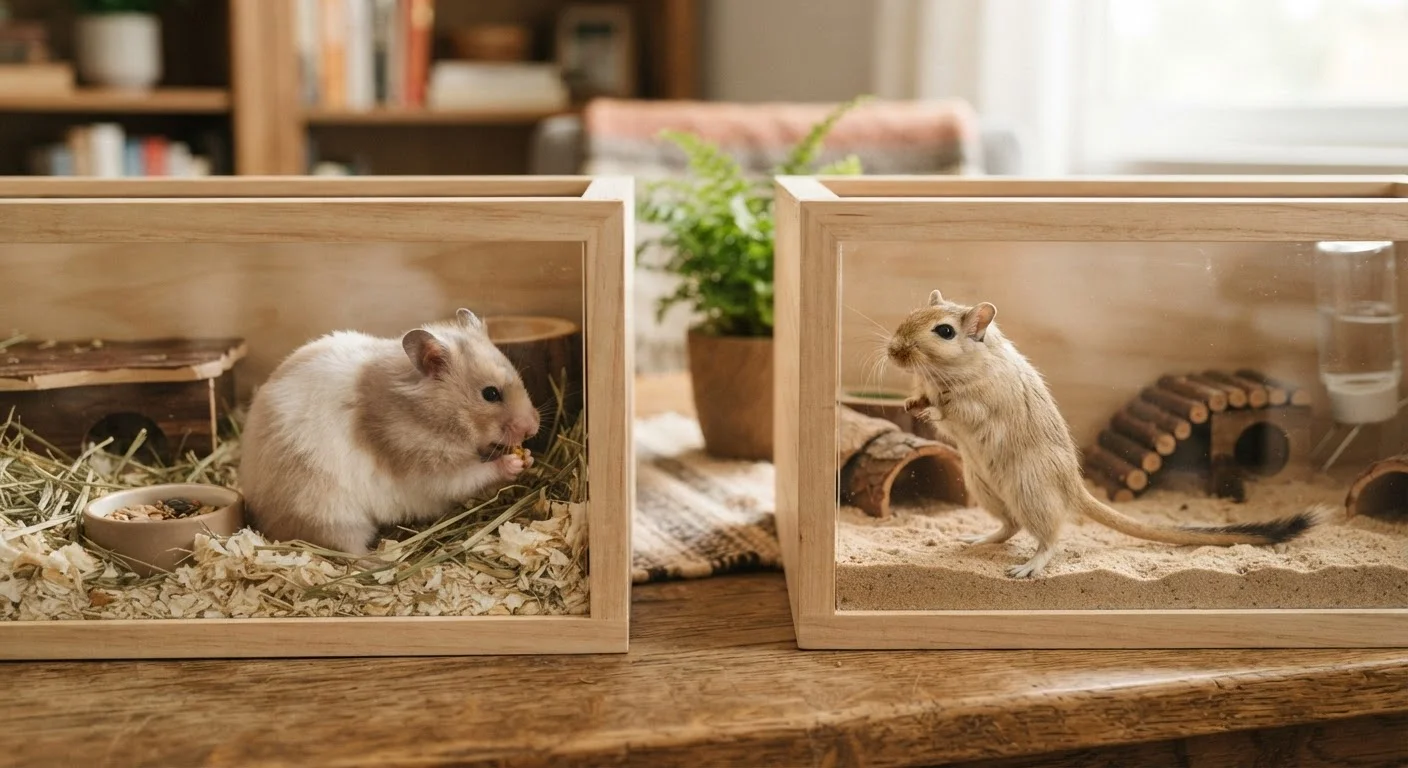
At first glance, hamsters and gerbils can seem nearly interchangeable - both are small, furry, and popular starter pets. But closer inspection reveals meaningful physical differences that signal their distinct needs.
Most pet hamsters in the U.S. are Syrian hamsters, which measure around 5-7 inches long and are notably stockier. Dwarf hamster species, such as the Roborovski or Campbell's dwarf, are considerably smaller. Gerbils, by contrast, average 4-5 inches in body length but have a long, slender tail - nearly equal to their body length - that hamsters lack. Gerbils also have longer hind legs built for digging and quick movement.
These structural differences aren't just cosmetic. Gerbils' longer limbs and tails reflect an evolutionary background in arid grasslands, while hamsters' compact builds are adapted to burrowing in underground tunnels. Understanding these physical traits helps predict the kind of habitat and enrichment each animal genuinely needs.
| Criterion | Hamster | Gerbil |
|---|---|---|
| Social structure | Solitary; must live alone | Social; thrives in same-sex pairs |
| Activity pattern | Primarily nocturnal | Active in bursts throughout day/night |
| Typical lifespan | 2-3 years | 3-5 years |
| Tail length | Very short or stub tail | Long tail, near body length |
| Biting tendency | Moderate; bites when startled | Lower; curious and exploratory |
| Enclosure depth needed | 6+ inches substrate for burrowing | 4-6 inches; gerbilarium recommended |
| Housing complexity | Simple; single-animal setup | Requires managing bonded pair |
Temperament, Activity Patterns, and Social Needs
Behavior is where hamsters and gerbils diverge most sharply - and where new owners are most often surprised.
Hamsters are solitary by nature. In the wild, they are highly territorial and will aggressively defend their space. Keeping two hamsters together, even of the same species, typically results in fighting that can cause serious injury. Syrian hamsters in particular must always be housed alone. Some dwarf species tolerate same-sex siblings if introduced early, but this carries risk and requires careful monitoring.
Gerbils are the opposite. They are social animals that form strong bonds with companions. A lone gerbil can experience chronic stress. Veterinary and behavioral guidance consistently recommends housing gerbils in same-sex pairs or small groups from a young age. The social dynamic between a bonded pair is one of the most rewarding aspects of gerbil ownership - they groom each other, sleep in piles, and explore together.
Activity timing also differs meaningfully. Hamsters are largely nocturnal, meaning they sleep through most of the day and become active after dark. Owners who expect interaction during daytime hours may find a hamster unresponsive or grumpy when disturbed mid-sleep. Gerbils follow a polyphasic pattern - active in multiple short bursts throughout the day and night - which makes them more visible and interactive during normal waking hours.
3-5 yrs
Average gerbil lifespan in captivity
Gerbils consistently outlive most hamster species, giving owners a longer window of companionship under good care conditions.
10-11 in
Minimum wheel size for Syrian hamsters
Exotic veterinarians and small animal welfare organizations recommend solid-surface wheels of this diameter to prevent spinal injury in adult Syrians.
60°F
Temperature threshold for hamster torpor risk
Hamsters exposed to temperatures below approximately 60°F can enter a dangerous torpor state that mimics hibernation and may be mistaken for death.
Habitat, Diet, and Handling
Both species require clean, enriched enclosures, but the specifics differ. Hamsters are prolific burrowers and do best in tanks or enclosures with at least 6 inches of deep, loose substrate - paper-based bedding is widely recommended by exotic veterinarians. A solid-surface wheel (not wire) is essential for physical and mental health. Syrian hamsters need a wheel at least 10-11 inches in diameter.
Gerbils also burrow but are equally interested in surface activity. A gerbilarium - a tank with a wire mesh lid and several inches of substrate - allows both digging and climbing. Because gerbils are housed in pairs, the enclosure footprint should be proportionally larger than a single-hamster setup.
Diet for both species centers on a high-quality commercial seed or pellet mix supplemented with fresh vegetables in small amounts. Avoid citrus, onion, and high-sugar fruits. Both animals can store food in cheek pouches (hamsters especially), so checking for hidden perishables is important to prevent mold.
When it comes to handling, patience is key for both animals. Hamsters may bite if startled, particularly when woken during daytime. Gerbils tend to be more naturally curious and less prone to biting, but both need consistent, gentle socialization from a young age. Neither species is well-suited to very young children who may grip too tightly or move unpredictably.
For a broader look at what to set up before any small pet arrives home, see our small pet preparation checklist. If you're weighing other small animal options, our guinea pig vs. rabbit comparison covers two other popular choices.
Health Considerations and Lifespan
Lifespan is a practical factor many adopters overlook. Syrian hamsters typically live 2-3 years, while dwarf hamster species often live slightly less. Gerbils generally reach 3-5 years under good conditions - a meaningful difference, especially for families with children who may form strong attachments.
Common health concerns for hamsters include wet tail (a bacterial intestinal disease, particularly in young animals), dental problems, and skin conditions. Hamsters are also prone to hibernation-like torpor if exposed to temperatures below about 60°F - a state that can be mistaken for death and that carries real health risks.
Gerbils are generally considered hardy but are susceptible to Tyzzer's disease (a bacterial infection), dental overgrowth, and - in older animals - epileptiform seizures, which are minor and usually not life-threatening but can alarm new owners unfamiliar with the behavior.
Regardless of species, a baseline wellness exam with an exotic animal veterinarian shortly after adoption is strongly advisable. Many common small rodent illnesses progress quickly, and early detection matters. See our overview of small pet lifespans for a broader context on what to expect across species.
If you're also researching housing for other small animals, our guide to rabbit housing needs explores what space and environment requirements look like for a different but equally popular small pet.
This article is intended for general informational purposes only and does not constitute veterinary advice. Always consult a licensed exotic animal veterinarian for health concerns specific to your pet.