

Key Takeaways
- Some plant pairings offer measurable benefits like nitrogen fixation, pest deterrence, or improved pollination.
- Well-known combos like the Three Sisters have solid ecological logic, though results vary by garden conditions.
- Not all companion planting claims are equally supported - separating evidence from folklore helps you plan smarter.
- Certain plants actively inhibit neighbors through chemical compounds or aggressive root competition.
- Companion planting works best as one layer of a broader, balanced approach to garden management.
What Companion Planting Actually Means
Companion planting is the practice of growing different plants in close proximity so they benefit one another - or at least don't get in each other's way. The idea has roots in traditional agriculture and Indigenous farming systems, and modern gardeners have built on those foundations with both experience and, increasingly, agronomic research.
The benefits claimed range from pest suppression and improved pollination to more efficient use of space, light, and soil nutrients. Some of these claims are well-supported; others fall more into the category of garden folklore. If you're just getting started with a vegetable garden, understanding the honest basis for companion planting helps you set realistic expectations and make better use of your plot.
Below, we walk through pairings that have a reasonable evidence base or strong practical rationale - and flag a few combinations you should actively avoid.
Tomatoes and Basil
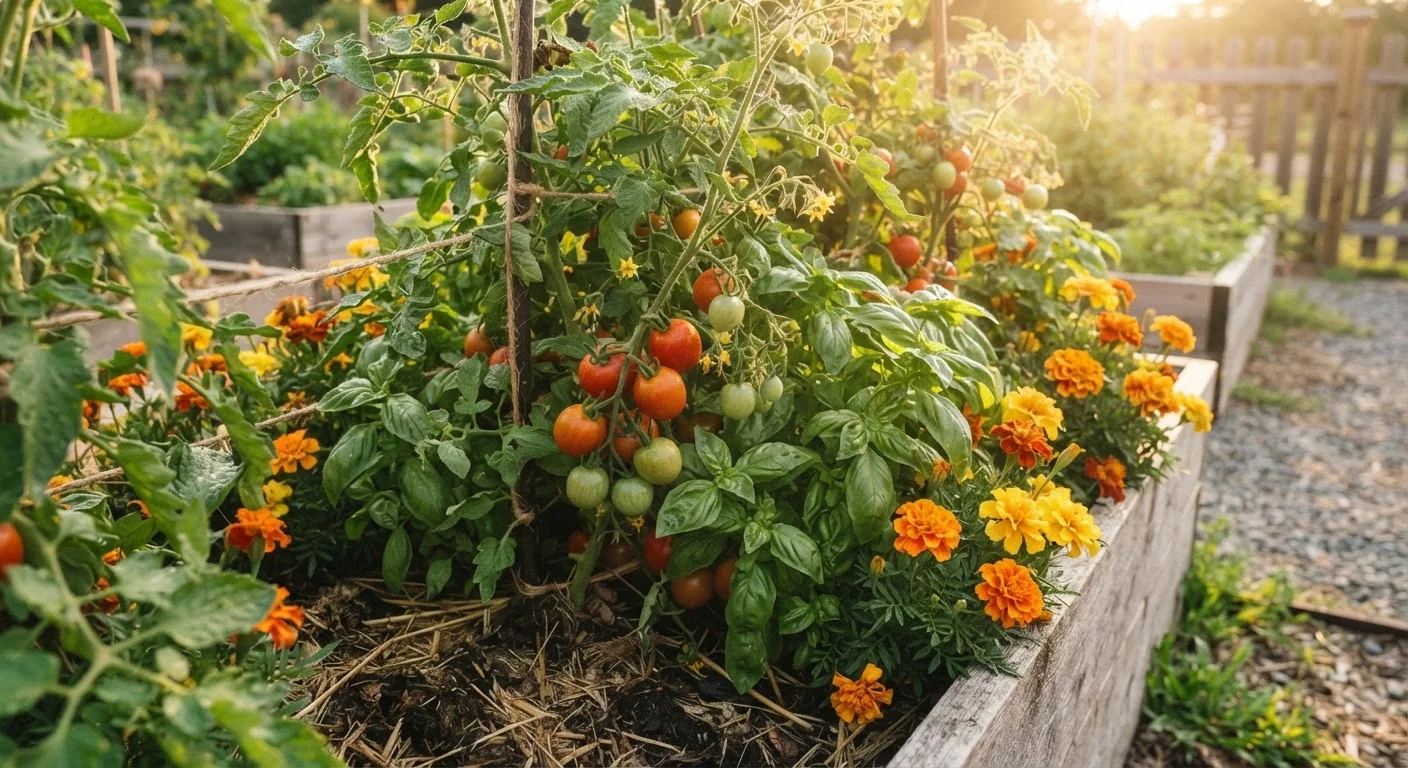
This is one of the most popular pairings in American home gardens, and while the claim that basil improves tomato flavor hasn't been scientifically confirmed, there are practical reasons to keep them together. Basil's aromatic oils are thought to repel thrips and aphids, and dense basil plantings can serve as a low ground cover that slows soil moisture loss near tomato roots.
Pollinator activity around flowering basil can also benefit nearby fruiting plants. Let a few basil plants go to flower at the edges of the bed rather than pinching them back constantly, and you'll draw in more beneficial insects overall.
Basil's aromatic oils may help deter aphids and thrips near tomato plants.
The Three Sisters: Corn, Beans, and Squash
Developed by multiple Indigenous peoples of North America over centuries, the Three Sisters system is one of the most ecologically coherent companion planting strategies documented. Corn provides a vertical structure for pole beans to climb. Beans fix atmospheric nitrogen into the soil in a form other plants can use. Squash spreads low to the ground, shading out weeds and retaining soil moisture with its broad leaves.
This system works best with sufficient space - squash needs room - and with varieties bred for the arrangement. It's a particularly good fit if you're weighing in-ground planting versus raised beds, since in-ground plots typically offer the footprint this trio requires.
The Three Sisters system integrates structure, nitrogen fixation, and ground cover in one planting.
Marigolds and Most Vegetables
French marigolds (Tagetes patula) are well-documented as a deterrent to certain soil nematodes - microscopic worms that damage root systems. Research has shown that growing dense marigold plantings for a full season can measurably reduce nematode populations in the soil beneath them. They also attract beneficial insects like hoverflies and parasitic wasps that prey on garden pests.
For ongoing pest management, interplanting marigolds throughout vegetable beds tends to be more effective than planting them only at the border. Note that the nematode-suppression benefit builds over a full growing season, so marigolds work best as a recurring element of your garden plan rather than a quick fix. They're also worth keeping in mind if you've noticed unusual pest activity that might actually be root-level damage.
Dense French marigold plantings can measurably reduce harmful soil nematode populations over a season.
Carrots and Onions (or Chives)
The traditional claim is that onion family plants confuse or repel carrot fly, while carrots repel onion fly - each masking the other's scent. The evidence here is mixed: some field studies show modest reduction in pest pressure with interplanting, while others show minimal effect. That said, the practice doesn't carry significant downside risk, and both crops use different soil depths, so they don't heavily compete for resources.
Chives are often recommended as a gentler companion for carrots and are easier to manage in a small bed. They also attract pollinators when flowering and are a low-maintenance perennial that returns each year.
Carrot and onion family plants may help mask each other's scent from specific fly pests.
Nasturtiums as a Trap Crop for Aphids
Nasturtiums are highly attractive to aphids - and that's the point. Planted near susceptible crops like beans or brassicas, nasturtiums can serve as a trap crop, drawing aphids away from the plants you want to protect. Once aphids colonize a nasturtium, the plant also attracts predatory insects like ladybugs and lacewings that help control the population naturally.
For this to work, the nasturtiums need to be close enough to act as a lure but not so tangled with your main crop that aphids migrate freely between them. Check the nasturtiums regularly; if aphid populations explode without predator control, you may need to remove and dispose of the infested plants.
Nasturtiums act as a trap crop by luring aphids away from higher-value vegetable plants.
Combinations to Avoid: Fennel, Black Walnut, and Allelopathic Plants
Not all plant relationships are neutral or beneficial. Fennel is notably allelopathic - it releases compounds from its roots and leaves that inhibit the growth of many common garden plants, including tomatoes, peppers, beans, and most herbs. Unless you're growing fennel specifically for harvest or to attract swallowtail butterflies, keep it in its own isolated spot or in a container.
Black walnut trees present a similar challenge. They produce a compound called juglone, which is toxic to a wide range of plants including tomatoes, peppers, apples, and many ornamentals. Anything planted within the root zone of a black walnut - which can extend well beyond the canopy - is at risk. This is worth knowing if you're planning beds near an established tree.
Brassicas (cabbage, broccoli, kale) also tend to inhibit the growth of nearby strawberries and vice versa, making that pairing one to sidestep even in small gardens.
Fennel releases root compounds that suppress the growth of tomatoes, peppers, and most herbs.
Putting It All Together in Your Garden
Companion planting is most effective when it's part of a thoughtful overall plan rather than a standalone fix. Soil chemistry matters enormously - even the best plant pairing won't compensate for a pH that locks out key nutrients. And if you're working with limited space, the principles here apply just as well to containers; see our guide on container gardening on patios and balconies for tips on scaling these ideas down.
Start Small and Observe Results
Rather than redesigning your entire garden around companion planting, introduce one or two new pairings per season alongside your existing layout. Compare those beds to your standard plantings and note any differences in pest pressure, yield, or plant health. This low-commitment approach lets you build a reliable, personalized picture of what actually works in your specific conditions.
Keep notes on what you try each season. Gardens are variable - what works in a neighbor's beds may underperform in yours due to soil type, sun exposure, or local pest populations. Iterating with real observations from your own space is the most reliable path to a companion planting strategy that delivers.