

Key Takeaways
- A solid check engine light usually indicates a non-emergency fault, but it still warrants prompt attention.
- A flashing check engine light signals an active, serious problem - pull over safely and avoid driving until it's diagnosed.
- An OBD-II scanner can read stored fault codes in minutes and helps you understand what triggered the light.
- Common causes include a loose gas cap, failing oxygen sensor, faulty catalytic converter, or misfiring spark plugs.
- Ignoring the light can turn minor, inexpensive repairs into major, costly ones over time.
Check Engine Light (CEL)
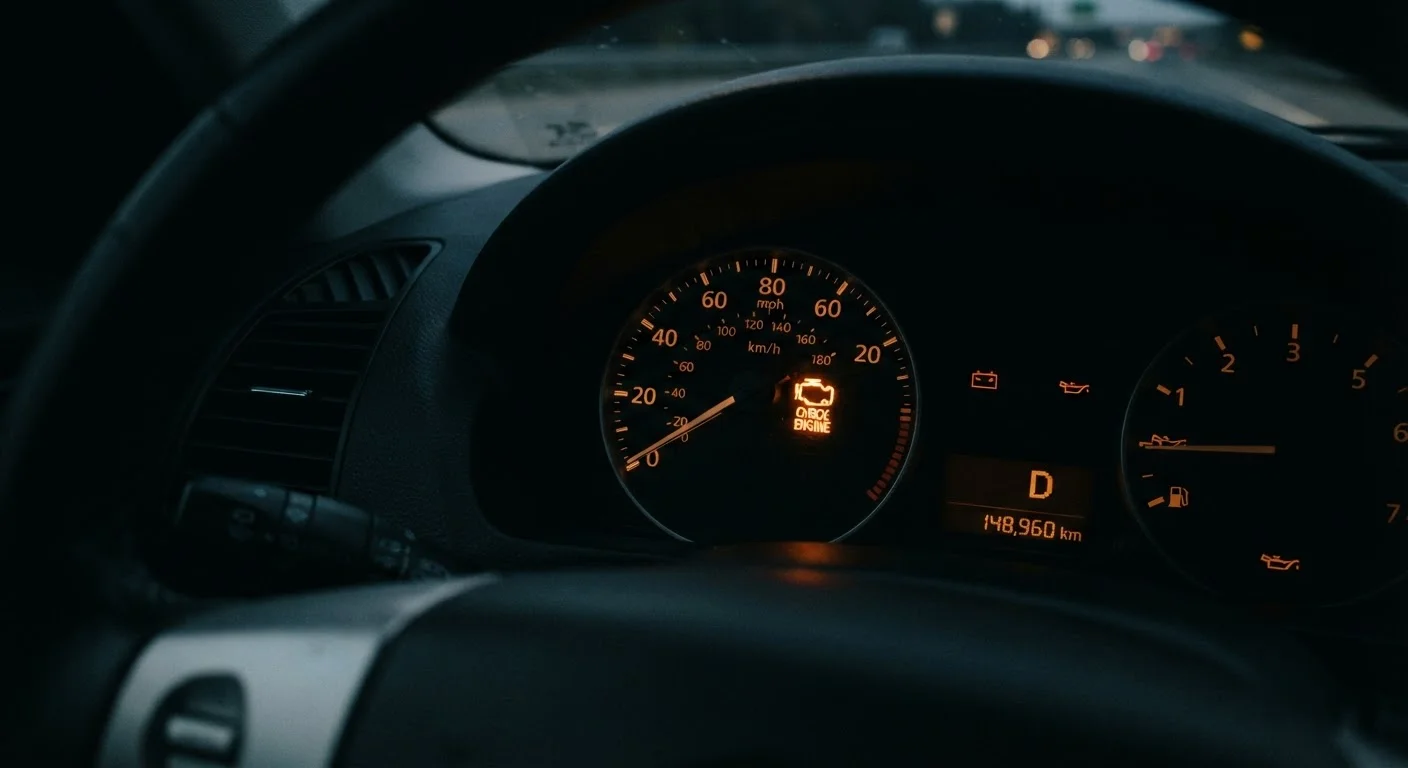
The check engine light - also called the malfunction indicator lamp (MIL) - is a dashboard warning that activates when your car's onboard diagnostic system (OBD-II) detects a fault in the engine, transmission, emissions, or related systems. It does not point to one specific problem; it signals that a stored diagnostic trouble code (DTC) needs to be read with a scan tool. The light can appear solid or flashing, and that distinction matters.
All vehicles sold in the U.S. since 1996 are required to use the standardized OBD-II system, which stores fault codes accessible with any compatible scanner.
What the Light Is Actually Doing
Your vehicle's OBD-II system continuously monitors dozens of sensors and components - from the oxygen sensors measuring exhaust gases to the throttle position sensor tracking how far you press the accelerator. When a reading falls outside the acceptable range, the system logs a diagnostic trouble code (DTC) and illuminates the check engine light to alert you.
The light itself carries no details - it's simply a signal that a code is stored. Think of it as a voicemail notification: the message is waiting, but you need a tool to retrieve it. That tool is an OBD-II scanner, which any driver can use or have a shop use on their behalf.
Understanding what your vehicle's dashboard warnings mean is a foundational part of car ownership. For a broader look at the gauges, indicators, and maintenance schedules your manufacturer recommends, see reading your owner's manual.
Solid vs. Flashing: Why It Matters
The single most important thing to observe when the check engine light comes on is whether it is steady or flashing.
- Solid light: Indicates a fault that has been detected but is not causing immediate, severe damage. Examples include an evaporative emission leak, a failed oxygen sensor, or a loose fuel cap. You should schedule a diagnostic soon - within a few days - but you do not necessarily need to stop driving immediately.
- Flashing light: Signals an active, serious condition, most commonly an engine misfire severe enough to damage the catalytic converter. A flashing light means you should reduce speed, minimize engine load, and get the vehicle inspected as soon as safely possible. Continued driving risks turning a repair into a far more expensive replacement.
Watch for Other Warning Lights Too
If the check engine light comes on alongside other warning indicators - temperature gauge spiking, oil pressure light illuminating, or a loss of power - treat the situation as urgent regardless of whether the check engine light is flashing. Multiple simultaneous warnings often indicate a more serious underlying condition.
If the light comes on alongside other warning indicators - temperature gauge spiking, oil pressure light, or a loss of power - treat it as urgent regardless of whether it is flashing.
The Most Common Triggers
While the OBD-II system can generate hundreds of fault codes, a handful of causes account for the majority of check engine light activations in everyday vehicles:
~40%
CEL activations linked to O2 sensors or gas caps
Industry scan data from OBD-II diagnostic service providers consistently shows oxygen sensor faults and evaporative emission leaks among the top triggers.
1996
Year OBD-II became mandatory in U.S. vehicles
The U.S. Environmental Protection Agency required OBD-II standardization on all cars sold domestically from the 1996 model year onward.
Hundreds
Possible diagnostic trouble codes in a modern vehicle
The OBD-II standard defines generic codes, and automakers add manufacturer-specific codes, meaning thousands of code combinations are possible across all makes and models.
- Loose or damaged gas cap: A cap that isn't sealed properly allows fuel vapors to escape, triggering an evaporative emission system fault. Always check the cap first - it takes seconds.
- Oxygen (O2) sensor failure: O2 sensors monitor exhaust gases to help the engine run efficiently. A failing sensor can reduce fuel economy and increase emissions over time.
- Catalytic converter issues: The catalytic converter reduces harmful exhaust emissions. Failure is often downstream of other neglected problems, like bad O2 sensors or persistent misfires.
- Mass airflow (MAF) sensor fault: The MAF sensor measures how much air enters the engine. A dirty or failing sensor throws off the air-fuel mixture, causing rough running and reduced efficiency.
- Spark plug or ignition coil failure: Worn spark plugs or failing ignition coils cause misfires - the leading cause of a flashing check engine light. Regular replacement per your manufacturer's schedule is the best prevention.
If you're evaluating a used vehicle and want to know whether past check engine light events were properly addressed, reading a vehicle history report can reveal documented repair patterns worth scrutinizing.
What to Do When It Comes On
A systematic response keeps you informed and prevents small problems from becoming large ones:
- Check the gas cap first. Remove it, reseat it firmly until it clicks, and drive normally for a day or two. If the light clears, the cap was the culprit.
- Note any drivability symptoms. Rough idling, hesitation, reduced power, unusual smells, or smoke all provide important context for a mechanic and help establish urgency.
- Get the codes read. Many auto parts retailers will read OBD-II codes at no charge. Write down the exact code numbers - not just the description - to share with your mechanic.
- Schedule a diagnostic. A qualified mechanic can interpret codes in context, perform further tests, and recommend repairs. A code is a starting point for diagnosis, not a guaranteed answer on its own.
- Don't delay unnecessarily. An ignored check engine light can mask new codes from additional faults. Keeping the system clear lets you catch emerging problems early.
A battery failure can sometimes trigger warning lights as well. If your check engine light appeared around the same time as starting difficulties or electrical quirks, it may be worth reviewing signs your car battery is failing.
Emissions Testing and the Check Engine Light
In most U.S. states with mandatory emissions inspections, an active check engine light results in an automatic failure. Even if you clear the codes manually, the OBD-II system requires a series of 'drive cycles' to confirm all monitors are ready before the vehicle can pass testing. If your registration renewal is approaching, address the light promptly rather than clearing codes as a workaround.