

Key Takeaways
- The advertised price rarely reflects what you'll actually pay after taxes, fees, and financing.
- Auto insurance premiums vary widely based on the vehicle, your driving history, and your location.
- Routine maintenance, fuel, and registration are recurring costs that need to fit your monthly budget.
- The finance and insurance office at a dealership can add significant costs through optional add-ons.
- Reading the full contract before signing is essential - verbal agreements alone carry no legal weight.
Start here
The Sticker Price Is Just the Starting Point
Next
Insurance Costs Can Surprise You
Then
Ongoing Ownership Expenses to Plan For
Important
Paperwork and Financing Pitfalls
Before you commit
What to Do Before You Sign Anything
The Sticker Price Is Just the Starting Point
When first-time buyers set a budget, they tend to anchor it to the advertised price on the window sticker or a listing. That number, while important, leaves out a substantial portion of what you'll actually pay. Sales tax alone can add several thousand dollars depending on your state. On top of that, title and registration fees, a dealer documentation fee, and any state inspection requirements all get added at closing.
Some dealers also roll in costs like nitrogen-filled tires, paint protection, or fabric treatment as pre-installed options - these may appear on the contract as non-negotiable, though that's worth discussing explicitly. Understanding the difference between the vehicle's out-the-door price and the advertised price is one of the most practical skills you can develop before walking onto any lot. For a clear walkthrough of every stage in this process, see The Full Car-Buying Journey, From Research to Keys in Hand.
Out-the-door price
The total amount you'll pay to drive the vehicle away, including the sale price, taxes, registration fees, and any dealer charges. This is the number that matters most for budgeting.
APR (Annual Percentage Rate)
The yearly cost of borrowing money expressed as a percentage. A lower APR means you pay less in interest over the life of your loan.
GAP insurance
Coverage that pays the difference between what you owe on your auto loan and what your car is actually worth if it's totaled or stolen. Most relevant when you finance most of the vehicle's value.
Comprehensive coverage
An auto insurance component that pays for damage to your vehicle from events other than a collision - such as theft, weather, or falling objects.
Documentation fee
A charge added by the dealership to cover the administrative cost of processing your purchase paperwork. The amount is set by the dealer and may be regulated by your state.
F&I office
Short for Finance and Insurance. This is where you finalize the loan, sign purchase documents, and may be offered optional add-on products after agreeing on a vehicle price.
Insurance Costs Can Surprise You
Many first-time buyers choose a vehicle first and check insurance rates second - sometimes finding that the monthly premium significantly changes the affordability picture. Insurance premiums are affected by the vehicle's value, repair costs, safety ratings, theft rates, your driving history, your age, and where you live. A vehicle with a lower purchase price can carry higher insurance costs if its repair parts are expensive or if it's statistically involved in more claims.
Lenders who finance your purchase will typically require both collision and comprehensive coverage - not just the state-minimum liability insurance - which adds to your monthly costs. Getting insurance quotes before you finalize a vehicle choice is a straightforward way to avoid this surprise. You can learn more about coverage types and how to evaluate them through our Car Insurance guidance.
Get Insurance Quotes Before You Decide
Before finalizing which vehicle to buy, request insurance quotes for each model you're seriously considering. Bring the VIN or at minimum the year, make, model, and trim level to get an accurate estimate. This step can meaningfully change which option fits your total monthly budget.
Ongoing Ownership Expenses to Plan For
The purchase itself is a one-time event; ownership is ongoing. Fuel costs, routine maintenance, and annual registration renewals are predictable expenses that many first-time buyers underestimate when calculating what they can afford each month.
Routine maintenance - oil changes, tire rotations, cabin air filters, brake inspections - follows a schedule outlined in every vehicle's owner manual. Skipping or delaying these services often leads to larger repair bills down the line. Proper tire pressure, for example, directly affects fuel economy and tire lifespan, meaning a small oversight can quietly add cost over time. For a broader introduction to keeping your vehicle in good shape from the start, see Car Maintenance for New Drivers: Building Good Habits from Day One.
Paperwork and Financing Pitfalls
After agreeing on a price, buyers move to the finance and insurance (F&I) office to complete the transaction. This stage often moves quickly, and it's where many first-time buyers feel least prepared. The F&I office may present optional products - extended warranties, GAP insurance, paint or interior protection packages, and credit insurance - at an additional cost. These products are not inherently bad, but they're worth evaluating on their own merits rather than accepting by default under time pressure.
The financing terms themselves also deserve close scrutiny. The annual percentage rate (APR), the loan term in months, and whether the rate is fixed or variable all affect your total repayment amount. A longer loan term lowers monthly payments but often increases the total interest paid. Getting pre-approved through your bank or credit union before visiting a dealership gives you a concrete rate to compare against. For a detailed look at what happens in this room, see The F&I Office Explained.
Don't Let Time Pressure Rush Your Decision
The F&I office can feel fast-paced, and some buyers report feeling subtle pressure to decide quickly on add-on products. You are entitled to take time to review every document and to decline optional products. No legitimate dealership should require you to make on-the-spot decisions about products you haven't had time to consider.
What to Do Before You Sign Anything
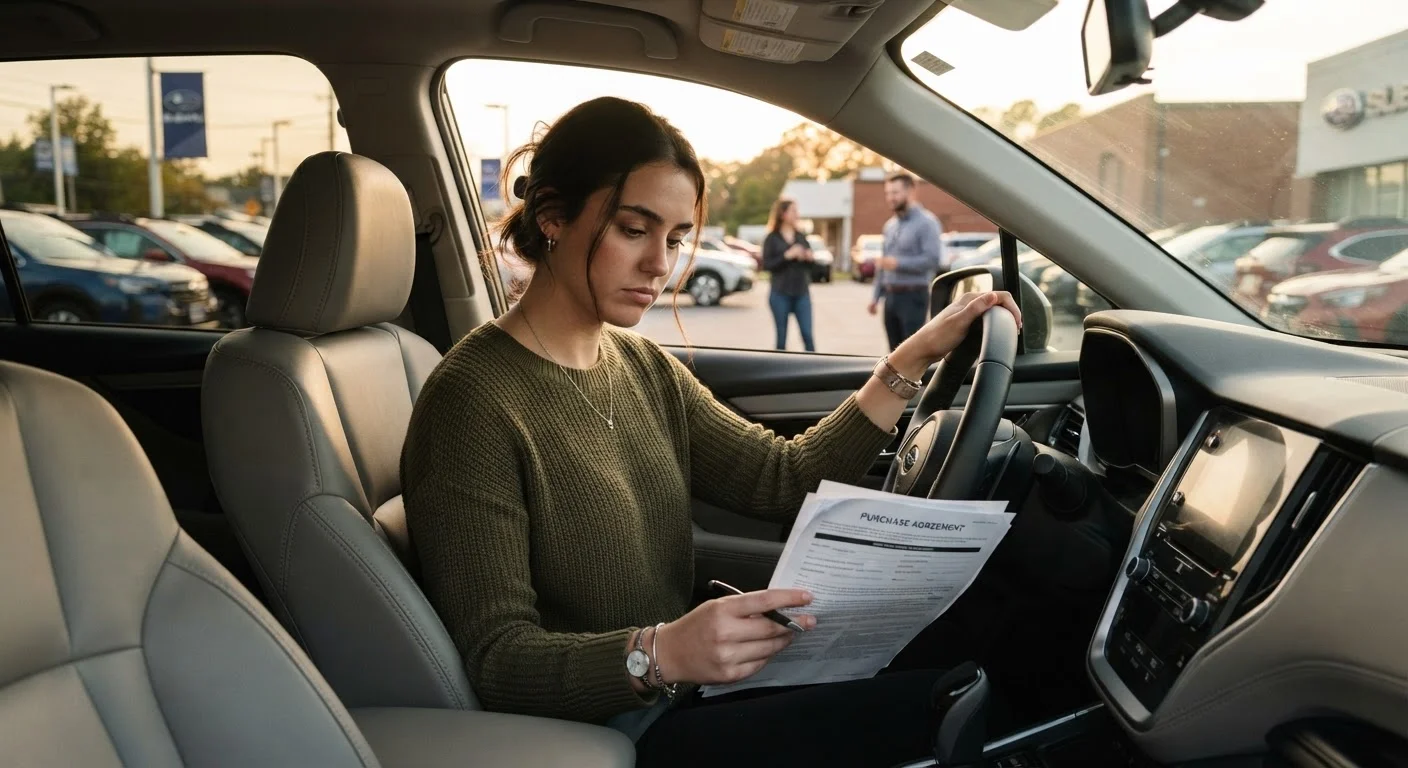
The most protective habit a first-time buyer can develop is taking time to read every document before signing. Ask for a copy of the purchase agreement and itemized fee breakdown before you sit down to sign. Verbal assurances - promises about included services, return policies, or included accessories - carry no legal weight unless they appear in writing in the contract.
It's also worth confirming that the vehicle identification number (VIN) on your contract matches the actual car, that the interest rate matches what was discussed, and that any agreed-upon trade-in value is listed correctly. The hidden costs that buyers routinely overlook extend well beyond the automotive world - a pattern worth recognizing in any major purchase. Taking 20 extra minutes to review paperwork carefully is one of the most straightforward ways to protect yourself throughout this process.