

Key Takeaways
- Correct tire pressure is listed on your driver's door jamb sticker, not on the tire sidewall.
- Underinflated tires are the more common and more dangerous of the two pressure errors.
- Even modestly low pressure measurably reduces fuel economy and accelerates tread wear.
- Tire pressure should be checked cold - before driving more than a mile.
- Temperature swings of 10°F can shift tire pressure by roughly 1 PSI.
- A quality digital gauge costs a few dollars and pays for itself quickly.
Tire Pressure (PSI)
Tire pressure refers to the amount of air inside a tire, measured in pounds per square inch (PSI). Every vehicle has a manufacturer-recommended PSI range - typically found on a sticker inside the driver's door jamb - that keeps tires performing safely and efficiently. Running outside that range, whether too high or too low, causes measurable harm to fuel economy, tire lifespan, and handling.
PSI is measured as gauge pressure, meaning it reflects the pressure above ambient atmospheric pressure (~14.7 PSI at sea level). The number molded on the tire sidewall is the maximum cold inflation limit, not the recommended operating pressure - these are frequently confused.
The Real Cost of Ignoring Tire Pressure
Tire pressure is one of the most straightforward maintenance tasks a driver can perform, yet industry data consistently shows that a significant share of vehicles on American roads are running on tires inflated outside the recommended range. The consequences reach directly into your wallet.
The U.S. Department of Energy has noted that underinflated tires can reduce fuel economy by roughly 0.2% for every 1 PSI drop across all four tires. That may sound marginal, but tires that are 8-10 PSI low - which is not unusual - can translate into a noticeable increase in fuel costs over thousands of miles. For drivers already watching their gas budget, that's a real and avoidable expense.
~0.2%
Fuel economy loss per 1 PSI underinflation
Per guidance from the U.S. Department of Energy, each PSI drop across all four tires reduces fuel efficiency by roughly 0.2%.
~25%
Pressure drop before TPMS warning activates
Federal TPMS standards require a warning only when pressure falls approximately 25% below the vehicle's recommended level - often 7-10 PSI low.
1 PSI
Pressure change per 10°F temperature shift
A commonly cited approximation from tire manufacturers: tire pressure drops roughly 1 PSI for every 10°F decrease in ambient temperature.
Beyond fuel, incorrect pressure shortens tire life. Tires are engineered to distribute vehicle load across a specific contact area with the road. When that area changes due to pressure errors, uneven wear patterns develop - often voiding any remaining tread warranty and forcing earlier replacement. Considering that a full set of tires represents a substantial investment, the math on regular pressure checks is straightforward.
Underinflation vs. Overinflation: Different Problems, Same Outcome
Both extremes damage tires and vehicle handling, but they do so differently.
Underinflation
When a tire carries less air than specified, its sidewalls flex more than designed during each rotation. This generates heat - the primary enemy of tire longevity and structural integrity. Persistent underinflation can lead to tread separation or sudden blowouts, particularly at highway speeds. Handling also suffers: the steering feels vague, and braking distances increase because the tire's contact patch shape becomes less predictable.
Overinflation
An overinflated tire bulges in the center, reducing the contact patch to a narrow strip. Traction decreases, the tire becomes more vulnerable to impact damage from potholes and road debris, and center-tread wear accelerates. Ride quality also hardens noticeably, which drivers sometimes mistake for a suspension issue.
Find Your Correct PSI Before You Check
Before reaching for a gauge, locate the recommended tire pressure for your specific vehicle. It's printed on a sticker inside the driver's door jamb and is also in your owner's manual. Front and rear tires sometimes have different recommended pressures. Never rely on the number embossed on the tire sidewall - that's the tire's maximum limit, not your target.
Both conditions are also linked to handling instability in emergency maneuvers. Research from organizations including the National Highway Traffic Safety Administration (NHTSA) has documented the relationship between underinflation specifically and increased rollover and blowout risk. Just as brake maintenance misconceptions can create hidden safety risks, assumptions about tire pressure - such as trusting a visual inspection instead of measuring - can be equally misleading.
How to Check Tire Pressure Correctly
Accurate tire pressure checks require a few simple conditions to produce a useful reading.
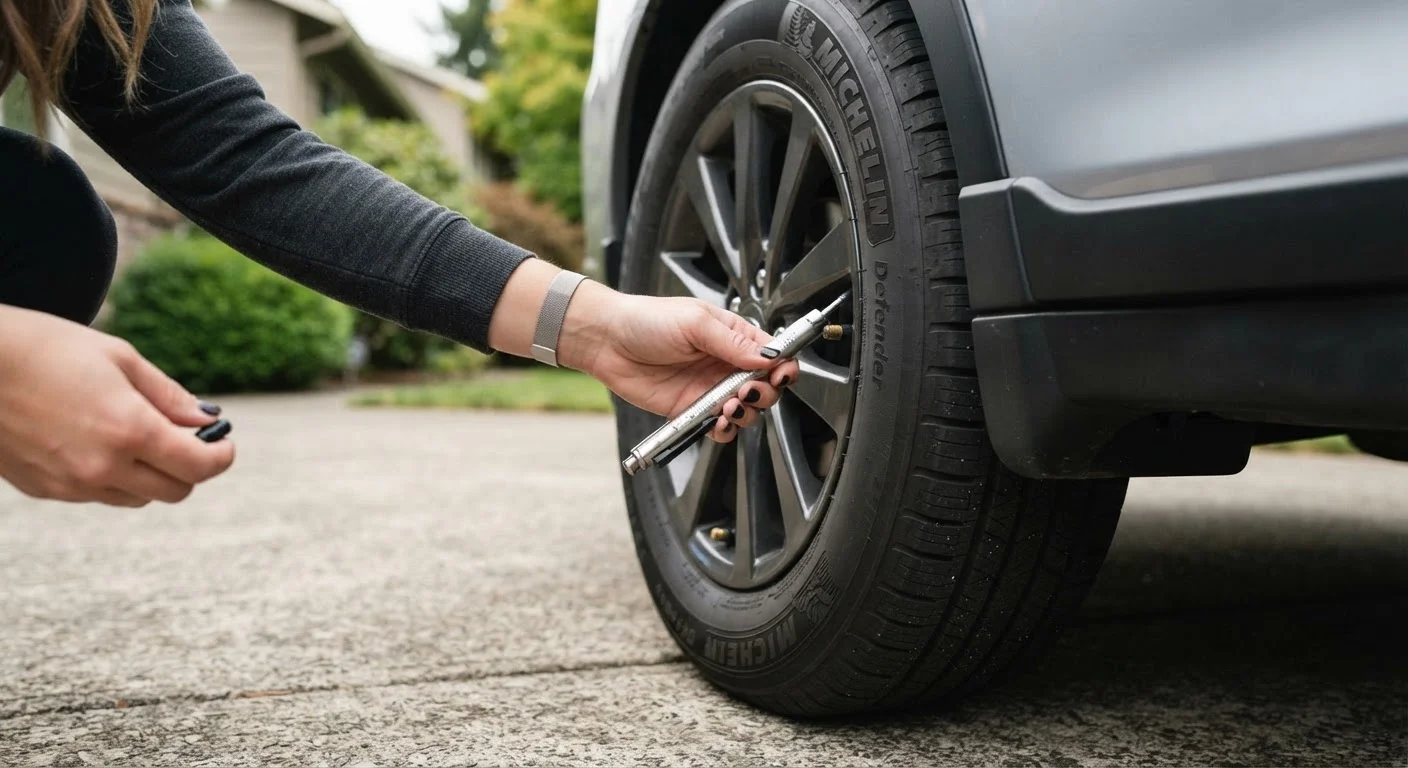
- Check tires cold. Driving heats the air inside tires, temporarily raising pressure. For an accurate baseline, measure before driving more than about one mile, or after the vehicle has sat for at least three hours.
- Know your target PSI. Look for the sticker inside the driver's door jamb - it lists the recommended front and rear tire pressures for your specific vehicle. Do not use the number on the tire sidewall as your target; that figure is the tire's maximum pressure limit, not your vehicle's recommended operating pressure.
- Use a reliable gauge. Dial and digital gauges both work well. Stick-type gauges can be less consistent. Check all four tires and the spare if accessible.
- Account for temperature. If ambient temperatures have recently dropped significantly, check pressure and adjust accordingly. A general rule of thumb is approximately 1 PSI change per 10°F shift in temperature.
- Add or release air as needed. Most gas stations have air pumps. After adjusting, recheck with the gauge - pumps vary in accuracy.
First-time car owners in particular often overlook this check when focused on larger concerns. Our guide for first-time car buyers covers this and other routine upkeep items that new owners frequently underestimate.
Tire Pressure Monitoring Systems: Helpful, But Not a Substitute
Since 2008, federal regulations have required all new passenger vehicles sold in the U.S. to include a Tire Pressure Monitoring System (TPMS). The dashboard warning light activates when one or more tires fall approximately 25% below the recommended pressure - a threshold that represents a meaningful safety concern.
The limitation is significant: by the time the TPMS light comes on, a tire may already be 7-10 PSI underinflated, meaning fuel economy and wear damage have been accumulating undetected. TPMS is a safety floor, not a substitute for monthly manual checks. Treat the warning light as an urgent prompt, not as confirmation that tires without a lit warning are correctly inflated.
Maintaining correct tire pressure is one of those small habits - like the diligence needed to avoid common brake wear mistakes - that compounds into meaningful savings and safety over the life of a vehicle. A two-minute check once a month costs nothing and protects one of your most critical investments.