

Key Takeaways
- Specs are usually self-reported by manufacturers and may reflect ideal conditions, not real-world performance.
- Third-party certifications carry more credibility than manufacturer claims because they involve independent testing.
- Marketing labels like 'premium,' 'professional grade,' and 'ultra' have no standard definition and mean whatever the seller wants.
- Model numbers can indicate product variations - sometimes minor, sometimes significant - worth researching before purchase.
- Price alone signals very little about actual quality; understanding what specs matter for your use case is more reliable.
Product Listing Anatomy
A product listing is the structured page or sheet that presents a product's specifications, certifications, pricing, and marketing claims. Understanding how each element works - what it means, who controls it, and how it can mislead - helps you evaluate what you're actually buying rather than what's being sold to you.
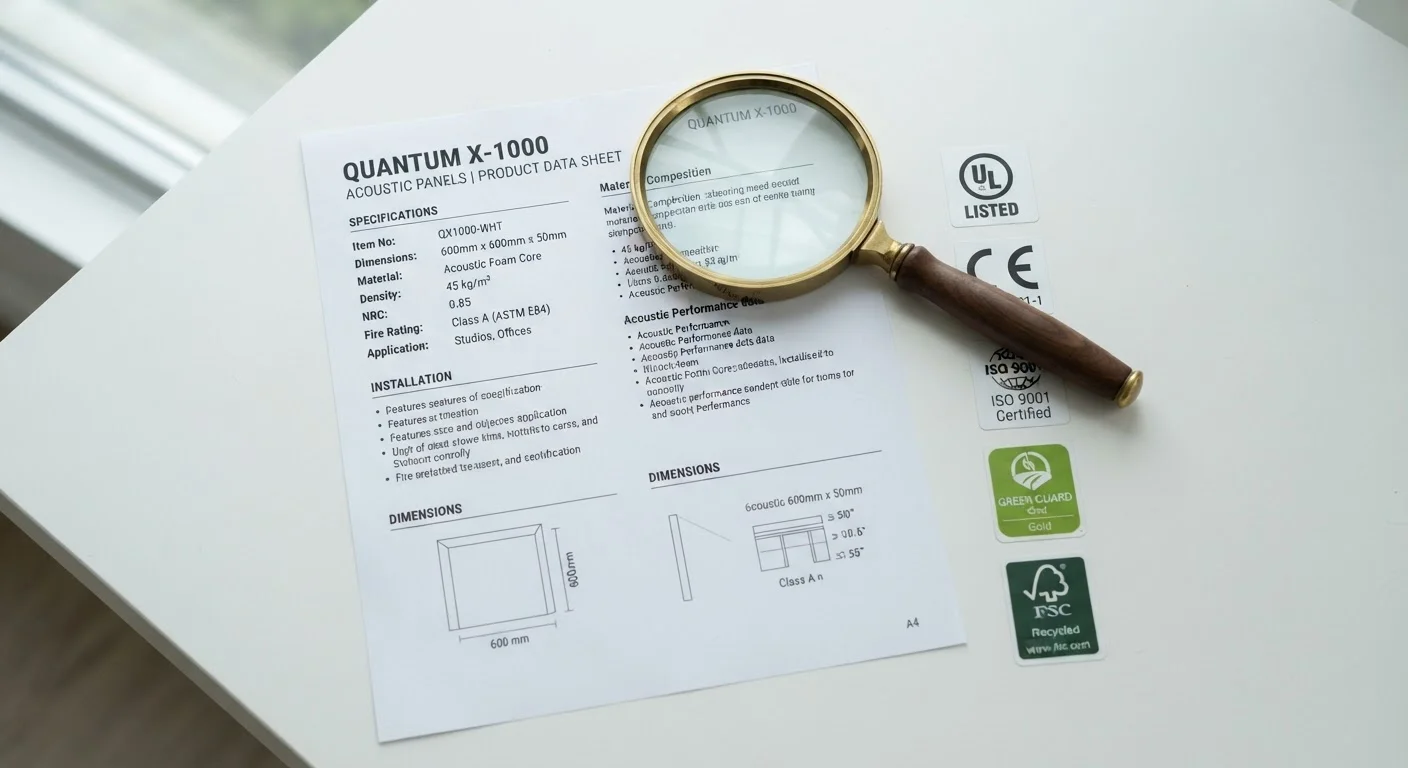
Specifications are typically self-reported by manufacturers; third-party certifications are independently verified and carry more evidential weight.
The Spec Sheet: Numbers That Need Context
Every product listing leads with specifications - storage capacity, wattage, thread count, megapixels - and the implicit message is that bigger equals better. That's often an oversimplification. Specs describe what a product can do under specific conditions, not necessarily what it will do in your home, on your job site, or in everyday use.
Take battery life as a common example. A manufacturer might list 20 hours of runtime measured at minimal brightness and low processing load in a controlled environment. Your actual use pattern will almost certainly yield something shorter. The same principle applies to wireless range, speaker output, and vacuum suction power. The numbers on the listing are real - the conditions that produced them just may not match yours.
Before treating any spec as a purchase signal, ask two questions: What conditions produced this number? and What value is considered adequate for my specific use? The second question matters because a spec that sounds impressive in isolation might be average or even underpowered for what you actually need - or far more than you'll ever use. For a deeper look at how manufacturers selectively present data, see how spec sheets can mislead.
~68%
Consumers who report post-purchase regret on tech items
A 2022 survey by NerdWallet found that roughly 68% of Americans have experienced buyer's remorse, with electronics among the most cited categories.
3rd party
Certification type that carries independent verification
Only certifications issued by organizations outside the manufacturer - such as UL, ENERGY STAR, or ASTM - involve testing by a party with no financial stake in the result.
Certifications: Who Actually Checked?
Certification marks are among the most useful signals on a product listing - but only when you know who issued them. There's a fundamental difference between a certification awarded by an independent testing organization and a badge a company put on its own packaging.
Established third-party certifiers - such as UL (Underwriters Laboratories) for electrical safety, ENERGY STAR for energy efficiency (administered by the EPA), or ASTM International for materials standards - test products against defined criteria before granting their marks. When you see these on a listing, someone outside the company has verified at least one specific claim.
By contrast, phrases like "laboratory tested," "quality certified," or "inspector approved" with no named certifying body are typically self-declarations. They may be technically accurate and well-intentioned, or they may be meaningless. Without knowing who ran the test and by what standard, you can't evaluate the claim. A plain-language reference to common certification marks can help you quickly identify which labels carry real accountability.
Self-Certification vs. Third-Party Certification
Some manufacturers conduct internal testing and label their products accordingly, which isn't inherently deceptive - internal quality controls can be rigorous. The key distinction is accountability: third-party certifiers publish their standards, and their marks can be revoked. Self-certifications have no such external check. When a purchasing decision depends on a safety or performance claim, prioritize marks from named, independent certifying bodies.
Marketing Labels: Decoration, Not Data
Product listings are also full of language that sounds meaningful but has no standardized definition. Words like "premium," "ultra," "professional grade," "military strength," and "industrial quality" are chosen by marketing teams, not regulated by any standards body. A product labeled "professional grade" is not required to meet any professional standard - the label simply suggests it.
This doesn't mean products using such language are necessarily poor quality. It means the label itself gives you no reliable information. The way to cut through this is to look for what's behind the label: specific, measurable specs that you can compare across products, or a third-party test result that validates a performance claim.
The same skepticism applies to comparative language. "Up to 3x faster" or "50% more powerful" requires you to ask: faster or more powerful than what, and measured how? A claim without a stated baseline is essentially unverifiable. When you're evaluating products side by side, a structured comparison approach helps you cut through surface-level language to differences that will actually affect your experience.
Model Numbers, Variants, and What Listings Often Omit
Model numbers are identification codes, not just inventory labels. Manufacturers use them to distinguish product variants - different colors, regional editions, feature tiers, or production runs. Two products listed under the same name with different model numbers may have different processors, different battery sizes, or different included accessories.
This matters because listings on retail sites sometimes aggregate reviews across model variants, which can make a product look better or worse than your specific version. Always note the exact model number you're evaluating and search for reviews or discussions specific to that number.
Listings also routinely omit things worth knowing: what the warranty actually covers, whether a key component (like a battery or filter) needs periodic replacement and what that costs, or whether the product requires proprietary accessories. If a listing seems unusually silent on a detail that should matter - compatibility, consumables, software requirements - that silence is worth investigating before purchase. For unfamiliar product categories, a structured research approach helps you identify which questions to ask before committing to a purchase.