

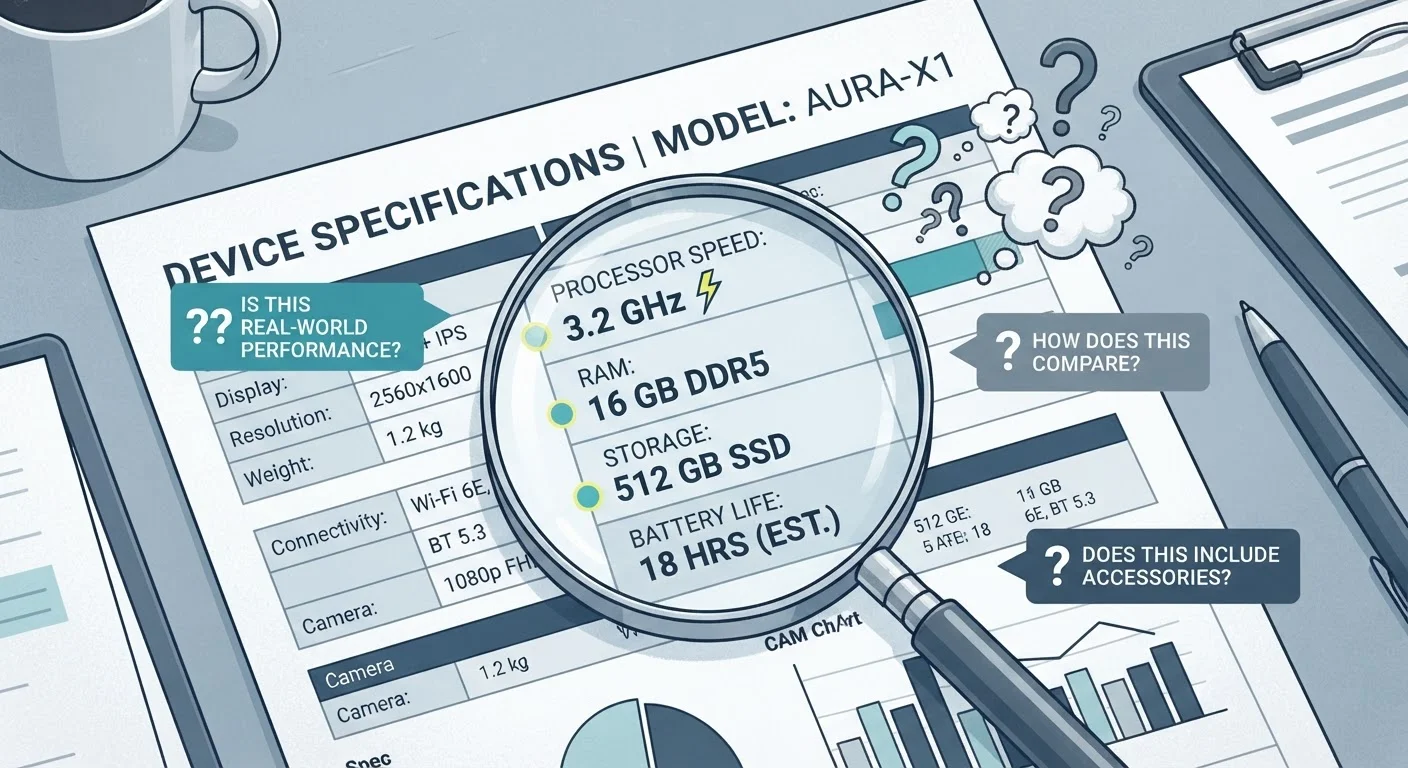
Key Takeaways
- Peak or maximum specs rarely reflect real-world performance under typical conditions.
- Manufacturers routinely omit compatibility limitations, accessory requirements, and degradation timelines.
- Megapixels, megahertz, and megabits are frequently inflated or measured under ideal lab conditions.
- The most important specs are often buried or absent entirely from product listings.
- Cross-referencing independent reviews and third-party tests is the most reliable way to validate claims.
Why Spec Sheets Are Designed to Impress, Not Inform
A product spec sheet isn't a technical document written for engineers - it's a marketing document written to close a sale. That distinction matters enormously when you're trying to make an honest comparison between two products. Manufacturers select, frame, and emphasize the numbers that make their product look best, while quietly sidelining the metrics that would complicate the story.
Understanding this dynamic doesn't require a technical background. It just requires knowing where the sleight of hand typically happens. Whether you're evaluating a laptop, a refrigerator, a TV, or a car, the same basic distortions show up again and again. For a broader look at what product listings are really communicating, see what those numbers and labels actually mean.
Myth
A higher megapixel count means a better camera.
Fact
Megapixels measure quantity of pixels, not image quality. Sensor size, lens quality, and image processing software matter far more.
Camera marketing has conditioned consumers to treat megapixels as the primary quality indicator for over two decades. In practice, a 12-megapixel camera with a large sensor and quality optics will consistently outperform a 108-megapixel sensor crammed into a physically small housing. What spec sheets rarely list: sensor size in square millimeters, aperture range, low-light performance (often expressed as ISO range, though that too can be gamed), or optical stabilization effectiveness. Pixel count tells you the maximum print size at a given resolution - it says almost nothing about how a photo will look.
Myth
The advertised battery life is what you'll get day-to-day.
Fact
Advertised battery life figures are measured under controlled, light-use conditions that rarely match typical usage patterns.
Manufacturers test battery life with screen brightness set low, wireless radios off or minimized, and workloads that don't reflect streaming, multitasking, or intensive applications. A laptop rated at "up to 18 hours" may deliver 7-9 hours under realistic workloads. Similarly, electric vehicle range estimates are generated under standardized test cycles that often don't account for highway speeds, cold weather, or heavy cabin climate use - all of which can reduce real-world range significantly. When evaluating battery claims, look for independent reviews that test under actual use conditions, not manufacturer benchmarks.
Myth
More RAM or processing cores always means faster performance.
Fact
Raw specs like RAM and core count are only meaningful in context of software optimization, thermal management, and the specific tasks you run.
A device with 16GB of RAM running a poorly optimized operating system may feel slower than one with 8GB that's been tightly tuned. Similarly, an 8-core processor that throttles heavily under sustained load due to inadequate cooling can underperform a 4-core chip that maintains its rated speed consistently. Spec sheets list the maximum clock speed and core count, but they don't disclose thermal limits, sustained performance benchmarks, or how the chip behaves after 10 minutes of continuous load - information that's only available through independent stress testing.
Myth
A TV's resolution spec tells you most of what you need to know about picture quality.
Fact
Resolution is one of the least differentiating specs in modern TVs; panel type, local dimming zones, peak brightness, and color volume matter considerably more.
Most current mid-range and higher TVs are 4K, making resolution a threshold rather than a differentiator. What actually separates a flat, washed-out picture from a vivid, accurate one includes peak brightness (measured in nits), contrast ratio, the number of local dimming zones, color gamut coverage, and response time. These figures are frequently absent from manufacturer spec sheets or buried in technical documentation. Panel type - OLED, QLED, IPS, VA - has a major impact on viewing angle and contrast performance and is sometimes omitted or obscured by proprietary marketing names that don't map cleanly to underlying technology.
Myth
"Up to" speed or capacity claims represent typical performance.
Fact
"Up to" is a ceiling, not an average - it describes the best-case scenario under ideal, often unreplicable conditions.
This phrasing appears across product categories: internet routers advertising "up to 3 Gbps," vacuums claiming "up to 25,000 Pa suction," storage drives rated at "up to 7,000 MB/s read speeds." In every case, the figure represents a maximum achieved under conditions that may never occur in a real home or office - a single device connected, no interference, specific test files, and so on. The practical average is almost always meaningfully lower. When you see "up to," mentally substitute "no more than" and adjust your expectations accordingly.
The Specs That Are Always Missing
Beyond inflated numbers, there's a more insidious problem: the specs that simply don't appear. Manufacturers are under no obligation to publish figures that make their product look unfavorable, and most don't. Common omissions include battery degradation curves (how much capacity you lose after 500 charge cycles), noise levels under load, real-world energy draw versus rated wattage, and software support timelines.
For devices and electronics, the gap between advertised wireless speeds and what a device actually delivers in a mixed-use household is a persistent pain point. The home internet myths that lead people to overpay or underperform article covers related distortions in network marketing. For connected devices specifically, check the Devices & Gadgets hub for practical guidance on evaluating real-world performance claims.
~30%
Typical real-world battery life shortfall vs. rated
Consumer electronics reviewers consistently find that real-world battery performance falls 25-40% short of manufacturer ratings under typical mixed-use conditions.
~20%
EPA fuel economy vs. real-world driving gap
Studies of actual vehicle fuel economy data have historically shown drivers achieve around 15-25% less than the published EPA estimate under mixed real-world driving conditions.
Compatibility is another chronic blind spot. A spec sheet may list every input and output port without disclosing that using two simultaneously requires an adapter sold separately, or that a specific feature is only available on the higher-cost configuration. Before purchasing, it's worth reviewing the hidden costs shoppers routinely overlook - accessories and compatibility gaps are among the most common sources of post-purchase regret.
Watch for Specs Measured at Unrealistic Conditions
Some manufacturers measure peak performance at temperatures, voltages, or usage scenarios that are physically impossible to maintain during normal operation. If a spec sheet doesn't specify the test conditions used to generate a figure, that's a red flag worth investigating before purchase. Look for independent benchmark data that documents methodology - not just the resulting number.
For vehicles, fuel economy figures published by manufacturers are typically derived from controlled test cycles that don't reflect city driving, climate variation, or cargo load. The Buying a Car hub is a useful resource for understanding how to evaluate automotive claims more critically. And when certifications appear on a product listing, treat them as a starting point rather than a guarantee - what common product certifications actually mean is worth a read before assuming a badge equals a promise.