

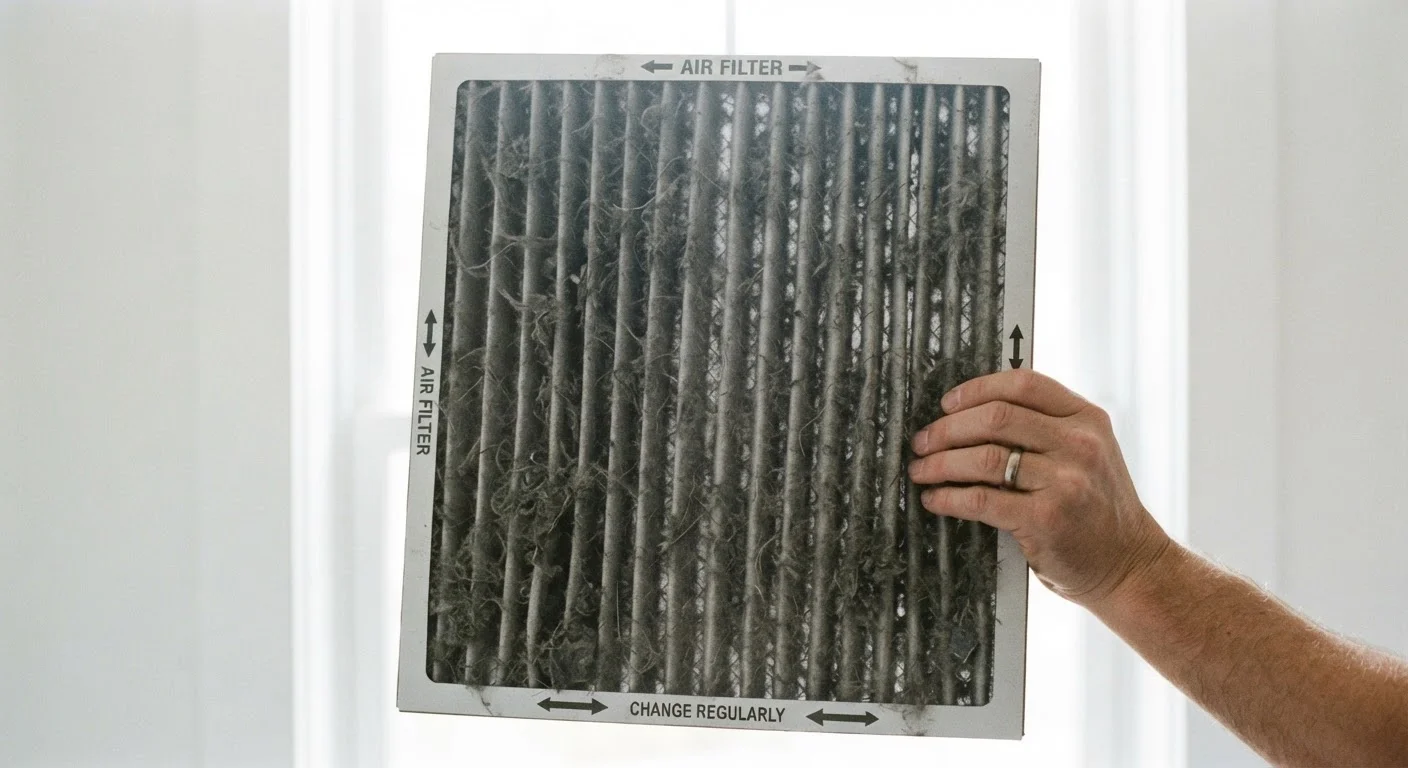
Key Takeaways
- A clogged filter forces your HVAC system to work harder, raising energy bills and accelerating wear.
- Most filters should be replaced every 1-3 months depending on filter type and household conditions.
- Neglected filters can cause frozen evaporator coils, overheated motors, and costly system failures.
- Indoor air quality deteriorates significantly when filters can no longer trap dust, allergens, and pollutants.
- Setting a simple calendar reminder is the most effective way to stay on a consistent replacement schedule.
Why Filter Maintenance Gets Skipped More Often Than You'd Think
The HVAC filter is easy to forget precisely because it works quietly behind a panel, in a closet, or tucked behind a ceiling vent. Unlike a dripping faucet or a flickering light, a clogged filter sends no obvious distress signal - at least not right away. By the time problems become noticeable, the system has often already been running under strain for weeks or months.
Homeowners also commonly underestimate how fast filters load up with particulates. A household with pets, heavy foot traffic, or anyone with allergies can clog a standard filter in as little as 30 days. Most manufacturers recommend replacement every one to three months, but that guidance rarely gets revisited after the initial installation. The result is a simple maintenance task that quietly falls through the cracks - with consequences that are anything but small.
If you've ever wondered what else gets overlooked around the house, our guide to commonly skipped home maintenance checks covers several other areas that deserve the same attention.
What Actually Happens to Your HVAC System When a Filter Clogs
When airflow is restricted by a saturated filter, the entire HVAC system compensates - and not in ways that are sustainable. The blower motor works harder and longer to move the same volume of air, which increases electricity consumption and generates more heat within the motor itself. Over time, this sustained strain shortens the motor's lifespan considerably.
In cooling mode, restricted airflow across the evaporator coil prevents it from absorbing heat efficiently. The coil temperature drops below the dew point and moisture freezes on its surface, forming ice. A frozen coil can't do its job, so the system runs continuously without cooling the space - and defrosting a coil means downtime and sometimes professional service. In heating mode, a clogged filter can cause the heat exchanger to overheat and trigger a safety shutoff, or worse, crack over repeated thermal cycling.
5-15%
Potential energy savings from timely filter replacement
The U.S. Department of Energy estimates that replacing a clogged air filter can reduce an air conditioner's energy use by roughly 5-15%.
#1
Leading cause of preventable HVAC service calls
HVAC industry technicians consistently cite dirty or clogged filters as among the most frequent causes of avoidable system breakdowns and service visits.
These aren't rare edge cases. HVAC technicians consistently cite dirty filters among the top causes of preventable service calls. As the U.S. Department of Energy notes, replacing a clogged filter can reduce an air conditioner's energy consumption noticeably - making the modest cost of a new filter one of the most straightforward efficiency improvements available. For more on how home systems interact with energy use, see our overview of energy efficiency upgrades that genuinely improve home performance.
Common Mistakes Homeowners Make With HVAC Filters
Waiting until the system underperforms before replacing the filter.
Why it happens: Homeowners associate filter changes with visible problems rather than treating them as routine preventive care.
Choosing the highest-MERV filter available without checking system compatibility.
Why it happens: Higher MERV ratings sound better for air quality, so buyers assume maximum filtration equals maximum benefit.
Installing the filter in the wrong direction.
Why it happens: The airflow arrow printed on the filter frame is easy to miss, especially in tight or dimly lit spaces.
Assuming a filter looks clean enough to keep using.
Why it happens: Visual inspection only reveals surface dirt; the inner layers can be fully saturated with fine particles while the face still looks passable.
Forgetting secondary or return-air vents with separate filters.
Why it happens: Many homeowners only know about the primary filter location and are unaware additional vents exist elsewhere in the home.
A Clogged Filter Can Void Your Warranty
Many HVAC manufacturers require documented evidence of regular maintenance - including filter changes - as a condition of honoring equipment warranties. If a system failure is traced back to a severely clogged filter, a claim may be denied entirely. Check your unit's warranty documentation and keep a simple log of filter replacement dates to protect your coverage.
Building a Filter Habit That Actually Sticks
The good news is that filter maintenance requires almost no skill - just consistency. The most effective approach is to remove the guesswork entirely. Write the change date on the filter's cardboard frame with a marker when you install it, and set a recurring phone or calendar reminder for the appropriate interval. Some homeowners buy filters in multipacks and store them near the air handler so the task requires minimal effort when the reminder arrives.
It's also worth knowing where all your return-air vents are located. Many homes have more than one, and each vent may have its own filter that needs attention. A quick walk-through when you move into a home - or during seasonal maintenance - ensures nothing is overlooked. Your home's hidden vulnerabilities are worth examining systematically; our article on what home inspectors check that owners often miss is a useful starting point for that kind of audit.
Finally, treat your HVAC filter check as part of a broader maintenance rhythm rather than an isolated task. Deferred maintenance compounds into expensive repairs across all mechanical systems - your home's heating and cooling equipment is no exception.
Never Run Your System Without a Filter in Place
Removing a clogged filter and running the system without a replacement - even briefly - allows dust, debris, and biological particles to coat the evaporator coil, blower wheel, and internal components directly. This contamination is difficult and expensive to clean professionally, and can degrade indoor air quality significantly. Always have a replacement filter on hand before removing the old one.