

Key Takeaways
- Drip irrigation delivers water directly to root zones, reducing evaporation and weed growth.
- Sprinkler systems cover large areas quickly, making them well-suited for lawns and open turf.
- Drip systems typically use significantly less water than overhead sprinklers for the same plantings.
- Installation complexity and upfront cost differ substantially between the two approaches.
- Your plant types, yard layout, and local water restrictions should guide your choice.
Our Verdict
Neither drip irrigation nor sprinkler systems are universally superior - each excels in specific settings. Drip irrigation is the stronger choice for garden beds, vegetable rows, and water-conscious landscapes, while sprinklers remain the practical standard for maintaining healthy lawns and covering wide open areas.
| Best for | Recommended |
|---|---|
| Vegetable gardens, flower beds, and shrub borders | Drip Irrigation |
| Established lawns and large open turf areas | Sprinkler Systems |
| Water-restricted regions or drought-prone climates | Drip Irrigation |
| Homeowners wanting simple, wide-coverage setup | Sprinkler Systems |
How Each System Works
Understanding the mechanics of each system helps clarify where they shine - and where they fall short.
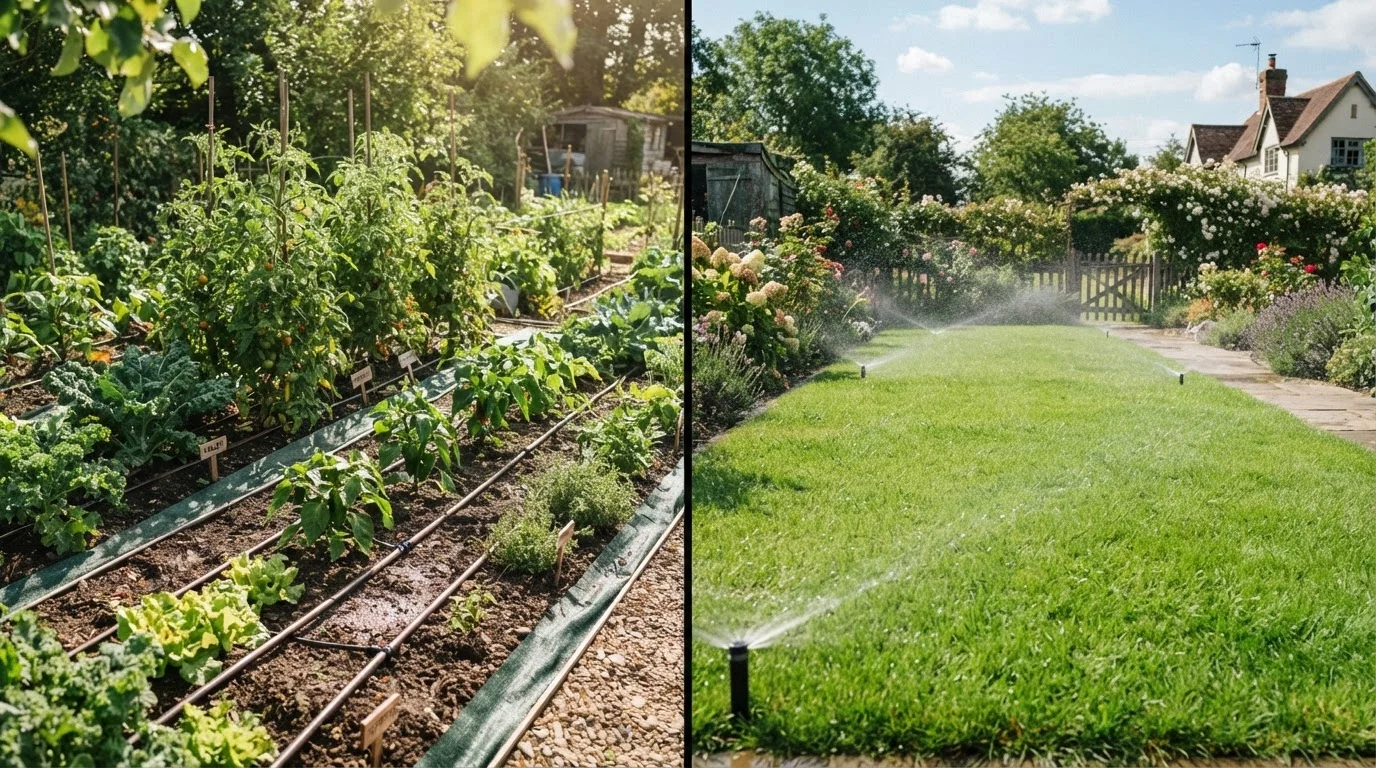
Drip irrigation runs low-pressure tubing along the soil surface or just beneath it, delivering water slowly and directly to each plant's root zone through emitters (small drip nozzles). Water seeps into the ground rather than being broadcast through the air, so very little is lost to evaporation or wind.
Sprinkler systems use pressurized water delivered through above-ground or pop-up heads that spray in arcs or rotating patterns. They're designed to cover large, uniform areas - lawns especially - quickly and with minimal hands-on effort once installed.
Both systems can be timer-controlled and zoned, but their delivery methods lead to meaningfully different performance across several key criteria.
Water Efficiency and Coverage
Water efficiency is often the deciding factor for homeowners in drier climates or areas with usage restrictions.
~90%
Efficiency rate for drip irrigation
The U.S. Environmental Protection Agency notes drip systems can be 90% efficient or more, compared to roughly 50-70% for conventional sprinkler systems.
50%
Potential water savings vs. overhead watering
According to general horticultural guidance, drip irrigation can reduce outdoor water use by up to 50% compared to traditional sprinkler watering for comparable plantings.
Drip systems apply water precisely where it's needed, at slow rates the soil can absorb. This dramatically reduces runoff and evaporation - two of the most common sources of water waste in residential landscapes. Because water never touches foliage, drip irrigation also reduces the risk of fungal diseases on leaves and stems.
Sprinklers, by contrast, distribute water broadly across the surface - which is exactly what turf grass needs, since lawns require relatively even moisture across a wide area. However, overhead spray is more susceptible to wind drift and midday evaporation. Watering during early morning hours reduces - but doesn't eliminate - this loss. For guidance on common mistakes, see our article on watering myths that harm gardens.
Installation and Setup Effort
Both systems are within reach of a motivated DIYer, but they require different levels of planning and labor.
| Drip Irrigation | Sprinkler Systems | |
|---|---|---|
| Water Efficiency | High - minimal evaporation and runoff | Moderate - overhead spray loses more water |
| Best Plant Types | Vegetables, shrubs, trees, flower beds | Lawns and large open turf areas |
| Installation Complexity | Moderate - surface tubing, no trenching | Higher - may require trenching and permits |
| Upfront Cost | Lower for comparable coverage | Higher for in-ground systems |
| Maintenance Needs | Emitter cleaning, UV checks, winterization | Head adjustments, freeze protection, repairs |
| Foliage Wetting | None - water goes to soil only | Yes - may increase disease risk on some plants |
| Automation Potential | Yes - with timers and controllers | Yes - with timers and smart controllers |
Drip systems involve laying out flexible tubing, punching in emitters at each plant location, and connecting to a water source with a pressure regulator and filter. The initial layout takes patience, particularly in complex garden beds, but no trenching is required. Components are modular and relatively easy to adjust as your garden changes.
Sprinkler systems - especially in-ground types with pop-up heads - typically require trenching to bury supply lines, connecting to your home's main water supply, and sometimes working with a local permit depending on your municipality. Above-ground oscillating or hose-end sprinklers sidestep this complexity but offer far less precision and automation.
If you're also evaluating your overall yard layout, our comparison of raised beds vs. in-ground planting explores how bed type affects watering needs.
Plant Compatibility and Best Use Cases
Plant type and garden structure are the clearest guides to which system fits your situation.
- Vegetable gardens and annual beds: Drip irrigation is widely considered the preferred method. Consistent, direct moisture supports steady growth while keeping foliage dry.
- Trees and shrubs: Drip works well with soaker loops or multi-emitter setups placed at the drip line (the outer edge of the canopy).
- Lawns and turf grass: Sprinkler systems are the practical choice. Grass needs uniform surface coverage that drip lines cannot efficiently deliver.
- Mixed landscapes: Many homeowners run both systems in separate zones - drip for beds and borders, sprinklers for open lawn areas.
Pairing your irrigation strategy with the right plants can also reduce watering demands. Native plants often thrive with minimal supplemental irrigation once established, regardless of which system you use.
Run Either System in the Early Morning
Regardless of which system you choose, scheduling irrigation in the early morning - typically between 5 and 9 a.m. - gives plants time to absorb moisture before midday heat increases evaporation. It also allows foliage to dry before nightfall, reducing fungal disease risk. Avoid watering during the hottest part of the day or late in the evening.
Long-Term Maintenance and Cost
Neither system is truly set-and-forget. Each requires seasonal attention to stay effective.
Drip emitters can clog, particularly in areas with hard water or heavy mineral content. Flushing lines seasonally and using a quality inline filter helps significantly. UV exposure can degrade surface tubing over time, so periodic inspection is worthwhile. Winterization in freeze-prone climates means draining and storing exposed tubing.
Sprinkler systems require head adjustments (to avoid watering driveways or structures), periodic checking for broken heads, and - for in-ground systems - professional or thorough DIY winterization before the first hard freeze to prevent pipe damage.
Upfront costs for in-ground sprinkler systems are generally higher than drip setups of comparable size, but both represent meaningful investments. Drip systems can reduce ongoing water bills, which over years may offset the initial cost difference. Complementary strategies like applying mulch around beds help retain soil moisture and reduce how often either system needs to run.