

Key Takeaways
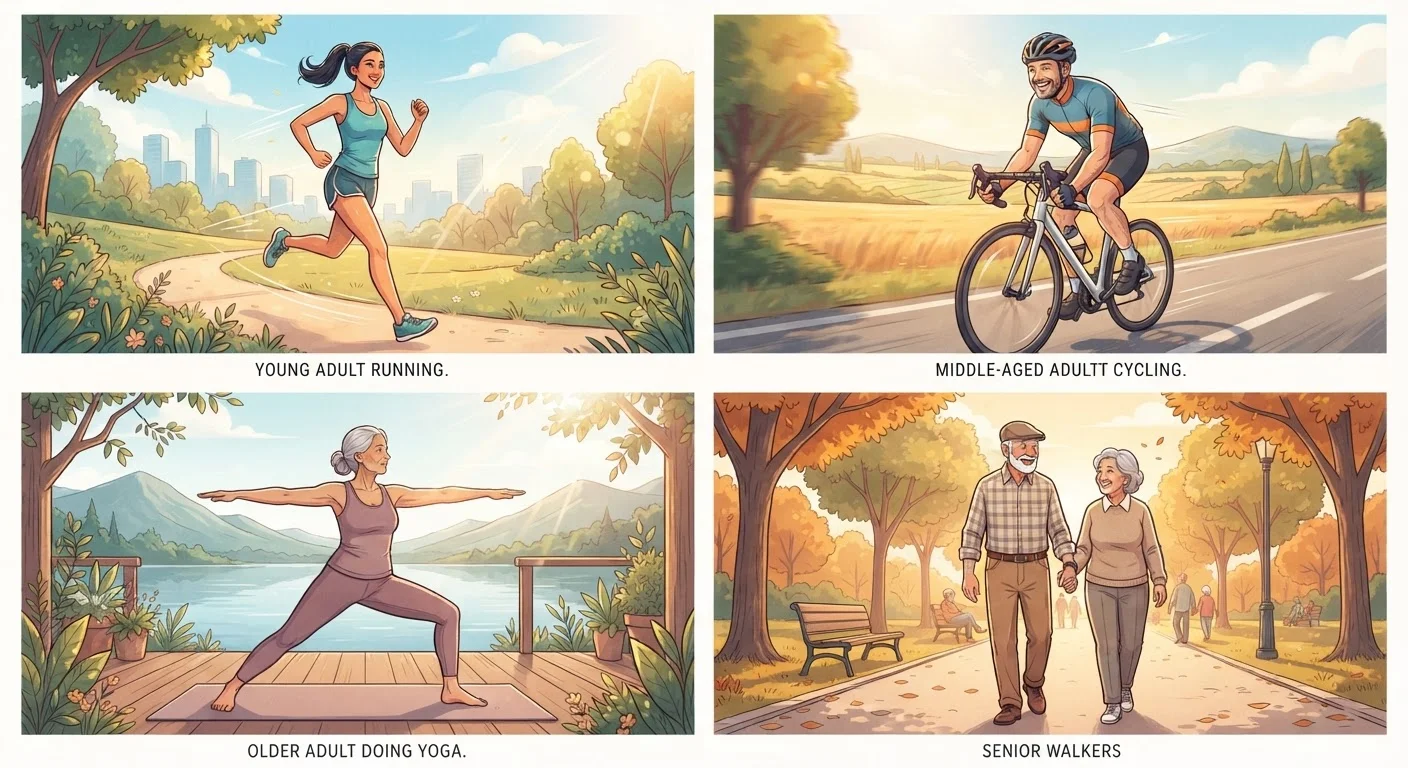
- Exercise needs shift across decades due to natural changes in muscle mass, hormones, and recovery capacity.
- In younger decades, building aerobic fitness and strength lays a foundation for lifelong health.
- From the 40s onward, recovery, mobility, and injury prevention increasingly deserve dedicated attention.
- Balance and functional strength become critical priorities in the 60s and beyond.
- Consistency over intensity is the most durable fitness principle at any age.
- Always consult a healthcare professional before making major changes to your activity level.
Why Exercise Needs Change With Age
Physical activity is one of the most well-supported contributors to long-term health - but what it looks like, and what it should prioritize, genuinely shifts as the body changes. These shifts are not signs of decline to resist; they are biological realities to plan around.
Beginning around the late 30s, adults naturally lose muscle mass at a rate of roughly 3-8% per decade, a process called sarcopenia. Bone density tends to peak in the late 20s and gradually decreases thereafter. Hormonal changes - including shifts in estrogen, testosterone, and growth hormone - affect recovery speed, fat distribution, and cardiovascular efficiency. Connective tissues such as tendons and cartilage become somewhat less elastic with time.
None of this makes vigorous activity impossible at older ages. It does mean the emphasis of a smart exercise program should evolve. Understanding that evolution helps people stay active sustainably, rather than pushing through inappropriate workouts or abandoning exercise because it no longer feels the way it once did.
3-8%
Muscle mass lost per decade after the late 30s
According to research on sarcopenia cited by the National Institutes of Health, this rate accelerates further after age 60.
150 min/week
Recommended moderate aerobic activity for adults
The U.S. Department of Health and Human Services Physical Activity Guidelines for Americans recommend this as a minimum target for adults of all ages.
~30%
Reduction in fall risk with balance training
Multiple systematic reviews, including those published in the Cochrane Database, suggest exercise programs can reduce fall rates in older adults by approximately this proportion.
Your 20s and 30s: Building the Foundation
For most people, the 20s and early 30s represent a physiological peak: high aerobic capacity, rapid muscle protein synthesis, and relatively fast recovery. This window is valuable for establishing habits and building a fitness base that pays dividends for decades.
General public health guidance - including recommendations from the U.S. Department of Health and Human Services - suggests adults aim for at least 150 minutes of moderate-intensity aerobic activity per week, along with muscle-strengthening activities on two or more days. In the 20s and 30s, many people can also safely pursue higher-intensity training, competitive sport, or endurance goals.
The most consequential habit to form in this decade isn't any specific workout - it's consistency. Research consistently shows that people who maintain physical activity across multiple decades experience substantially better health outcomes than those who are active in bursts. Think of the 20s and 30s less as a time to maximize performance and more as a time to make movement a durable part of life.
In your 20s and 30s, prioritize learning proper movement patterns - squats, hinges, pushes, and pulls - over chasing maximum weight or speed. Good form built early protects joints for decades.
Injury patterns in midlife often trace back to load or technique errors established in younger years, making early skill-building a high-return investment.
If you are in your 40s or 50s and notice that your usual routine leaves you more fatigued than it used to, adding a dedicated recovery day - rather than pushing through - is typically the more effective long-term strategy.
Recovery capacity declines gradually with age; respecting this physiological reality reduces overuse injuries and helps sustain training quality over time.
Your 40s and 50s: Shifting Priorities
The 40s and 50s often bring the first noticeable signals that recovery takes longer, that joints complain more after hard sessions, and that maintaining weight requires more deliberate effort. These changes reflect real physiology: declining sex hormones (including the perimenopause and menopause transition for many women), a gradual slowdown in metabolic rate, and accumulating wear on joints and connective tissue.
The productive response is not to stop training intensely but to train smarter. A few evidence-informed shifts worth considering in this decade:
- Resistance training becomes non-negotiable. Preserving muscle mass is increasingly important for metabolic health, bone density, and functional independence later in life.
- Dedicated mobility work pays off. Stretching, mobility, and flexibility are distinct but complementary practices that help preserve range of motion and reduce injury risk.
- Recovery deserves scheduling, not just hoping for it. Sleep quality and adequate rest between hard sessions matter more as the body's repair systems slow down.
Cardiovascular fitness remains important: aerobic exercise supports heart health, mood, and cognitive function. See our overview of how physical activity relates to mood for a closer look at the mental health dimension.
Your 60s and Beyond: Strength, Balance, and Longevity
Once people reach their 60s and beyond, the fitness goals that matter most for quality of life come into sharper focus: maintaining functional strength, preserving balance, and supporting independence. Falls are among the most serious health risks for older adults in the U.S., and evidence from multiple systematic reviews suggests that resistance and balance training can meaningfully reduce fall risk.
Key priorities in this life stage include:
- Balance training: Activities such as tai chi, yoga, and specific single-leg exercises have demonstrated benefits for fall prevention in older adults.
- Resistance training: Continued strength work counters sarcopenia and supports bone density. Exercises do not need to be heavy - bodyweight, resistance bands, and light free weights can all be effective.
- Low-impact aerobic activity: Walking, swimming, and cycling allow cardiovascular conditioning with reduced joint stress. If daily movement feels like a challenge, practical strategies for building movement into an ordinary day can lower the barrier.
Home environments can also play a supporting role in active aging. Thoughtful aging-in-place home modifications reduce fall hazards and make it easier to stay mobile within familiar surroundings.
Individuals with existing health conditions, limited mobility, or significant deconditioning should consult a physician or physical therapist before starting or substantially changing an exercise program.
What Stays the Same at Every Age
Amid all the decade-by-decade variation, several principles of physical activity hold across the entire lifespan:
- Consistency outperforms intensity
- Moderate activity practiced regularly produces greater long-term health benefits than sporadic high-intensity efforts followed by long gaps. This is true at 28 and at 78.
- Social and environmental context matters
- Whether someone prefers group fitness classes or solo workouts, or outdoor versus indoor exercise, the best setting is the one a person will actually use.
- Returning after a break is always possible
- Life disrupts routines. Returning to exercise after a long break requires recalibration - but it is always worthwhile.
Practical Tips for Staying Consistent Across Life Stages
Sustainable movement habits tend to share a few characteristics regardless of age or fitness level:
- Anchor activity to existing routines - a walk after dinner, stretching before a morning shower - rather than relying on motivation alone.
- Track what feels good, not just what burns the most calories. Enjoyment is one of the strongest predictors of long-term adherence.
- Adjust expectations after setbacks. Illness, injury, and life stress will interrupt any routine. The goal is to resume, not to compensate.
- Partner with a healthcare provider. A physician or physical therapist can help tailor activity recommendations to individual health history, especially as complexity increases with age.
This article is for general informational purposes only and does not constitute medical advice. Always speak with a qualified healthcare professional before starting, stopping, or significantly changing any exercise program, particularly if you have existing health conditions or have been sedentary for an extended period.