

Key Takeaways
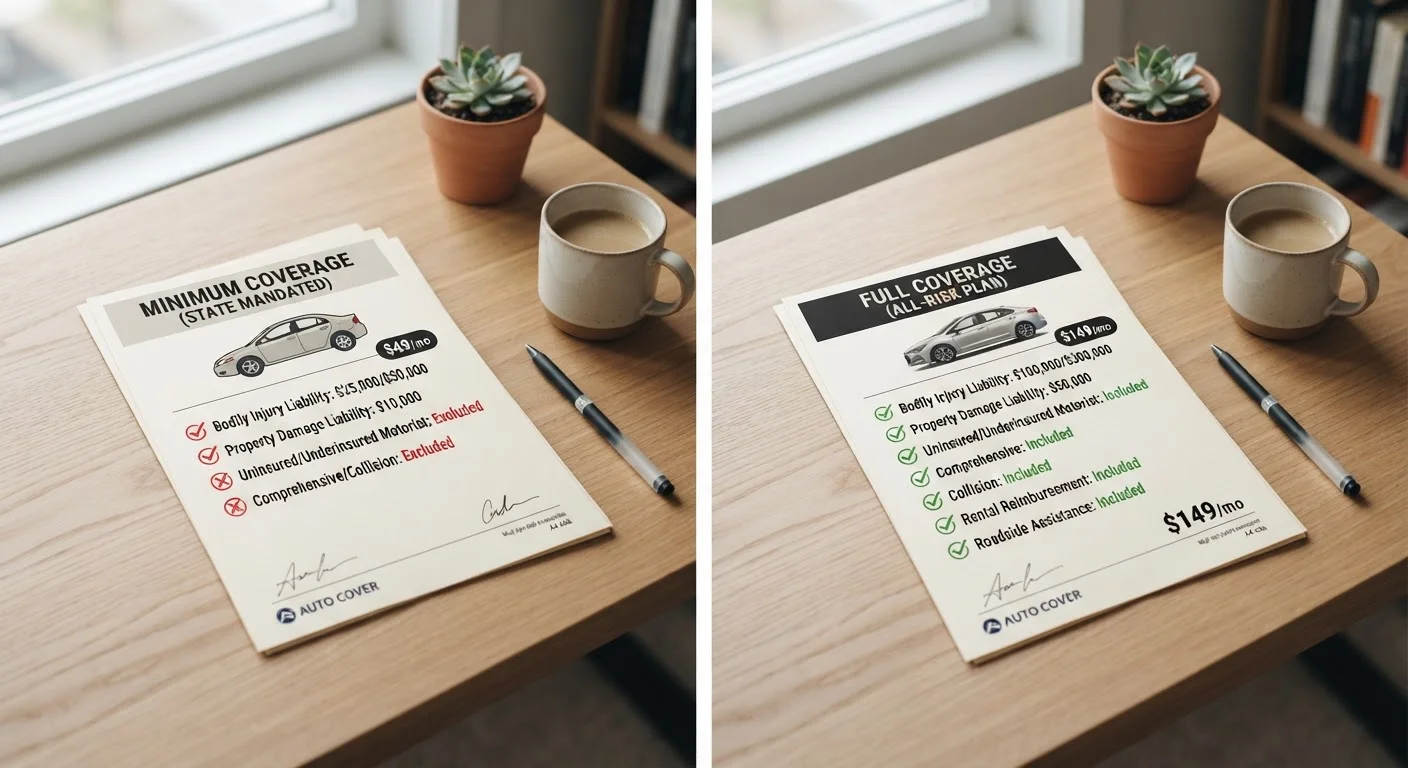
- "Full coverage" is not an official insurance term - it typically means liability plus collision and comprehensive.
- Minimum coverage only pays for damage you cause to others; it never covers your own vehicle.
- State minimum requirements vary significantly; some states require personal injury protection or uninsured motorist coverage.
- Lenders and lessors almost always require full coverage for financed or leased vehicles.
- The right level of coverage depends on your vehicle's value, your financial situation, and your risk tolerance.
Option A
Full Coverage
The broader, more protective package most lenders require.
Best for: Drivers with newer, financed, or higher-value vehicles who want protection beyond liability alone.
Option B
Minimum Coverage
The legally required baseline - nothing more.
Best for: Drivers with older, fully owned vehicles who want to limit monthly premium costs.
If you're financing or leasing your vehicle
Full Coverage
Lenders contractually require collision and comprehensive coverage to protect their financial interest in the vehicle.
If you drive an older car worth less than a few thousand dollars
Minimum Coverage
When repair or replacement costs approach the vehicle's market value, the added premium for collision and comprehensive may not be financially justified.
If you couldn't afford to replace your car out of pocket after a total loss
Full Coverage
Comprehensive and collision coverage pay for your vehicle's repair or replacement - without them, that cost falls entirely on you.
If you want to minimize monthly expenses and accept the risk on an owned vehicle
Minimum Coverage
For drivers who own their car outright and have savings to absorb a loss, minimum coverage keeps costs low while meeting legal requirements.
What "Full Coverage" Actually Means
Despite how often the phrase appears in conversations and advertisements, "full coverage" has no official definition in the insurance industry. It is not a standardized policy type - it is informal shorthand that typically refers to a combination of three coverage types: liability, collision, and comprehensive.
Liability coverage pays for injuries and property damage you cause to others in an accident. Collision coverage pays to repair or replace your own vehicle after a collision, regardless of fault. Comprehensive coverage handles vehicle damage from non-collision events - theft, fire, flooding, hail, or animal strikes, for example. Together, these three form what most people mean when they say "full coverage." For a detailed breakdown of each, see the core coverage types explained.
Some drivers and insurers also fold in additional protections under this umbrella - such as uninsured motorist coverage or personal injury protection - but those are not universally included. Common misconceptions about what car insurance covers often stem from assuming "full coverage" means truly comprehensive protection against every possible loss.
| Criterion | Full Coverage | Minimum Coverage |
|---|---|---|
| Covers damage to others | Yes (liability included) | Yes (liability only) |
| Covers your own vehicle | Yes (collision + comprehensive) | No |
| Required by law | No (but lenders require it) | Yes, state minimums required |
| Required for financed cars | Yes | No (insufficient for lenders) |
| Covers theft or weather damage | Yes (comprehensive) | No |
| Monthly premium cost | Higher | Lower |
| Financial risk to driver | Lower | Higher |
What Minimum Coverage Actually Requires
Every U.S. state except New Hampshire requires drivers to carry a minimum level of liability insurance. These minimums are set by state law and generally include bodily injury liability (covering medical expenses for people you injure) and property damage liability (covering repairs to vehicles or structures you damage).
Some states go further. States like Florida and Michigan require personal injury protection (PIP), which covers medical expenses for you and your passengers regardless of fault. Others mandate uninsured motorist coverage. To understand why that protection matters, learn how UM and UIM coverage work.
~13%
U.S. drivers estimated to be uninsured
The Insurance Research Council has estimated roughly one in eight drivers on American roads carries no insurance at all.
50+
Different state minimum requirements across the U.S.
Each state sets its own liability minimums; limits can vary by two to three times between the most and least demanding states.
The critical point: minimum coverage pays for damage you cause to others - it never pays for your own vehicle. If you carry only the legal minimum and your car is totaled, you absorb that cost entirely yourself.
The Real Trade-Offs to Weigh
Choosing between these two levels isn't simply about cost - it's about matching your coverage to your actual financial exposure. A few factors to consider:
- Vehicle value: A general industry guideline suggests that if a vehicle's market value is close to the annual cost of adding collision and comprehensive (typically after applying a deductible), those coverages may offer limited financial return. Use a vehicle valuation resource to check your car's current worth.
- Loan or lease obligations: If you owe money on your vehicle, minimum coverage is almost certainly not an option. Lenders require you to protect their collateral. If you're underwater on a loan, also consider whether gap insurance applies to your situation.
- Your savings buffer: Minimum coverage transfers financial risk entirely to you. If an uninsured driver totals your car tomorrow, minimum coverage leaves you with nothing for your own vehicle repairs.
- Premium differences: Full coverage costs more - the exact difference depends on your driving history, location, vehicle, and the deductible you choose. A higher deductible lowers premiums but increases your out-of-pocket cost after a claim.
For a broader grounding in how policies are structured, car insurance decoded is a useful starting point.
This article is for general informational purposes only and does not constitute personalized insurance advice. Coverage terms, requirements, and options vary by state and provider. Always read your actual policy documents and consult a licensed insurance agent to evaluate what coverage is appropriate for your circumstances.