

Key Takeaways
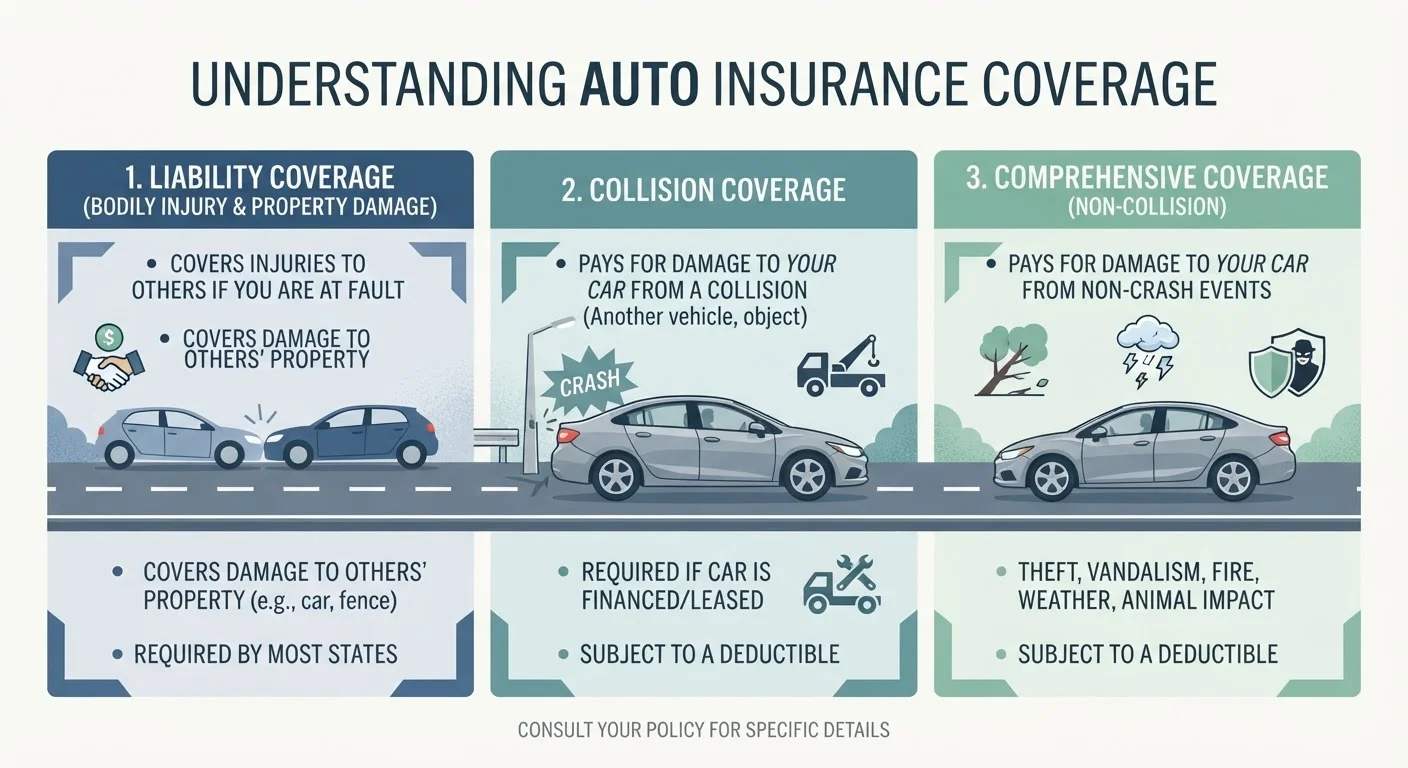
- Liability coverage pays for damage and injuries you cause to others - it does not pay for your own vehicle.
- Collision coverage pays to repair or replace your car after a crash, regardless of who was at fault.
- Comprehensive coverage pays for vehicle damage from non-collision events like theft, weather, or fire.
- Most states legally require liability coverage; collision and comprehensive are typically optional add-ons.
- Lenders and leasing companies usually require both collision and comprehensive on financed vehicles.
- Each coverage type carries its own separate deductible and limit that you set when purchasing a policy.
Auto Insurance Coverage Types
Auto insurance is not a single blanket protection - it is a collection of individual coverages, each designed to pay for a specific kind of loss. Liability, collision, and comprehensive are the three foundational coverage types that form the backbone of most personal auto policies. Knowing what each one covers - and what it does not - helps drivers avoid surprises when a claim arises.
Insurers may bundle or label these coverages differently across states, but their core functions are standardized across the industry. Policy terms, exclusions, and limits vary by provider and state regulation.
Liability Coverage: Protecting Others From the Costs You Cause
Liability coverage is the foundation of nearly every auto policy and the coverage that most states legally require. It pays for bodily injury and property damage that you cause to other people in an accident where you are at fault.
Liability is divided into two components. Bodily injury liability covers medical expenses, lost wages, and pain-and-suffering claims for people you injure. Property damage liability covers repairs to vehicles, fences, buildings, or other property you damage. Neither component pays for your own injuries or your own vehicle - those require separate coverages.
Limits are typically written as three numbers, such as 25/50/25, representing $25,000 per injured person, $50,000 per accident total for injuries, and $25,000 for property damage. Selecting limits too low can leave you personally responsible for costs that exceed your policy's cap.
For a broader look at how liability fits into an overall policy structure, see Car Insurance Decoded.
State Minimums Are a Floor, Not a Recommendation
Every state sets minimum liability limits that drivers must carry, but these minimums are often quite low relative to the real costs of a serious accident. Medical bills, vehicle repairs, and legal fees can quickly exceed a minimum-limit policy. Drivers are generally encouraged to review whether their limits reflect their actual financial exposure - not just the legal threshold.
Collision Coverage: Paying for Your Vehicle After a Crash
Collision coverage pays to repair or replace your vehicle when it is damaged in a crash - whether you hit another car, a guardrail, a tree, or another stationary object. Importantly, collision applies regardless of which driver was at fault.
When you file a collision claim, you pay your chosen deductible first, and the insurer covers the remaining eligible repair costs up to the vehicle's value. Common deductible amounts range from $250 to $1,000 or higher; choosing a higher deductible generally lowers your premium but increases your out-of-pocket cost at claim time.
Collision is optional under most state laws, but lenders and leasing companies almost always require it when a vehicle is financed or leased. Once a car is paid off, drivers often weigh the vehicle's current market value against what they're paying in annual premiums to decide whether to keep it.
Understanding how your insurer values your vehicle after a loss is directly tied to how much a collision claim pays out. The valuation method used - actual cash value, agreed value, or stated value - can significantly affect your settlement.
Review Your Deductible Before a Claim Happens
Your collision and comprehensive deductibles are set when you buy or renew a policy - not when you file a claim. It's worth confirming your deductible amounts now so you know your actual out-of-pocket cost if you need to file. Higher deductibles lower premiums but require you to cover more upfront after a loss.
Comprehensive Coverage: Non-Collision Events and Acts of Nature
Comprehensive coverage handles vehicle damage from events that are not crashes. Common covered perils include theft, vandalism, fire, hail, flooding, wind damage, falling trees or debris, and collisions with animals like deer. Because these events are largely outside a driver's control, comprehensive is sometimes informally called other than collision coverage.
Like collision, comprehensive carries a deductible. It also pays up to the vehicle's actual cash value, so the payout for an older vehicle with significant depreciation may be modest. Drivers with low-value vehicles sometimes drop comprehensive - and occasionally collision - once the combined annual premium cost approaches what the car is actually worth.
Comprehensive does not cover mechanical breakdowns, normal wear and tear, or damage from a collision with another vehicle or fixed object - those scenarios belong to collision coverage. Damage from flooding is covered under comprehensive but is not covered under standard homeowners or renters insurance, which is a common misconception. For more on what standard policies do and don't cover, see common car insurance myths.
How the Three Coverages Work Together
Liability, collision, and comprehensive serve different purposes and respond to different events. A complete understanding of each one prevents the most costly assumption in auto insurance: expecting one coverage to pay for a loss that only another coverage addresses.
Consider a straightforward scenario: you rear-end another driver. Your liability coverage pays for their vehicle repairs and medical bills. Your collision coverage pays to fix your own car, minus your deductible. Comprehensive plays no role in this scenario at all.
Now consider a different situation: a hailstorm damages your parked car and a thief breaks in and steals the audio equipment. Comprehensive covers the hail damage and the theft of the vehicle itself, but personal property inside the car - including electronics - is generally not covered by any auto coverage and may fall under a separate renters or homeowners policy.
Together, these three coverages address the most common and financially significant risks drivers face. For guidance on how to think about coverage levels relative to your situation, see full coverage vs. minimum coverage. And for definitions of terms like deductible, premium, and limit that appear across all three coverage types, the auto insurance terms reference provides clear, plain-language explanations.
This article provides general educational information about auto insurance coverage types and is not personalized insurance or legal advice. Coverage terms, exclusions, requirements, and availability vary by state and insurer. Always read your policy documents carefully and consult a licensed insurance agent for guidance specific to your situation.