

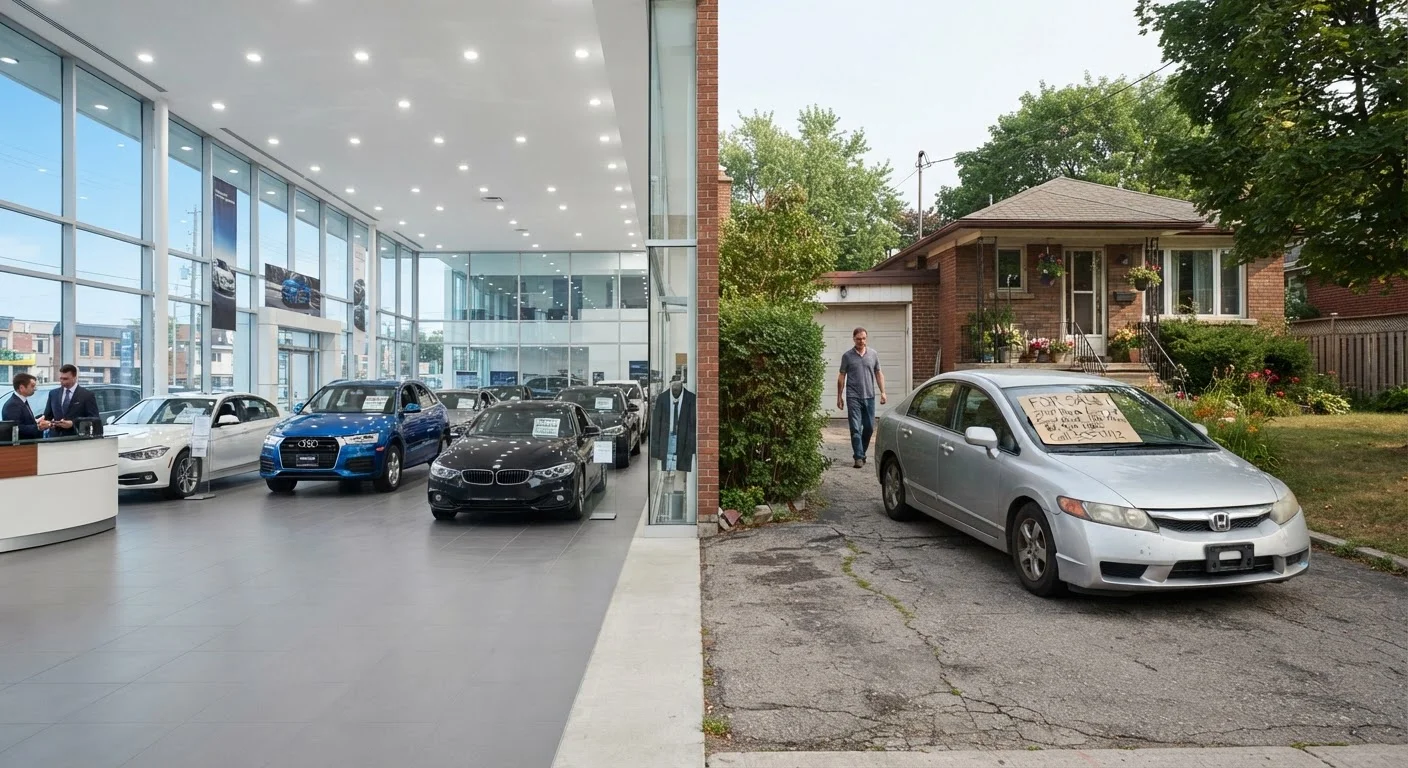
Key Takeaways
- Dealerships are regulated businesses; private sellers transact with far fewer legal obligations to the buyer.
- Financing is available in-house at dealerships, while private sales typically require pre-arranged loans or cash.
- Private sellers often price lower, but that gap narrows once you factor in dealer incentives and certified pre-owned programs.
- Neither channel eliminates the need for an independent vehicle history check and pre-purchase inspection.
- Paperwork is more standardized at dealerships; private sales require the buyer to manage more of the title transfer process.
Option A
Buying From a Dealership
The structured, protection-rich channel with more moving parts.
Best for: Buyers who want financing options, consumer protections, and a documented purchase process under one roof.
Option B
Buying From a Private Seller
The direct, negotiable route with fewer formalities and fewer safety nets.
Best for: Experienced buyers who have done their research, can arrange independent financing, and are comfortable handling due diligence themselves.
If you need financing arranged at the point of sale
Buying From a Dealership
Dealerships work with multiple lenders and can structure a loan during the same visit, which is difficult to replicate when buying privately.
If you want maximum price flexibility and are paying cash
Buying From a Private Seller
Private sellers carry no overhead costs, making them more willing to negotiate on price - especially for older or high-mileage vehicles.
If you want warranty coverage or a certified vehicle
Buying From a Dealership
Only franchised dealerships can sell certified pre-owned (CPO) vehicles backed by the manufacturer's program, and they may offer limited dealer warranties on used stock.
If you're a first-time buyer or less experienced with vehicle evaluation
Buying From a Dealership
The regulated environment, disclosure requirements, and standardized paperwork provide a clearer framework for buyers who are new to the process.
If you've already identified a specific used vehicle and have done your research
Buying From a Private Seller
When you know exactly what to look for and have pre-approved financing, private sales can be faster and straightforward with fewer layers of fees.
How Each Channel Works
When you buy from a dealership, you're transacting with a licensed business subject to federal and state consumer protection laws. Dealers must comply with the FTC's Used Car Rule, which requires them to display a Buyers Guide disclosing warranty terms on used vehicles. They maintain inventory, employ finance managers, and handle most title and registration paperwork on your behalf.
A private sale is a direct transaction between two individuals. No licensing authority oversees it, no Buyers Guide is required, and the seller has limited legal disclosure obligations beyond basic fraud laws. The buyer and seller negotiate freely and split responsibility for transferring the title correctly through the relevant state motor vehicle agency.
Understanding what each channel involves before you start shopping is useful preparation. The full car-buying journey walks through each stage so you can map your expectations to either route.
| Criterion | Dealership | Private Seller |
|---|---|---|
| Regulatory oversight | Licensed, FTC-regulated business | No licensing requirement |
| Warranty options | As-is, limited, or CPO warranty | Remaining factory warranty only (if applicable) |
| Financing | Available in-house | Buyer must arrange independently |
| Price negotiability | Moderate; overhead limits flexibility | Higher; no business overhead |
| Fees beyond sticker price | Doc fees, prep, add-ons common | Minimal; mostly state title/registration |
| Title and paperwork handling | Dealer manages most of it | Buyer and seller manage directly |
| Vehicle inspection before sale | Dealer reconditioning; independent check still advisable | No reconditioning; independent check essential |
| Trade-in option | Yes | No |
Pricing and Fees: What's Actually Different
Private sellers typically list vehicles closer to market value without the overhead costs - facility fees, reconditioning, staff commissions - that a dealership must recoup. However, dealerships sometimes have access to manufacturer incentives or promotional financing rates that can offset their higher sticker prices, particularly on new vehicles.
At a dealership, the advertised price is rarely the final price. Documentation fees, dealer prep charges, and optional add-ons can add hundreds to the total. The breakdown of dealer fees explains which are standard, which are negotiable, and what questions to ask before signing. Private sales generally involve fewer line items, but buyers must still budget for their own title transfer fees and any immediate repairs the seller hasn't addressed.
If you plan to trade in a vehicle, that transaction is only available through a dealer. Understanding how trade-in valuations work is worth doing in advance - the trade-in value guide covers the factors that shape offers and where buyers commonly leave money on the table.
~40%
Used vehicles sold by private sellers in the U.S.
Industry estimates from Cox Automotive suggest roughly four in ten used vehicle transactions occur between private parties rather than through dealerships.
$1,000-$2,500
Typical dealer doc and prep fees range
Documentation and reconditioning fees vary widely by state and dealer; some states cap documentation fees while others do not.
3 in 4
Used car buyers who finance their purchase
According to Experian's automotive finance data, a substantial majority of used vehicle buyers use some form of financing rather than paying cash outright.
Protections, Warranties, and Risk
Dealers selling used vehicles are required to provide a Buyers Guide stating whether the vehicle comes with a warranty, a limited warranty, or is sold "as-is." Certified pre-owned vehicles sold through franchised dealers carry manufacturer-backed warranty programs with defined coverage terms. These protections don't exist in private sales - unless a remaining factory warranty transfers with the vehicle, which buyers should verify directly with the manufacturer.
Neither channel eliminates the risk of buying a vehicle with hidden problems. A vehicle history report (using the VIN) and an independent pre-purchase inspection by a qualified mechanic are worth arranging regardless of where you buy. Sellers in either channel are not obligated to disclose every issue they're unaware of, which is why independent verification matters.
Familiarizing yourself with common terminology before you sit down with paperwork reduces confusion. The car buying glossary explains financing, pricing, and legal terms in plain language. And once you understand the channel differences, negotiating the price is the next practical step - the approach differs noticeably between a dealership and a private seller.
CPO Vehicles Are Dealer-Exclusive
Certified pre-owned (CPO) programs are offered only through franchised new-car dealerships and are backed by the original manufacturer. Vehicles marketed as 'certified' by independent used-car lots are subject to the dealer's own standards, not a manufacturer program. The distinctions between new, used, and CPO vehicles are worth understanding before comparing options.
Financing and Paperwork
Dealerships offer in-house financing through relationships with banks, credit unions, and captive finance arms. This convenience comes with a trade-off: the dealer may earn a fee for arranging the loan, sometimes reflected in the interest rate offered. Buyers who arrive with a pre-approved loan from their own bank have a useful comparison point and can negotiate from a stronger position.
Private sales require buyers to arrange financing before closing. Most banks and credit unions offer private-party auto loans, though the terms sometimes differ from dealer financing. Cash transactions simplify the process but require the buyer to be especially careful about the title transfer. Each state has its own requirements for reassigning a title, paying sales tax, and registering the vehicle - confirming those steps with your state's DMV before finalizing the deal is important.
After purchasing, car insurance must be in place before you drive the vehicle. Coverage requirements and minimum limits vary by state, so verify what's needed in yours before completing the transaction.