

Key Takeaways
- A product's average star rating can be misleading without considering review volume and distribution.
- Fake and incentivized reviews share recognizable patterns that sharp readers can learn to spot.
- Filtering by lowest ratings and sorting by most recent reveals problems sellers would rather you miss.
- Specific, detailed complaints in 2- and 3-star reviews are often the most honest feedback you'll find.
- Cross-referencing reviews across multiple platforms gives a more reliable overall picture.
What you will need
Why Star Ratings Alone Mislead You
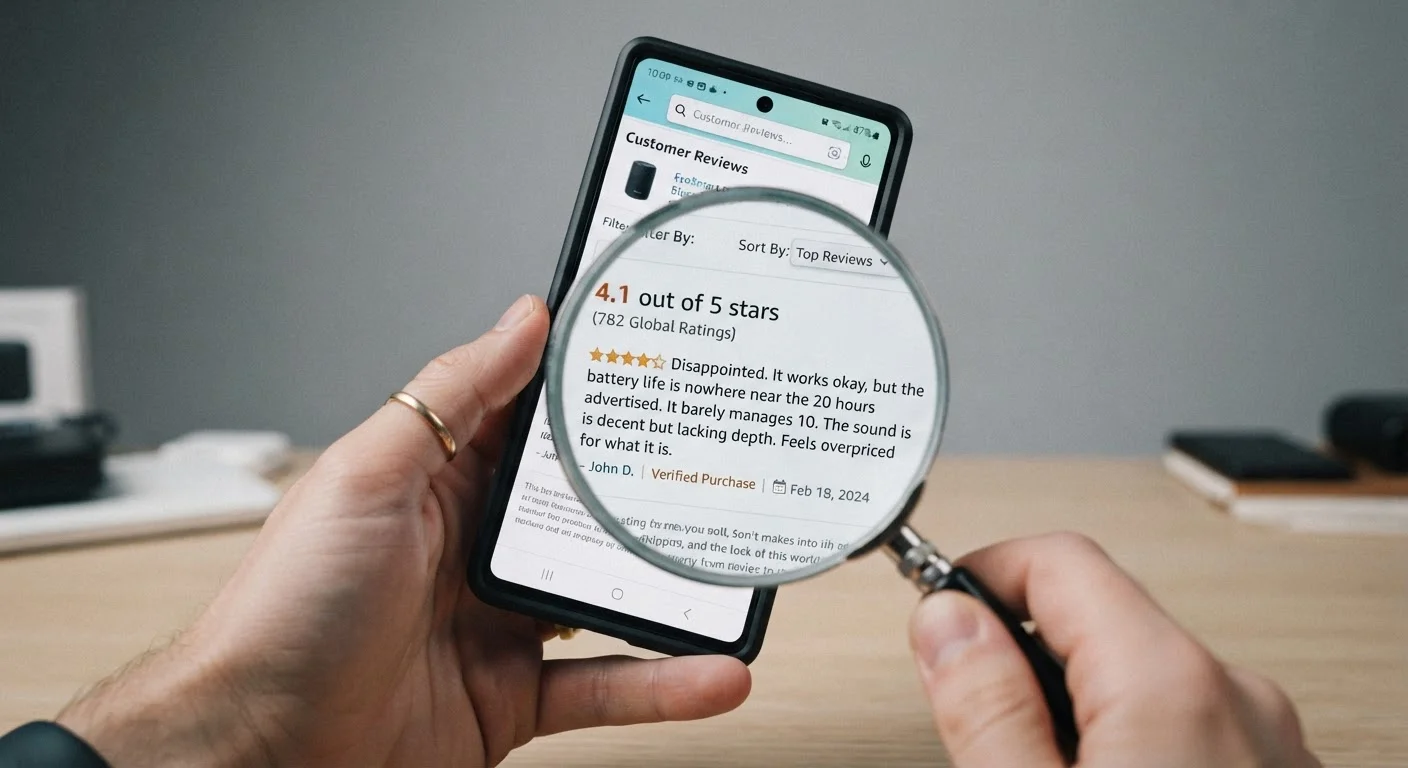
A 4.4-star average sounds reassuring until you realize that number can be built from 12 reviews submitted the week the product launched, half of which came from the seller's network. Review counts matter as much as averages. A product with 4.1 stars across 2,000 verified purchases typically reflects reality more accurately than a 4.8 from 30 reviews.
Pay attention to the rating distribution, not just the average. Most legitimate products show a rough bell curve - a large cluster of 4- and 5-star reviews, a smaller middle, and a visible tail of 1- and 2-star entries. When you see a product where nearly every review is either 5 stars or 1 star with almost nothing in between, that polarized pattern often signals either a quality problem or review manipulation. Neither is good news for you as a buyer.
For a complementary look at how to evaluate sources of feedback more broadly, see how user and expert reviews compare.
Spotting Fake and Unreliable Reviews
Fake reviews aren't always obvious, but they do follow patterns. Watch for these signals:
- Vague, generic praise: Phrases like "great product, highly recommend" without a single specific detail about how the item was actually used.
- Reviewer profile red flags: Accounts that were created recently, have only ever reviewed products from one brand, or post clusters of reviews within a short time window.
- Identical or near-identical phrasing across multiple reviews - a sign of templated or coordinated posting.
- Over-the-top enthusiasm that reads more like marketing copy than a real person's experience.
Incentivized Reviews Are Not Always Disclosed
Some sellers offer free products, discounts, or other perks in exchange for positive reviews, sometimes without requiring the reviewer to disclose the arrangement. Federal trade guidelines require disclosure, but enforcement is uneven. Treat unusually glowing reviews with appropriate skepticism, especially on newer product listings with fast-climbing review counts.
Contrast this with what genuine reviews tend to look like: a mix of what worked and what didn't, mention of specific use cases, and an honest acknowledgment of tradeoffs. A reviewer who says "the battery life is great but the charging cable feels flimsy" is giving you real signal. One who calls a product "absolutely perfect in every way" is giving you almost none.
If you're evaluating a brand you haven't encountered before, this guide on unfamiliar brands pairs well with what you're learning here.
How to Read Review Sections Strategically
Most shoppers read the top few reviews and move on. Here's a more useful approach:
Sort reviews by lowest rating first
Switch the default sort from "top reviews" to 1- or 2-star reviews. These are the customers who felt strongly enough to report a problem. Look for patterns: if multiple people cite the same flaw independently, it's likely a real and recurring issue, not an isolated incident.
Filter by most recent reviews
Product quality can change over time - especially after a manufacturer switches suppliers or after a product has been on the market long enough for durability issues to emerge. Sorting by most recent shows you how the product is performing now, not how it performed when it launched.
Read the 3-star reviews carefully
Three-star reviews are frequently the most honest. Reviewers who land in the middle usually felt the product was neither a great success nor a total failure - and they're more likely to describe the tradeoffs plainly. This is where you often find the most useful real-world context about who the product works well for and who it doesn't.
Check review dates relative to product changes
If a listing shows a product has been updated or a new version was released, reviews from before that change may not reflect what you'll receive. Look for reviewers who mention which version they purchased, and check whether the listing clearly identifies which version is currently being sold.
Cross-check on at least one external source
Search for the product on a platform or forum where the seller has no control over what appears - consumer protection sites, Reddit communities, or independent review blogs. The tone and content of feedback in those spaces tends to be less curated and more candid than what you'll find on a retail listing.
Once you've worked through the reviews, check the seller's responses to negative feedback. A seller who responds defensively, dismisses complaints, or simply doesn't respond at all tells you something important about what happens when things go wrong after purchase. Compare this to what return policy fine print actually allows you to do if you're dissatisfied.
Search the Product Name Outside the Marketplace
Run a quick web search using the product name plus words like 'problems,' 'complaints,' or 'broke after.' Forum posts, Reddit threads, and independent blogs often surface issues that never make it into a retail listing's review section. This takes two minutes and can save significant regret.
Building a Complete Picture Before You Buy
No single review source is fully reliable on its own. Retail platform reviews are subject to manipulation. Third-party review sites have their own incentive structures. Social media comments can be cherry-picked in brand posts. The most informed shoppers triangulate - they check two or three sources and look for consistency in what people praise and what they complain about.
For physical products with specs and certifications, cross-reference what reviewers say against what the listing actually claims. Decoding a product listing's numbers and labels can help you catch gaps between marketing language and real-world performance.
Review Gating Distorts What You See
Some sellers practice 'review gating' - privately asking satisfied customers to leave reviews while never reaching out to dissatisfied ones. The result is a lopsided sample that inflates the average. If a product has thousands of reviews but almost no 1- or 2-star entries, that pattern itself is worth questioning.
The goal isn't to become so skeptical that you never buy anything - it's to spend five or ten extra minutes gathering signal so you're not surprised later. Buyer's remorse is almost always cheaper to prevent than to fix.