

Key Takeaways
- Rushing cat introductions is the most common mistake - the process typically takes two to four weeks.
- Scent swapping before any visual contact is the foundation of a successful feline introduction.
- Separate resources - food bowls, litter boxes, and resting spots - reduce competition and territorial stress.
- Hissing and growling during early meetings is normal; physical fighting or sustained aggression requires intervention.
- Your resident cat's stress signals are important feedback; slow down if either cat shows distress.
What you will need
Why Cat Introductions Require a Deliberate Approach
Cats are territorial by nature. Unlike dogs, which generally follow a social hierarchy and adapt relatively quickly to new group members, domestic cats are facultatively social - meaning their comfort with other cats varies enormously by individual temperament, early socialization, and life history. Dropping a new cat into an established cat's space without preparation almost always triggers fear, aggression, or lasting anxiety in one or both animals.
Understanding how feline stress presents before you begin is genuinely useful here. Subtle signs - reduced appetite, over-grooming, hiding, or changes in litter-box use - can indicate that the pace of introduction needs to slow down before either cat reaches a breaking point.
The goal of a structured introduction is to allow both cats to build a positive or neutral association with each other's presence before any direct contact occurs. This approach is grounded in behavioral science: repeated, low-stakes exposure paired with something positive (food, play) conditions cats to view a potential rival as a non-threat.
What you will need
Setting Up for Success Before the New Cat Arrives
Preparation happens before the new cat crosses your threshold. Designate a separate room - sometimes called a "base camp" - equipped with its own litter box, food and water bowls, bedding, and hiding spots. This room will be the new cat's exclusive territory for the first phase of the introduction.
Apply the one-plus-one rule for litter boxes: provide one box per cat, plus one extra. If you have two cats, that means three boxes in different locations. This reduces the likelihood of guarding behavior, which is a common source of tension. You'll also want at least one vertical space (a cat tree or cleared shelf) per cat, as height access is a significant resource in feline social dynamics.
If you haven't already, review the essentials for bringing a new cat home - many of those foundational steps apply here too, particularly around vet check-ups and initial supply lists.
Baby gate or mesh pet barrier
Allows visual contact between cats while maintaining a physical boundary during the introduction phase.
Extra litter boxes
Prevents resource guarding; the standard recommendation is one box per cat plus one additional box.
Scent-swapping cloths
Small, clean fabric pieces used to transfer each cat's facial scent to the other cat's environment.
Puzzle feeders or food-dispensing toys
Provides mental enrichment and helps manage stress levels in both cats during the transition period.
Wand or interactive fishing-rod toys
Used during supervised shared sessions to redirect energy and create positive associations between the cats.
Cat tree or vertical perching space
Vertical territory reduces competition for floor space and gives each cat an escape route during interactions.
Step-by-Step Introduction Process
Follow the steps below in order, and resist the urge to accelerate. Each phase should last a minimum of two to three days - longer if either cat is showing stress signals. There is no fixed timeline; some cats move through the full process in two weeks while others need six or more.
Confine the new cat to the base camp room
Bring the new cat directly into their dedicated room and close the door. Allow them 24-48 hours to decompress and explore their safe space without any contact - visual, olfactory, or physical - with your resident cat. Place a worn T-shirt or blanket from each cat in the other's area so they begin encountering each other's scent passively.
Begin active scent swapping
After the initial decompression period, use a clean cloth to gently rub one cat's cheeks and forehead (where scent glands are concentrated), then present it to the other cat to sniff. Do this once or twice daily. Gauge each cat's reaction - curiosity or indifference is ideal; intense agitation suggests you need more time before progressing.
Swap territories temporarily
Once both cats are responding to scent-swapped items calmly, swap their spaces for short periods. Let the new cat explore the main home while the resident cat investigates the base camp room. This exposes each cat to a much richer scent profile of the other without any direct encounter. Keep the swap sessions to 30-60 minutes initially.
Introduce visual contact through a barrier
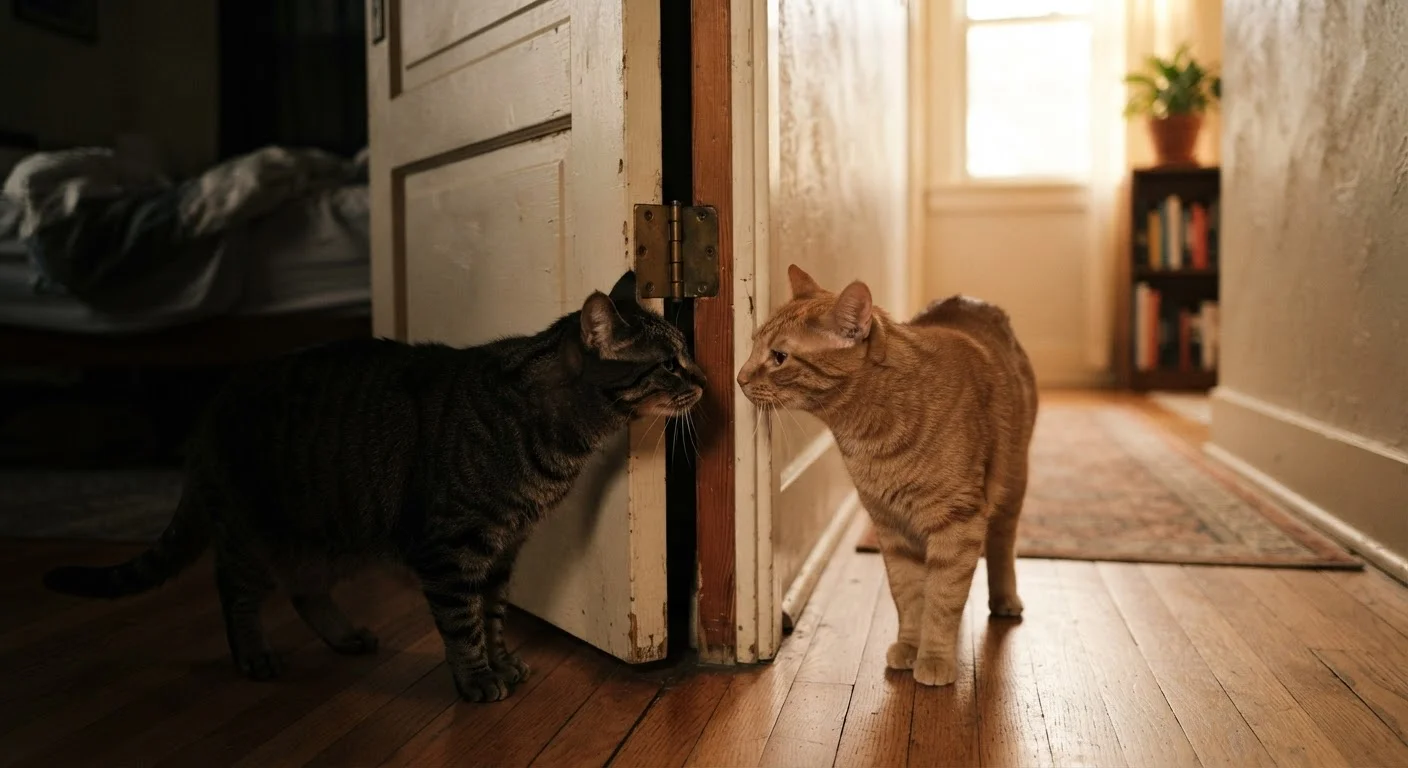
Use a baby gate, a cracked door secured with a door stop, or a mesh screen to allow the cats to see each other while remaining physically separated. Conduct these sessions during mealtimes so that positive reinforcement (food) is occurring simultaneously. Start with sessions of five to ten minutes and increase gradually as both cats remain relaxed.
Allow supervised, shared space interactions
When both cats are eating calmly and showing minimal stress during barrier sessions, open the door for brief, fully supervised shared-space time. Keep the first few sessions under 15 minutes. Have a towel or a second person available to separate cats if an interaction escalates. Do not leave them unsupervised until you have observed multiple calm, uneventful sessions.
Reading the Room: What Normal Looks Like
Hissing, growling, and puffed tails during early visual or physical meetings are expected - they are not signs of failure. These are cats communicating boundaries. What matters is the trajectory: are the interactions becoming shorter and less intense over days? That's progress.
Watch for concerning escalations: prolonged stalking, one cat completely refusing to eat or use the litter box, sustained screaming or violent fighting, or one cat becoming entirely reclusive. Any of these signals warrants stepping back to an earlier phase and, if they persist, consulting a veterinary behaviorist or certified cat behavior consultant.
Environmental enrichment for both cats during this period - puzzle feeders, interactive wand toys, and window perches - helps discharge stress and creates positive emotional states that carry over into inter-cat interactions. A calmer cat is a more tolerant cat.
Progress at the Slower Cat's Pace
Always calibrate the speed of the introduction to whichever cat is showing more stress - this is usually, but not always, the resident cat. Advancing too quickly based on one cat's comfort while ignoring the other's signals is a common reason introductions fail. Patience in the early weeks pays off in a more stable long-term relationship.