

Key Takeaways
- Indoor cats need deliberate environmental design to meet their natural behavioral needs.
- Rotating toys and varying play sessions prevents boredom and reduces stress-related behaviors.
- Vertical space, hiding spots, and window access address a cat's instinct to climb, hide, and observe.
- Food puzzles and scent enrichment engage a cat's hunting drive without requiring outdoor access.
- Consistent interactive play with a human is one of the most effective enrichment tools available.
Why Enrichment Matters for Indoor Cats
Indoor cats live longer, safer lives - but the trade-off is a reduced range of stimulation compared to their free-roaming counterparts. Without deliberate enrichment, that gap shows up as problem behaviors: destructive scratching, excessive vocalization, overgrooming, or aggression. These aren't personality flaws - they're signals of unmet behavioral needs.
Feline behavioral science frames enrichment across five core categories: sensory, cognitive, social, physical, and nutritional. A well-rounded approach touches all five. The good news is that meaningful enrichment doesn't require expensive equipment or a large home - it requires understanding how cats think and what they're wired to do. For a deeper look at how an indoor lifestyle compares to outdoor access, see our article on indoor vs. outdoor cats.
Below are seven evidence-informed strategies to keep your cat engaged, mentally sharp, and behaviorally healthy - all from home.
Create Vertical Territory
Cats are vertical animals. In the wild, elevation provides safety, vantage points for hunting, and escape routes from threats. Indoors, a cat with access only to floor-level space is essentially living in one dimension.
Wall-mounted shelves, cat trees, and sturdy bookcases give cats the ability to survey their territory from above - a behavior linked to lower stress levels. Position vertical options near windows for compounded benefit. Even a single tall cat tree in a frequently used room can meaningfully shift a cat's comfort and confidence.
Vertical space gives cats control over their environment, which directly reduces stress.
Leverage Window Access and Bird Feeders
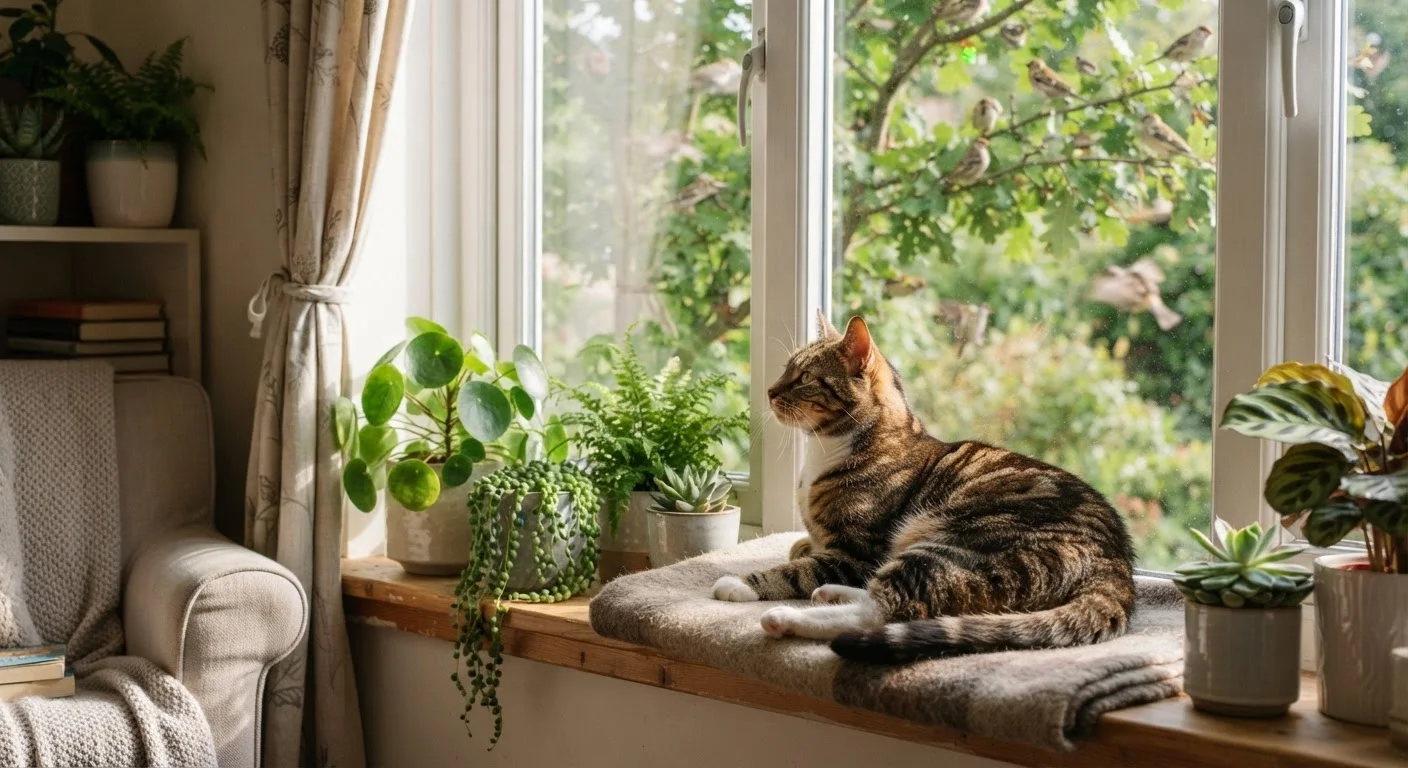
A window is essentially free enrichment. Cats are hardwired visual predators, and watching outdoor movement - birds, squirrels, passing pedestrians - activates the same neural circuits as a hunt without requiring any effort from you.
Placing a bird feeder or birdbath within view of an accessible window transforms a static pane of glass into dynamic, ever-changing stimulation. A padded window perch or a secured shelf at sill height makes the experience comfortable enough for long viewing sessions. This is one of the highest-return enrichment investments available to indoor cat owners.
A bird feeder outside a window is one of the highest-return enrichment investments for indoor cats.
Use Food Puzzles and Scatter Feeding
Cats in the wild spend a significant portion of their waking hours hunting - not just eating. When food appears in a bowl twice a day with zero effort required, that predatory drive goes entirely unsatisfied.
Food puzzles (also called puzzle feeders) require a cat to manipulate an object to access food, reintroducing a cognitive and physical challenge into mealtime. Research published in veterinary behavioral literature suggests puzzle feeders can reduce anxiety and obesity-related risks in indoor cats. Scatter feeding - spreading dry kibble across a textured mat or around a room - achieves a similar effect more simply. If you're evaluating food formats for puzzle feeding, our wet vs. dry food comparison can help inform that choice.
Puzzle feeders reintroduce cognitive challenge at mealtime, addressing the predatory drive bowls ignore.
Schedule Daily Interactive Play
No toy replicates the unpredictability of a human-controlled wand. Interactive play - where you move a feather, ribbon, or toy mouse in erratic, prey-like patterns - engages a cat's full predatory sequence: stalk, chase, pounce, catch. That complete arc matters behaviorally.
Two focused ten-to-fifteen-minute sessions per day, ideally one near dusk when cats are naturally most active, is a widely recommended baseline among feline behavior consultants. Always end sessions with a "catch" so your cat experiences the satisfying conclusion of the hunt. Immediately after play is also a natural window to offer a small meal, mimicking hunt-catch-eat patterns.
Ending play with a 'catch' completes the predatory sequence and leaves your cat behaviorally satisfied.
Rotate and Vary Toys Strategically
Cats habituate quickly to static stimuli. A toy that generated intense interest on Monday may be completely ignored by Thursday - not because your cat is picky, but because novelty drives engagement in predatory species.
Rather than offering all toys simultaneously, keep most in a closed container and rotate a subset every few days. Reintroducing a "forgotten" toy can trigger near-new-toy enthusiasm. Adding a small amount of dried catnip or a drop of silvervine (another plant attractant that works for cats unresponsive to catnip) can temporarily refresh an old toy's appeal.
Rotating toys every few days resets novelty and re-engages a cat's predatory interest.
Introduce Scent Enrichment
A cat's sense of smell is estimated to be roughly fourteen times more sensitive than a human's, making olfactory enrichment a powerful and underused tool. New scents stimulate investigation behaviors and can occupy a cat for extended periods.
Safe scent enrichment options include dried herbs (valerian, silver vine, honeysuckle), cat-safe essential oil-free botanicals, or items brought from outdoors such as pinecones or leaves. Rotating scent items alongside toy rotations layers two enrichment types simultaneously. Always verify that any plant or substance is non-toxic to cats before introducing it - the ASPCA maintains a comprehensive toxic plant database as a useful reference.
Scent enrichment is one of the most underused tools available, engaging cats for extended periods with minimal cost.
Design Dedicated Hiding and Retreat Spaces
Cats are simultaneously predator and prey animals, which means the ability to hide is not just a preference - it's a psychological need. A cat that has no place to retreat when stressed or overwhelmed will show that stress in other ways.
Hiding spots don't need to be elaborate. Cardboard boxes, covered cat beds, paper bags with handles removed, or a blanket draped over a chair leg all serve the function. Position at least one hiding option in each room your cat uses regularly. Crucially, never force a cat out of a hiding spot - the retreat itself is the enrichment. This principle also applies when introducing a second cat, where safe retreats become essential to managing stress during the adjustment period.
Never force a cat from a hiding spot - access to retreat is a core psychological need, not avoidance behavior.
Putting It All Together
No single strategy carries the full load. The most behaviorally healthy indoor cats tend to live in homes where multiple enrichment types are woven into daily life - a window perch here, a puzzle feeder there, a ten-minute wand session before dinner. Small, consistent efforts compound over time.
Start Small and Build Gradually
If your cat is unaccustomed to enrichment, introducing multiple changes at once can itself become a stressor. Add one new element per week and observe your cat's response before layering in more. Even a single new perch or a first puzzle feeder can produce noticeable behavioral improvement within days.
Watch for subtle stress cues - hiding more than usual, changes in litter box habits, or reduced appetite - as signs that enrichment may need adjustment. Our guide on feline stress signs and triggers can help you identify and address those early signals. If your cat is older, also consider that enrichment needs shift with age - our senior cat care guide outlines how to adapt your approach.