

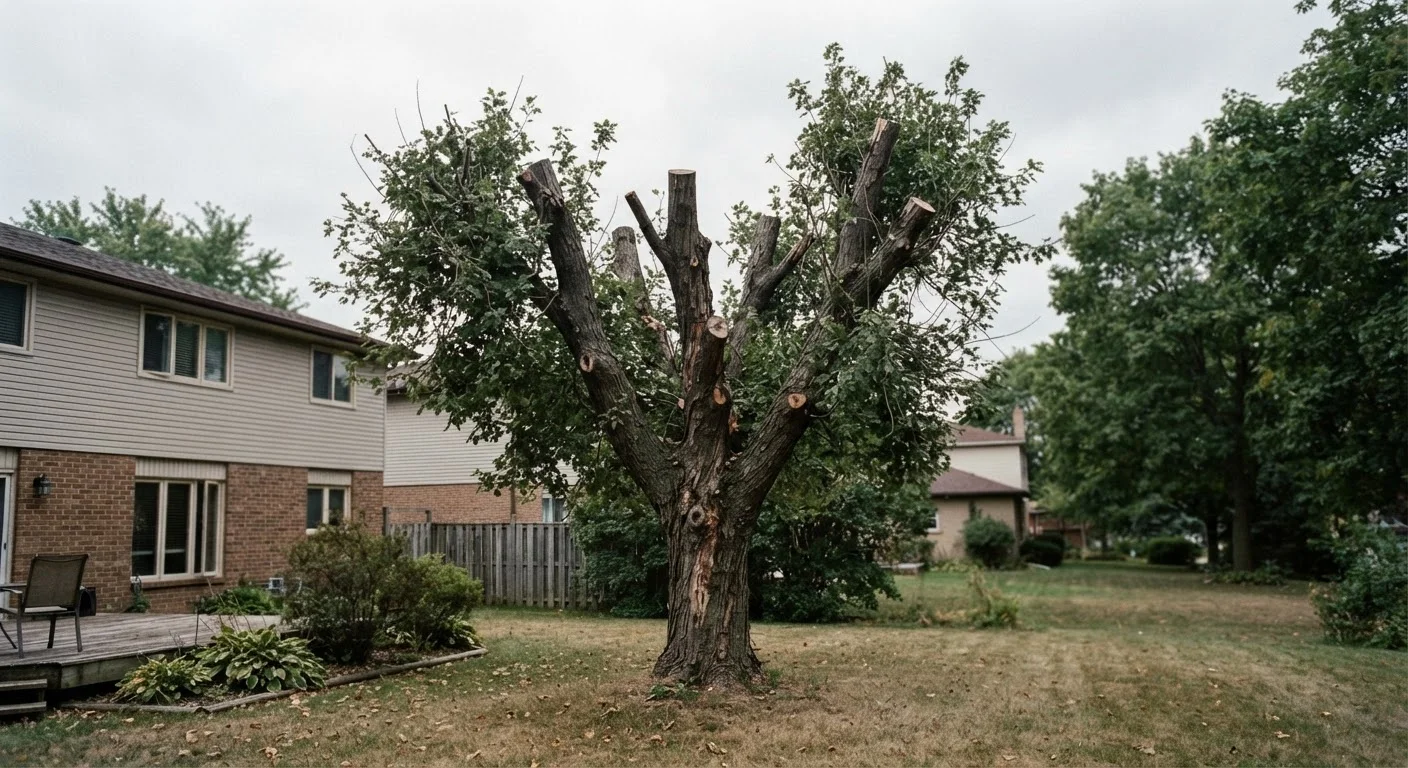
Key Takeaways
- Tree topping removes too much canopy at once, triggering weak, fast-growing regrowth that is more hazardous than the original branches.
- Topped trees are highly vulnerable to decay, disease, and sun damage at every cut site.
- Proper crown reduction by a certified arborist achieves size control without destroying a tree's structure.
- Topping often costs more in the long run due to repeated maintenance or eventual tree removal.
- Most mature trees can be safely managed through selective pruning rather than drastic cutting.
What Tree Topping Actually Does to a Tree
Tree topping - the practice of cutting back main branches or the central leader to arbitrary stubs - is one of the most widespread and damaging tree-care mistakes in residential landscaping. Despite its prevalence, every major professional arboricultural organization in the United States considers topping harmful and contrary to sound tree care.
When a tree is topped, it suddenly loses a massive portion of its leaf area. Leaves are where a tree manufactures food through photosynthesis, so losing them is a genuine crisis for the plant. The tree's immediate response is to push dozens of fast-growing shoots from dormant buds near each cut, attempting to restore its canopy as quickly as possible.
50-100%
Canopy often removed in a single topping
Industry arborists note that topping commonly removes half to all of a tree's photosynthetic capacity, forcing extreme survival responses.
3-5x
Regrowth rate after topping vs. normal pruning
Stressed topped trees push vigorous water sprout growth in an attempt to restore lost leaf area, creating denser and weaker canopies within a few seasons.
10+ years
Time for decay to compromise structural integrity
Decay fungi entering large topping wounds can hollow a tree's core within a decade, according to general arboricultural guidance on wound response.
Those new shoots - called water sprouts or epicormic growth - grow two to four times faster than normal branches. But speed comes at a structural cost. They attach at the surface of the wood rather than developing the interlocking grain a properly formed branch has. The resulting canopy looks full within a few seasons, yet it is mechanically weaker than what was there before the topping.
The Wound Problem Topping Creates
Every cut a topped tree sustains is a large, exposed wood surface. Unlike a proper pruning cut made at the branch collar - where the tree concentrates protective chemistry - topping cuts are made across the middle of branches, leaving wide stubs the tree struggles to close. In many cases, the stubs never fully seal.
Topping Can Kill a Mature Tree
Removing more than 25-30% of a tree's canopy at once puts it under severe stress. The resulting wounds are often too large to close properly, leaving exposed wood vulnerable to decay fungi and insects. Over several years, internal rot can hollow a tree structurally, making it far more likely to fail during a storm than it would have been before topping.
Unsealed wood is an open door for decay fungi and wood-boring insects. Decay tends to work inward and downward through the branch and into the trunk over time. From the outside, a topped tree may look merely unattractive; inside, structural wood may be deteriorating in ways that only become visible during a wind or ice event - often catastrophically.
Sun damage compounds the problem. A thick canopy shades the bark and wood beneath it. When that canopy is suddenly removed, exposed bark can crack and split from rapid temperature fluctuation, a condition called sunscald. These cracks create additional pathways for decay and disease.
Common Mistakes That Lead to Topping - And What to Do Instead
Topping rarely happens without a reason. Understanding what drives the decision helps homeowners make better choices before picking up the phone or the chainsaw.
Topping a tree to reduce its height for safety or aesthetics.
Why it happens: Large trees near homes or power lines can look threatening, and topping seems like an obvious size-reduction solution. Many homeowners have also seen neighbors or unlicensed crews do it, normalizing the practice.
Making flush cuts or leaving extremely long stubs at the pruning site.
Why it happens: Without knowing where the branch collar is, people either cut too close to the trunk or leave a long stub - both of which disrupt the tree's natural wound-closing process.
Removing more than a quarter of the tree's living canopy in a single season.
Why it happens: When a tree is badly overgrown or storm-damaged, the impulse is to correct the problem all at once. This feels efficient but overwhelms the tree's ability to recover.
Assuming a topped tree needs no further attention.
Why it happens: Homeowners often view topping as a one-time fix. In reality, the dense regrowth that follows requires more frequent management, not less.
Hiring an unlicensed crew because they offer a significantly lower price.
Why it happens: Tree work is expensive, and low bids are tempting. Unlicensed crews frequently default to topping because it is fast and requires less skill than proper crown work.
Water Sprouts Are Weakly Attached
The rapid shoots that grow from topping cuts - called water sprouts or epicormic shoots - attach to the outer layer of wood rather than developing the strong union a normally growing branch has. In high winds or ice storms, these sprouts break away easily, creating the exact hazard topping was meant to prevent. Do not assume a topped tree is a safer tree.
For trees that genuinely need size management, the professional alternative is crown reduction - removing selected branches back to healthy lateral growth points that can take over as the new branch tip. This method respects the tree's natural form, keeps wound sizes manageable, and avoids triggering the stress responses that topping causes. Combined with good timing and proper cut placement, as covered in our pruning fundamentals guide, crown reduction can meaningfully reduce a tree's height and spread without putting it at risk.
If a tree is already too large for the space it occupies, removal and replacement with a species suited to that site's constraints is often a more honest and cost-effective solution than repeated topping cycles.