

Key Takeaways
- A balanced diet is a pattern of eating, not a strict daily formula.
- No single food group alone can meet all of the body's nutritional needs.
- Established frameworks like MyPlate offer general guidance, but individual needs vary widely.
- Ultra-processed foods are linked to nutrient gaps even when calorie needs are met.
- Consulting a registered dietitian is the most reliable way to personalize dietary balance.
Balanced Diet
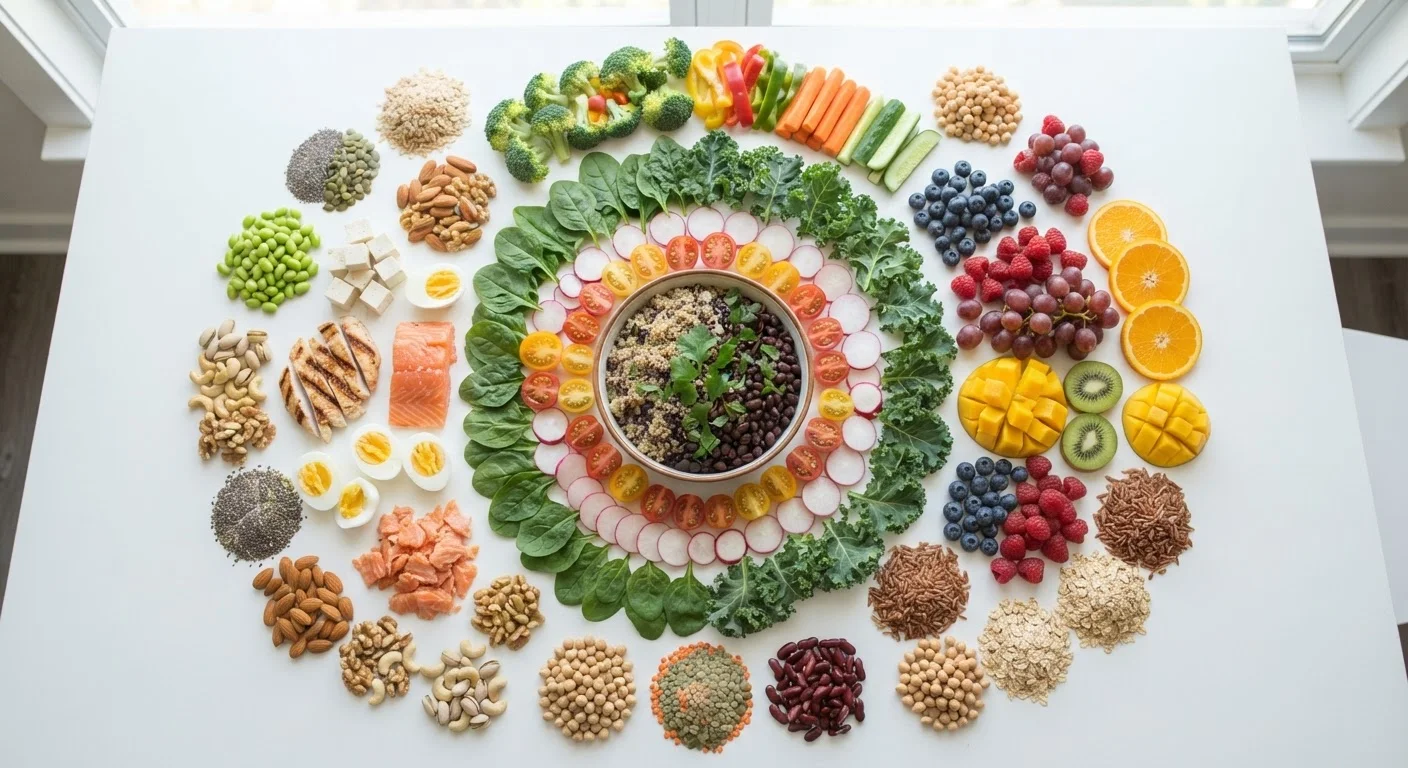
A balanced diet is one that provides your body with the essential nutrients it needs to function properly - including carbohydrates, proteins, fats, vitamins, minerals, and water - in proportions that support long-term health. Rather than a fixed formula, it describes an overall pattern of eating that covers nutritional needs without consistently over- or under-supplying any major nutrient category. The concept is general by design, because nutritional needs vary by age, sex, activity level, health status, and other individual factors.
In nutritional science, balance is typically assessed relative to Dietary Reference Intakes (DRIs), a set of evidence-based guidelines developed by the National Academies of Sciences, Engineering, and Medicine that define adequate and safe intake ranges for essential nutrients.
Why the Phrase Is Everywhere but the Meaning Is Elusive
"Eat a balanced diet" appears on packaging, in public health campaigns, and in doctors' offices - yet it rarely comes with a clear explanation of what that actually means. The vagueness is not accidental. The term originated as a general public health message, meant to steer people away from extreme restriction or monotonous eating toward variety and moderation. Over time, it became shorthand for "eat well" without a universally agreed-upon definition.
Part of the difficulty is that nutritional needs are not uniform. A sedentary adult, a competitive athlete, a pregnant woman, and a child all have meaningfully different requirements for energy, protein, calcium, iron, and dozens of micronutrients. Any single definition of "balance" will be an imperfect fit for all of them simultaneously.
For readers trying to make sense of conflicting nutrition headlines, it helps to understand this ambiguity upfront. As our article on why nutrition studies seem to contradict themselves explains, much of the confusion around diet comes from applying population-level research to individual situations.
The Core Nutritional Framework Most Experts Agree On
Despite the lack of a single universal definition, nutrition science does offer a consistent underlying framework. A diet that provides adequate amounts of the following is widely considered the foundation of balance:
- Macronutrients: Carbohydrates (the body's primary energy source), proteins (critical for tissue repair and immune function), and fats (essential for hormone production, brain health, and fat-soluble vitamin absorption).
- Micronutrients: Vitamins and minerals, including vitamin D, calcium, iron, potassium, and B vitamins, which support virtually every physiological process.
- Dietary fiber: Found in whole grains, legumes, fruits, and vegetables, fiber supports digestive health and is consistently associated with reduced chronic disease risk.
- Water: Often omitted from diet discussions, adequate hydration is inseparable from nutritional function. Our related piece on how water fits into a balanced diet explores this in depth.
The U.S. government's MyPlate model - which replaced the Food Pyramid in 2011 - visualizes this by dividing a plate into roughly equal sections of vegetables, grains, fruits, and protein, with a side of dairy or fortified alternative. It is a starting point, not a prescription.
57%
Of U.S. calories from ultra-processed foods
A study published in BMJ Open estimated that ultra-processed foods account for roughly 57% of total energy intake in the average American diet.
10+
Essential nutrients tracked in federal dietary guidelines
The U.S. Dietary Guidelines identify more than ten nutrients of public health concern, including calcium, vitamin D, potassium, and dietary fiber.
~90%
Of Americans fall short on vegetables
According to CDC data, approximately 90% of Americans do not meet federal recommendations for daily vegetable consumption.
Where Ultra-Processed Foods Complicate the Picture
One reason balance is harder to achieve than it sounds is the modern food environment. A significant portion of the American diet consists of ultra-processed foods - items engineered for palatability but often low in fiber, vitamins, and minerals relative to their calorie content.
It is entirely possible to meet daily calorie targets while still falling short on several key nutrients. This is sometimes called "hidden hunger" - adequate energy intake alongside micronutrient deficiency. Understanding how to read a nutrition label is a practical skill for identifying these gaps before they accumulate.
Focus on Food Patterns, Not Single Meals
Nutritional balance is best evaluated over days or weeks, not one meal at a time. If you eat a nutrient-light meal today, the goal is to compensate with variety and whole foods over the following days - not to feel that you've "failed" at balance. This long-view approach is more sustainable and better supported by dietary research.
The energy balance equation - calories consumed versus calories used - is a real and important concept, but as our explainer on calories in, calories out notes, it is a framework with real limitations. Calorie counting alone does not account for nutrient quality, satiety, or metabolic differences between individuals.
What Balance Looks Like Across Different Eating Patterns
Nutritional balance is not exclusive to any single dietary pattern. Research supports the idea that both plant-based and omnivore approaches can meet essential nutrient needs when well-planned - though each comes with distinct considerations. Our comparison of plant-based eating versus omnivore diets walks through where the key nutritional differences lie.
What consistently characterizes nutritionally balanced diets across cultures and research populations includes: a high proportion of whole or minimally processed foods, substantial vegetable and fruit variety, adequate but not excessive protein, and limited added sugars and sodium. The Mediterranean, DASH, and traditional Japanese dietary patterns are among those with the strongest long-term health evidence - none of which maps neatly onto any single "balanced diet" template.
The honest takeaway is that balance is a direction, not a destination. It is built through consistent food habits over time rather than achieved in any single meal or day. When in doubt, a registered dietitian can translate the general framework into guidance that fits your actual life - something no article can fully substitute for.
This article is for general informational and educational purposes only and does not constitute medical or nutritional advice. Consult a qualified healthcare professional or registered dietitian before making significant changes to your diet.