

Key Takeaways
- Fake storefronts mimic real retailers so closely that even cautious shoppers get deceived.
- Scammers rely on urgency, fear, and familiarity to bypass your critical thinking.
- Counterfeit goods and non-delivery are among the most reported e-commerce fraud types.
- Payment method matters - some offer far stronger fraud protections than others.
- Reporting scams to the FTC and your payment provider is a key step toward recovery.
Online Shopping Scam
An online shopping scam is any fraudulent scheme designed to trick consumers into paying for goods or services they won't receive, or into handing over personal and financial information under false pretenses. Scammers operate fake storefronts, hijack legitimate-looking platforms, and send deceptive communications to exploit the trust shoppers place in e-commerce. The goal is always the same: take your money or your data.
Many online shopping scams involve layered tactics - combining domain spoofing, social engineering, and counterfeit payment portals - making them difficult to detect with basic scrutiny alone.
The Anatomy of a Fake Storefront
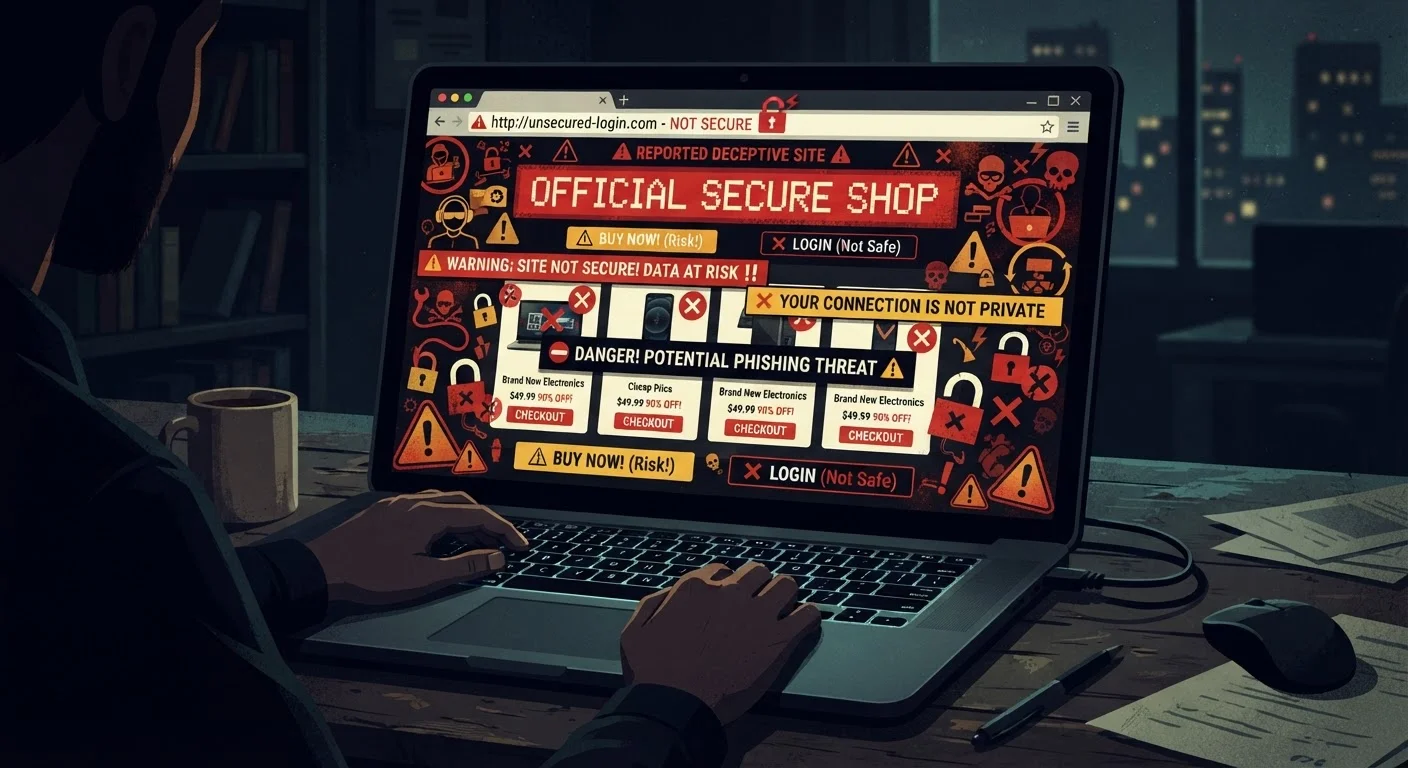
The most common e-commerce scam starts with a website that looks entirely real. Scammers use stolen logos, copied product descriptions, and professional templates to build storefronts that pass a quick visual inspection. They register domains that closely resemble legitimate retailers - swapping a letter, adding a word, or using a different domain extension - a tactic known as typosquatting.
These sites accept payment, send order confirmation emails, and then either ship nothing, deliver a cheap counterfeit, or disappear entirely after collecting funds. Some operate for weeks or months before being taken down, accumulating victims the entire time.
The urgency plays a key role too. Flash sale timers, low-stock warnings, and steep discounts create pressure to skip verification steps. Understanding the terminology behind these tactics is useful - the plain-English glossary of online scam terms covers the vocabulary scammers rely on.
$10B+
Consumer fraud losses reported in the U.S.
According to the FTC's Consumer Sentinel Network, Americans reported losing more than $10 billion to fraud in 2023 - a record high.
$480
Median loss per online shopping fraud report
The FTC reported that online shopping and negative reviews fraud accounted for a significant share of fraud complaints, with a median individual loss around $480.
Top 3
Fraud category by report volume at the FTC
Online shopping fraud consistently ranks among the most-reported fraud categories in annual FTC Consumer Sentinel data.
Why These Scams Are So Effective
Scammers succeed because they exploit normal, reasonable human behavior. Shoppers are conditioned to trust HTTPS padlocks, professional layouts, and fast checkout experiences. Fraudulent sites are designed to mirror all of these signals without any of the underlying legitimacy.
The psychological levers are deliberate. Fake countdown timers trigger loss aversion. Fabricated five-star reviews build false credibility. Emails impersonating shipping carriers or payment processors create a false sense of a trusted ecosystem around the transaction. The difference between real purchase alerts and fake ones is increasingly difficult to spot without knowing what to look for.
Social media advertising has amplified the problem significantly. Targeted ads for non-existent or counterfeit products appear in feeds alongside legitimate retailers, with no visual distinction. Many victims report that the ad itself - not a suspicious email - was their entry point into the scam.
“Scammers are running businesses. They invest in making their schemes look legitimate because the return on that investment is high. Consumers need to treat unfamiliar online sellers the way they'd treat an unfamiliar street vendor - with reasonable caution before handing over money.”
— FTC Consumer Education Division, Federal Trade Commission, consumer protection guidance
Common Scam Types Every Shopper Should Recognize
While fake storefronts get the most attention, online shopping fraud takes several distinct forms:
- Non-delivery fraud: Payment is processed but goods are never shipped. The seller becomes unreachable after the transaction.
- Counterfeit goods: An item arrives, but it's a low-quality fake misrepresented as genuine - common with electronics, apparel, and health products.
- Triangulation fraud: A scammer lists a product, collects your payment, then orders the real item from a legitimate retailer using stolen credit card data, shipping it to you. You receive the product but are unknowingly connected to fraud.
- Overpayment scams: A fake buyer sends a check for more than an item's price and asks for the difference to be refunded. The original check bounces days later.
- Account takeover: Scammers gain access to an existing marketplace account and use stored payment methods or loyalty points.
For a broader look at staying safe across the entire purchase journey, the consumer awareness guide from first click to final purchase walks through each stage in detail.
What Actually Protects You
Consumer protection in e-commerce is real, but it depends heavily on how you pay and where you shop. Credit cards issued in the U.S. carry chargeback rights under the Fair Credit Billing Act, allowing you to dispute fraudulent charges with your card issuer. Debit cards offer weaker protections, and gift cards, wire transfers, or cryptocurrency offer almost none - which is exactly why scammers request them.
Platform-level protections vary. Some marketplaces offer buyer guarantees that cover non-delivery or significantly misrepresented items, but these programs have eligibility rules and time limits. Reading the policy before purchasing - not after - determines whether you're covered.
Reporting matters beyond your own recovery. Filing complaints with the FTC (ReportFraud.ftc.gov) and the Internet Crime Complaint Center (IC3.gov) contributes to the enforcement data that helps shut down scam operations. It also creates a paper trail that can support your dispute with a financial institution.
Maintaining healthy skepticism about what you encounter online is part of the foundation - and common online safety myths outlines why many people underestimate their exposure to these threats.