

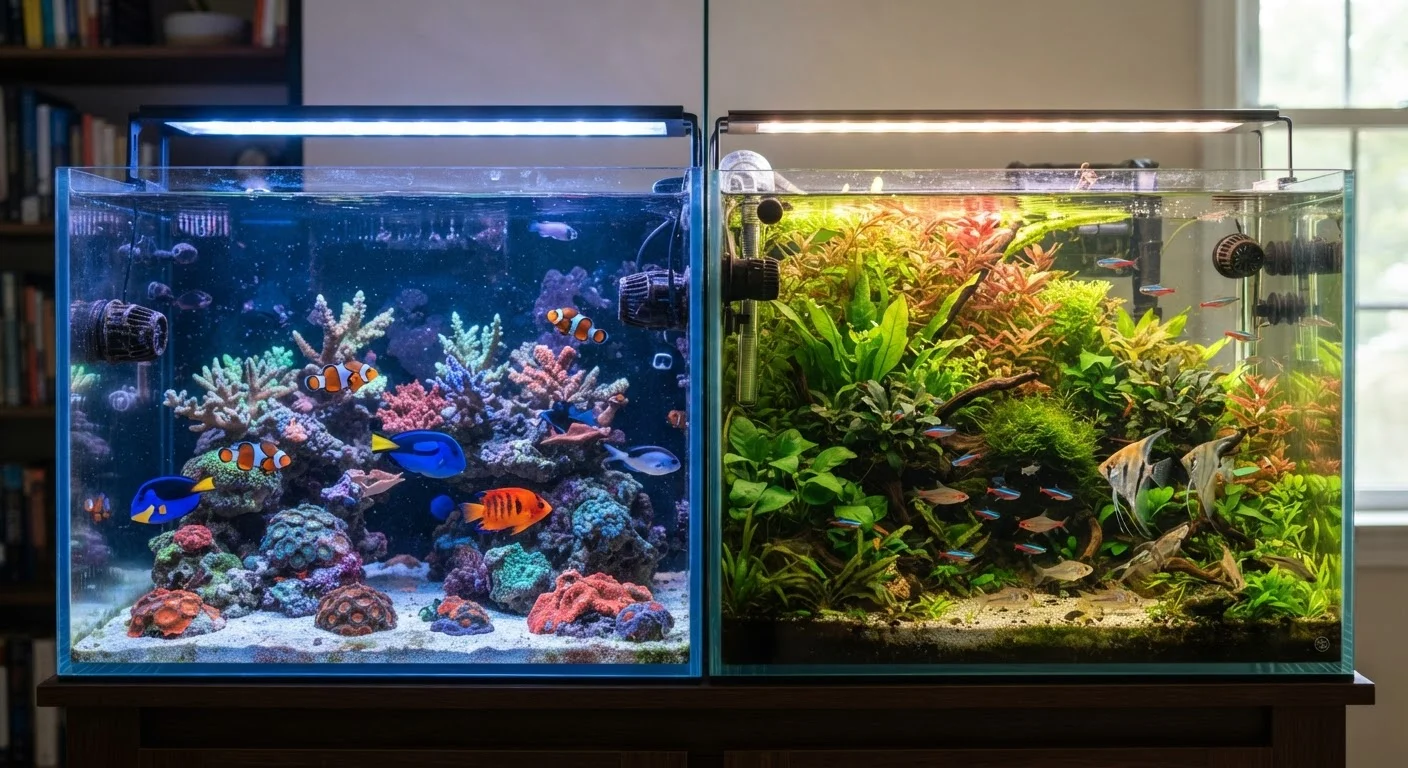
Key Takeaways
- Freshwater tanks cost significantly less to set up and maintain than saltwater tanks.
- Saltwater aquariums offer stunning biodiversity but require stricter water chemistry management.
- Beginners almost universally find freshwater tanks more forgiving and easier to learn on.
- Saltwater tanks can include live coral, dramatically expanding the hobby's creative potential.
- Both tank types require understanding the nitrogen cycle as a foundation for fish health.
Freshwater tanks are affordable and beginner-friendly
Lower equipment costs, widely available hardy fish, and more forgiving water parameters make freshwater tanks an accessible entry point for new hobbyists.
Saltwater tanks offer unrivaled visual biodiversity
Marine fish, invertebrates, and live coral create living ecosystems with color and complexity that are difficult to match in freshwater setups.
Freshwater species selection is extensive and varied
From peaceful community fish to territorial cichlids, freshwater encompasses thousands of species suited to tanks of every size and experience level.
Reef tanks can include living coral as a centerpiece
Coral adds a dimension unavailable in freshwater, turning an aquarium into a functioning reef ecosystem that grows and changes over time.
Freshwater maintenance routines are more straightforward
Regular water changes, basic parameter testing, and standard filtration cover most freshwater maintenance needs without specialized equipment.
Saltwater setup and livestock costs are high
Initial equipment for a saltwater tank routinely runs several hundred to over a thousand dollars before adding fish, and marine livestock prices are considerably higher than freshwater equivalents.
Saltwater water chemistry demands precision
Salinity, alkalinity, calcium, and magnesium levels must all be monitored in reef tanks - a single parameter drifting out of range can harm or kill sensitive corals and invertebrates.
Evaporation constantly alters saltwater salinity
Because only freshwater evaporates, salinity rises daily and must be corrected with freshwater top-offs - a task that requires either daily attention or automated equipment.
Marine fish diseases can be harder to treat
Common saltwater parasites like ich (Cryptocaryon irritans) are more difficult to eliminate in reef tanks because many effective medications are harmful to invertebrates and corals.
Freshwater tanks lack the drama of a reef system
While beautiful in their own right, even heavily planted freshwater tanks cannot replicate the movement, color variety, and living complexity of a mature saltwater reef.
Saltwater tanks have a steeper learning curve
Managing a marine system requires understanding additional chemistry concepts and specialized equipment that take time to learn, making mistakes more costly than in freshwater.
Our Verdict
Freshwater aquariums are the clear starting point for most people - they're more affordable, more forgiving, and supported by a wide range of hardy fish species. Saltwater tanks reward patience and experience with unmatched visual diversity, but they demand more time, money, and technical knowledge to maintain safely.
Freshwater is best for beginners and budget-conscious hobbyists; saltwater suits experienced fishkeepers ready to invest in a more complex, visually spectacular setup.
Setup Costs: A Significant Gap From the Start
The upfront cost difference between freshwater and saltwater tanks is substantial. A basic freshwater setup - tank, filter, heater, lighting, and substrate - can be assembled for a few hundred dollars. A comparable saltwater system typically costs two to four times more before a single fish is purchased.
Saltwater tanks require additional equipment: a protein skimmer to remove organic waste, a quality refractometer or hydrometer to measure salinity, and often a live rock structure that serves as both biological filtration and decor. If you plan to keep coral (a reef tank), specialized lighting with the correct spectrum adds another significant expense.
2-4×
Higher typical saltwater setup cost vs. freshwater
Aquarium hobby retailers and hobbyist communities consistently report that comparable saltwater systems cost two to four times more to set up than freshwater equivalents.
1.023-1.025
Target specific gravity range for marine fish tanks
This salinity window is a widely cited standard in marine aquarium husbandry guidance from fishkeeping organizations and veterinary aquatic specialists.
Livestock costs also diverge sharply. Freshwater fish like tetras, danios, and platies are widely available and inexpensive. Many popular saltwater species, such as clownfish or tangs, carry much higher price tags - and corals can range from modest to extraordinarily expensive depending on species and coloration.
Maintenance Demands and Water Chemistry
Water quality is the foundation of any healthy aquarium, and both systems require regular monitoring - but saltwater tanks have a narrower margin for error. Salinity must stay within a precise range (typically a specific gravity of 1.023-1.025), and temperature swings that a freshwater fish might tolerate can stress or kill marine species.
Evaporation is a persistent challenge in saltwater tanks because only freshwater evaporates, leaving salt behind and raising salinity. Many saltwater hobbyists use automated top-off systems to address this. Freshwater tanks require only standard water changes and basic parameter checks for ammonia, nitrite, nitrate, and pH.
Cycling Applies to Both Tank Types
Whether you choose freshwater or saltwater, every new aquarium must complete the nitrogen cycle before fish are added safely. This biological process establishes beneficial bacteria that convert toxic ammonia into less harmful compounds. Skipping or rushing this step is one of the most common causes of early fish loss in both freshwater and marine tanks.
Understanding the nitrogen cycle is non-negotiable regardless of tank type. See how the nitrogen cycle works for a detailed breakdown of cycling your tank before adding any livestock.
Species Variety and Visual Appeal
This is where saltwater tanks genuinely shine. The ocean's biodiversity is unmatched - vibrant reef fish, intricate invertebrates, and living coral create a dynamic ecosystem that many freshwater setups simply cannot replicate in terms of visual drama. A well-maintained reef tank is widely considered one of the most beautiful displays in the hobby.
That said, freshwater tanks offer their own impressive variety. From the dazzling colors of discus fish to the architectural elegance of a planted aquascape, freshwater aquariums can be just as artistically compelling. Species diversity in freshwater is enormous - from nano fish suited to small tanks to large cichlids with distinct personalities.
Freshwater tanks are affordable and beginner-friendly
Lower equipment costs, widely available hardy fish, and more forgiving water parameters make freshwater tanks an accessible entry point for new hobbyists.
Saltwater tanks offer unrivaled visual biodiversity
Marine fish, invertebrates, and live coral create living ecosystems with color and complexity that are difficult to match in freshwater setups.
Freshwater species selection is extensive and varied
From peaceful community fish to territorial cichlids, freshwater encompasses thousands of species suited to tanks of every size and experience level.
Reef tanks can include living coral as a centerpiece
Coral adds a dimension unavailable in freshwater, turning an aquarium into a functioning reef ecosystem that grows and changes over time.
Freshwater maintenance routines are more straightforward
Regular water changes, basic parameter testing, and standard filtration cover most freshwater maintenance needs without specialized equipment.
If you decide freshwater is your starting point, setting up a freshwater aquarium for the first time walks through everything from equipment selection to initial stocking in practical detail.
Saltwater setup and livestock costs are high
Initial equipment for a saltwater tank routinely runs several hundred to over a thousand dollars before adding fish, and marine livestock prices are considerably higher than freshwater equivalents.
Saltwater water chemistry demands precision
Salinity, alkalinity, calcium, and magnesium levels must all be monitored in reef tanks - a single parameter drifting out of range can harm or kill sensitive corals and invertebrates.
Evaporation constantly alters saltwater salinity
Because only freshwater evaporates, salinity rises daily and must be corrected with freshwater top-offs - a task that requires either daily attention or automated equipment.
Marine fish diseases can be harder to treat
Common saltwater parasites like ich (Cryptocaryon irritans) are more difficult to eliminate in reef tanks because many effective medications are harmful to invertebrates and corals.
Freshwater tanks lack the drama of a reef system
While beautiful in their own right, even heavily planted freshwater tanks cannot replicate the movement, color variety, and living complexity of a mature saltwater reef.
Saltwater tanks have a steeper learning curve
Managing a marine system requires understanding additional chemistry concepts and specialized equipment that take time to learn, making mistakes more costly than in freshwater.
Which Tank Type Is Right for You?
Choosing between saltwater and freshwater comes down to three honest questions: How much time can you commit weekly? What is your realistic budget? And how much complexity are you comfortable managing while still learning?
If you're new to fishkeeping, a freshwater tank lets you develop the core skills - water chemistry management, feeding routines, disease recognition - without the added pressure of saltwater-specific parameters. Most experienced saltwater hobbyists began with freshwater and recommend that path.
If you already have aquarium experience and are drawn to marine life, a saltwater tank can be deeply rewarding. Start with a fish-only or fish-only-with-live-rock (FOWLR) setup rather than jumping immediately into a reef tank - it's a meaningful step up in complexity and cost.
Whatever you choose, both systems share the same foundational principle: stable water chemistry and consistent care produce healthy, thriving fish.