

Key Takeaways
- Dogs jump on guests primarily to seek attention, not to assert dominance or misbehave.
- Inconsistent responses from family members and guests are the most common reason the behavior persists.
- Punishment-based corrections often backfire, unintentionally reinforcing the very behavior they target.
- Teaching an incompatible behavior - like sitting - is more effective than simply saying 'no.'
- Guests play a critical role; without their cooperation, training progress is difficult to maintain.
Why Dogs Jump - Understanding the Root Motivation
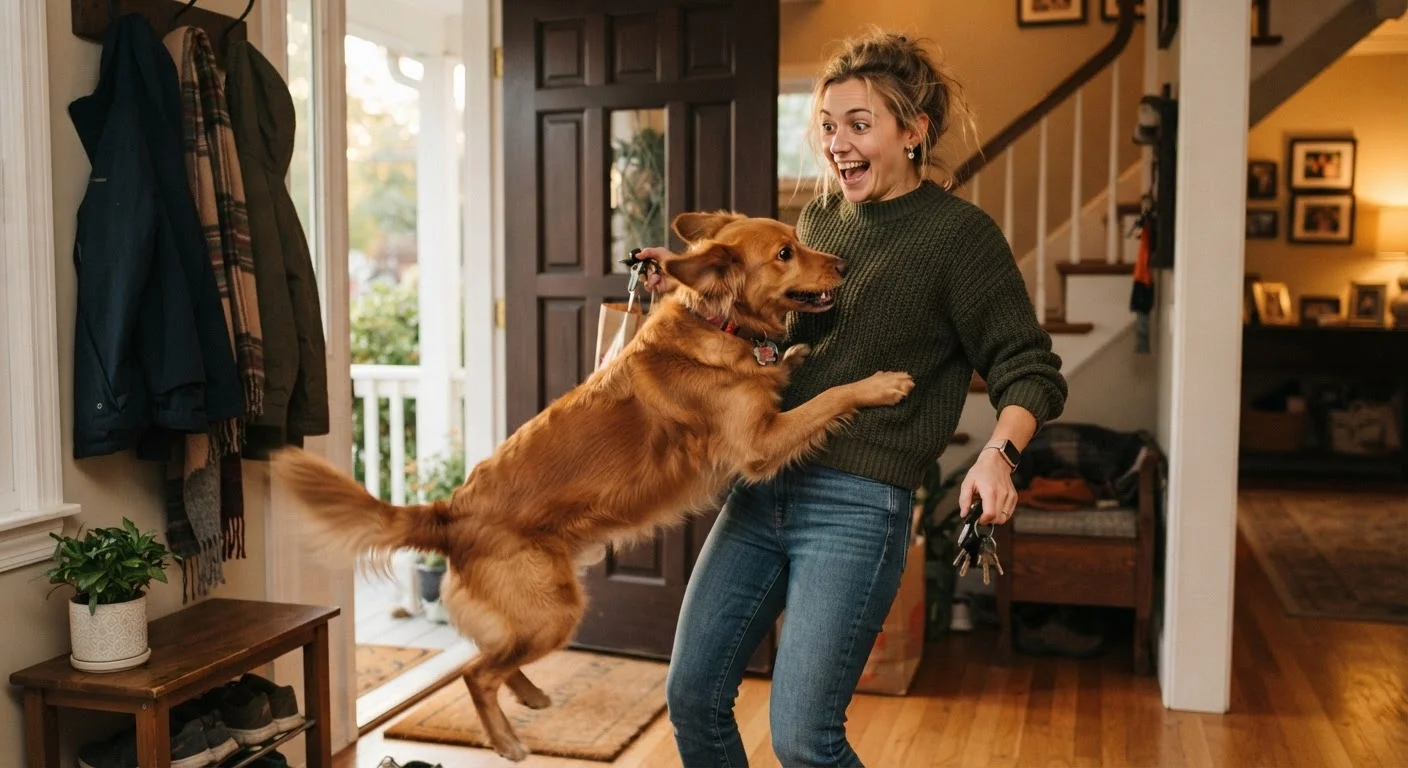
Jumping on people is one of the most frequently reported behavior concerns among dog owners, yet it is also one of the most frequently misunderstood. The behavior is almost never about dominance, disobedience, or a deliberate attempt to cause chaos. It is, at its core, a greeting behavior - one that makes perfect sense from a dog's social perspective.
Puppies reach upward to lick their mothers' muzzles as a submissive, affiliative gesture. As dogs mature, this impulse doesn't disappear; it gets redirected toward the humans they're excited to see. When a guest walks through the door, the dog experiences a rapid spike in arousal. Jumping is the most immediate way it knows to close the physical gap and make face contact.
Understanding this what your dog's body language is actually communicating is foundational. Once you recognize that jumping is communication rather than defiance, you can respond in ways that actually shift the behavior instead of accidentally reinforcing it.
Jumping Is Communication, Not Defiance
Dogs do not jump to challenge your authority or embarrass you in front of company. Jumping is an attention-seeking behavior rooted in social greeting instincts - puppies lick their mothers' faces by reaching upward, and adult dogs carry that impulse forward. Understanding this distinction matters because it shapes which training strategies will actually work.
The Mistakes That Keep Jumping Going
Most jumping problems persist not because the dog is stubborn, but because the humans around it are - unintentionally - keeping the behavior on a reinforcement schedule. The following are the most common errors owners make, why they happen, and what to do differently.
Giving attention - even negative attention - when the dog jumps.
Why it happens: Telling a dog to 'get down,' making eye contact, or pushing them off all register as social interaction. From the dog's perspective, jumping worked.
Allowing jumping sometimes but scolding it other times.
Why it happens: Owners often permit jumping when they're in casual clothes or in a good mood, then correct it when guests arrive or they're dressed up. Dogs learn from patterns, and mixed signals create confusion rather than clarity.
Failing to train an alternative, incompatible behavior.
Why it happens: Most owners focus entirely on stopping the jump rather than replacing it with something the dog can do instead. Dogs need an outlet for the excited energy that greetings generate.
Not briefing guests before they enter.
Why it happens: Owners assume guests will naturally ignore the dog or follow their lead. In reality, many guests - especially dog lovers - immediately reach down to pet an incoming jumper, which delivers a reward the owner was working to withhold.
Only practicing greetings when guests actually arrive.
Why it happens: Real guest arrivals are unpredictable, emotionally charged events. Dogs that haven't practiced calm greetings in low-stakes settings are unlikely to perform them when excitement spikes.
Addressing jumping requires treating it as a training project with consistent rules, not a discipline problem that demands harsher corrections. The science behind dog training is clear: reward-based methods that build alternative behaviors outperform punishment across virtually every metric.
Avoid Knee-to-Chest Corrections
Raising a knee to block a jumping dog is a widely repeated tip that lacks reliable evidence of effectiveness and can inadvertently injure smaller dogs. Some dogs interpret the physical contact as play engagement and escalate the behavior rather than stopping it. Stick to removing attention entirely - turning away, crossing your arms, and remaining silent - as the default non-reinforcing response.
Building a Consistent Greeting Routine That Sticks
Lasting change requires structure, repetition, and everyone in the household rowing in the same direction. Start by identifying every person who interacts with your dog regularly - family members, frequent visitors, dog walkers - and align them on the same response protocol. One person reinforcing the sit-to-greet while another allows jumping is enough to reset progress significantly.
Practice matters more than most owners realize. Daily mock arrivals - a family member leaving through the front door, ringing the bell, and re-entering - let you rehearse the calm-greeting sequence without the emotional stakes of a real guest visit. Keep sessions short, upbeat, and heavily rewarded. Over time, the dog builds a new behavioral habit around the door: excitement is fine, but four paws stay on the floor.
~77%
Dog owners reporting jumping as a problem behavior
Survey data from the American Pet Products Association and veterinary behaviorists consistently place jumping among the top reported behavior concerns in companion dogs.
3-5 sec
Window to deliver reinforcement effectively
Behavioral science research indicates that rewards or corrections must occur within a few seconds of the behavior to be associated with it by the dog.
If your dog's jumping is accompanied by other anxious or hyperaroused behaviors - excessive barking, inability to settle, or signs of distress - it may be worth consulting a certified applied animal behaviorist or your veterinarian. Some dogs have underlying anxiety that amplifies excitement responses, and behavioral support alongside veterinary guidance can make a meaningful difference.