

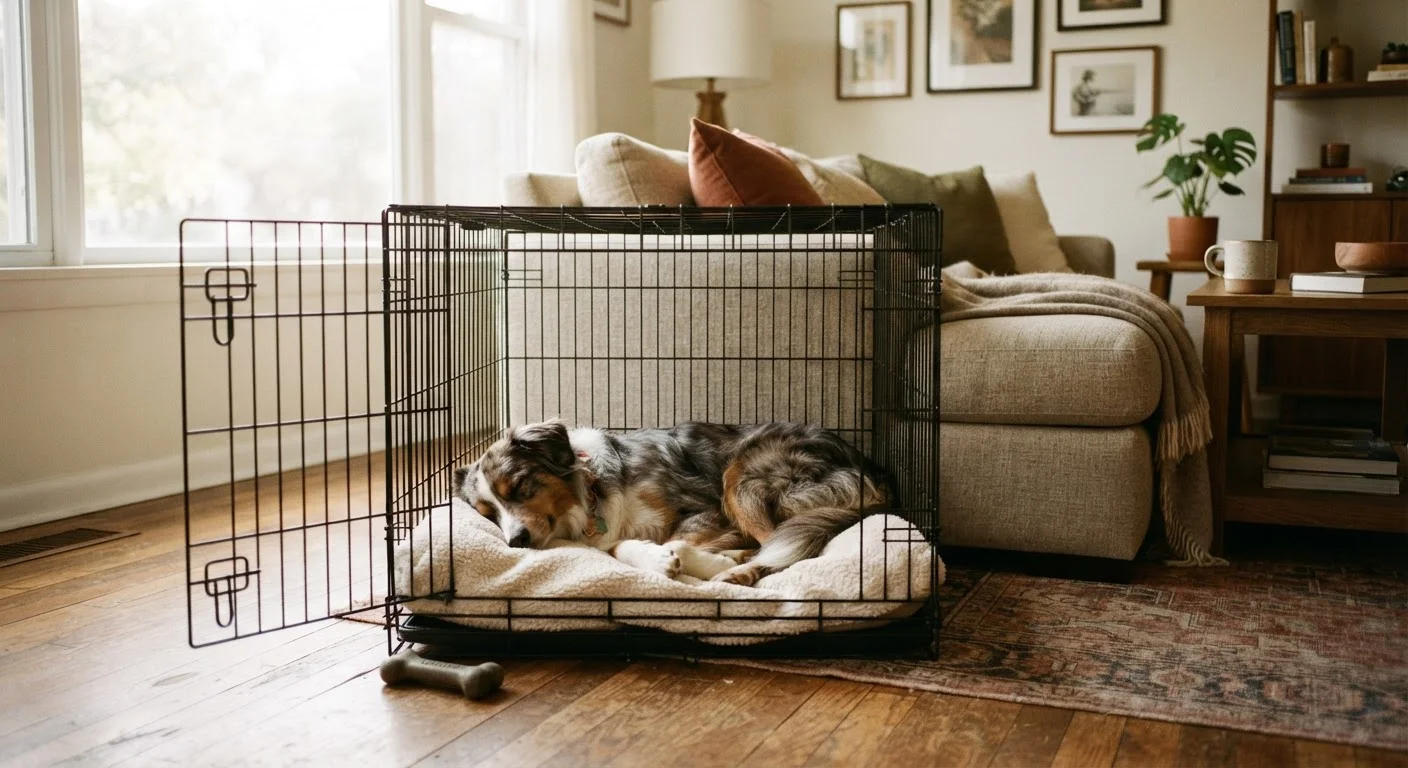
Key Takeaways
- Crates support house-training and provide a safe den space, especially for puppies and anxious dogs.
- Free roaming works best for adult dogs with proven reliability and a fully dog-proofed home.
- Neither approach is universally superior - the right choice depends on the individual dog.
- Misuse of a crate as punishment can undermine its benefits and damage trust.
- Many owners use a hybrid approach, gradually expanding freedom as the dog matures.
Accelerates house-training for puppies
Dogs instinctively avoid soiling their sleeping area, making the crate a practical aid for bladder and bowel control during early training stages.
Provides a consistent safe retreat
A familiar crate offers dogs a predictable space to decompress, which can reduce anxiety - particularly in busy households or during stressful events like fireworks.
Prevents unsupervised destructive behavior
Chewing hazardous items, ingesting household chemicals, or destroying furniture are risks that are virtually eliminated when a dog is safely crated while unattended.
Useful for travel and veterinary recovery
Crate-trained dogs are far less stressed during car travel, boarding stays, and post-surgical rest periods, because the crate is already an established comfort zone.
Boredom risk if crating is prolonged
Dogs left crated for more hours than is appropriate may develop frustration, anxiety, or compulsive behaviors - the crate itself is not the cause, but excessive confinement is.
Requires thorough dog-proofing of the home
Free roaming is only safe if hazards - including toxic plants, accessible trash, open staircases, and electrical cords - have been systematically addressed throughout the home.
Not suitable for dogs still developing reliability
Puppies and newly adopted dogs with unknown behavior history are rarely ready for unsupervised home access; granting it too soon often leads to accidents and ingestion of dangerous items.
Crate misuse can undermine training and trust
Using a crate as punishment or placing a distressed dog in one without proper introduction teaches negative associations that can make the space a source of fear rather than comfort.
Our Verdict
Crate training offers clear structure during a dog's developmental years and can remain a calming retreat throughout life. Free roaming suits dogs who have demonstrated consistent, reliable behavior and live in homes with minimal hazards. For most households, the two approaches are not mutually exclusive - a well-introduced crate and a carefully phased expansion of home access together make the most practical long-term strategy.
Owners of puppies or newly adopted dogs will generally benefit most from starting with crate training before gradually introducing free roaming as trust is established.
Why This Decision Matters More Than It Seems
Deciding how much of your home your dog can access isn't just about convenience - it directly shapes house-training outcomes, safety, and your dog's emotional wellbeing. Both crate training and free roaming are legitimate approaches endorsed by veterinary and behavioral professionals, but each comes with trade-offs that depend heavily on your dog's age, breed tendencies, and individual temperament.
If you're preparing to bring home a new puppy, establishing a containment strategy early on is one of the most impactful decisions you'll make. For owners of adult or rescue dogs, the calculus shifts somewhat - but the core questions remain the same.
Crate Size Matters
A crate should be large enough for the dog to stand up, turn around, and lie down comfortably - but not so large that one end becomes a bathroom area. For puppies, many owners use a divider panel to adjust the space as the dog grows. An ill-fitting crate can undermine house-training progress and cause physical discomfort.
The Case for Crate Training
A crate, when introduced with patience and positive reinforcement, functions as a den - a space dogs can genuinely come to feel secure in. Dogs have a natural inclination to seek enclosed resting spaces, which makes a well-sized crate a behaviorally sound tool rather than a form of confinement.
Accelerates house-training for puppies
Dogs instinctively avoid soiling their sleeping area, making the crate a practical aid for bladder and bowel control during early training stages.
Provides a consistent safe retreat
A familiar crate offers dogs a predictable space to decompress, which can reduce anxiety - particularly in busy households or during stressful events like fireworks.
Prevents unsupervised destructive behavior
Chewing hazardous items, ingesting household chemicals, or destroying furniture are risks that are virtually eliminated when a dog is safely crated while unattended.
Useful for travel and veterinary recovery
Crate-trained dogs are far less stressed during car travel, boarding stays, and post-surgical rest periods, because the crate is already an established comfort zone.
Beyond house-training, crates are valuable during travel, veterinary recovery, and emergency evacuations. They also reduce destructive behavior in unsupervised situations - not because they punish the dog, but because they eliminate the opportunity for costly (and potentially dangerous) mistakes while training is still in progress. Common training myths sometimes frame crates as cruel, but behavioral science consistently supports their use when applied humanely.
The Case for Free Roaming
Giving a dog unrestricted home access - whether that's the full house or a large, gated area - reflects trust built over time. For adult dogs who are fully house-trained, non-destructive, and calm when left alone, free roaming can support their mental wellbeing by reducing isolation and boredom.
Boredom risk if crating is prolonged
Dogs left crated for more hours than is appropriate may develop frustration, anxiety, or compulsive behaviors - the crate itself is not the cause, but excessive confinement is.
Requires thorough dog-proofing of the home
Free roaming is only safe if hazards - including toxic plants, accessible trash, open staircases, and electrical cords - have been systematically addressed throughout the home.
Not suitable for dogs still developing reliability
Puppies and newly adopted dogs with unknown behavior history are rarely ready for unsupervised home access; granting it too soon often leads to accidents and ingestion of dangerous items.
Crate misuse can undermine training and trust
Using a crate as punishment or placing a distressed dog in one without proper introduction teaches negative associations that can make the space a source of fear rather than comfort.
Freedom of movement allows dogs to self-regulate: they can shift between cool and warm spots, drink water on their own schedule, and find a comfortable resting place. For high-energy breeds, access to more space during the day may ease anxiety. That said, free roaming is most effective alongside a consistent daily routine that provides predictable exercise, feeding, and rest periods.
Making the Right Choice for Your Dog
There is no single correct answer - the best approach is the one that balances your dog's developmental stage, behavior history, and your home environment. Puppies and newly adopted dogs almost always benefit from starting in a crate or confined area, then earning expanded access as they prove reliable. A dog that chews baseboards or raids trash cans unsupervised is not ready for full home access, regardless of age.
4-6 hrs
Maximum recommended daytime crating for adult dogs
Veterinary and behavioral organizations generally advise against crating adult dogs for longer than four to six consecutive hours during the day.
~28%
U.S. dog owners who report using a crate regularly
Survey data from the American Pet Products Association has indicated that roughly one in four U.S. dog owners uses a crate as part of their pet's routine.
Conversely, crating an adult dog for excessively long periods - particularly one that is already calm and well-trained - can cause frustration and anxiety. Most behavioral guidelines suggest that adult dogs should not be crated for more than four to six hours at a stretch during the day.
Responsible ownership means regularly reassessing your setup as your dog matures. For a fuller picture of what long-term dog care involves, see what goes into responsible dog ownership.