

Key Takeaways
- Knocking things over is an instinctive hunting behavior, not spite or deliberate mischief.
- Cats use their paws to test whether objects are alive, safe, or interesting - just like prey.
- Boredom and under-stimulation are among the most common drivers of the behavior.
- Cats that knock things over may be seeking owner attention, which they have learned works reliably.
- Providing appropriate play outlets can significantly reduce destructive surface-sweeping.
- Sudden increases in the behavior can occasionally signal a sensory or neurological change worth discussing with a vet.
Cats Knocking Things Over
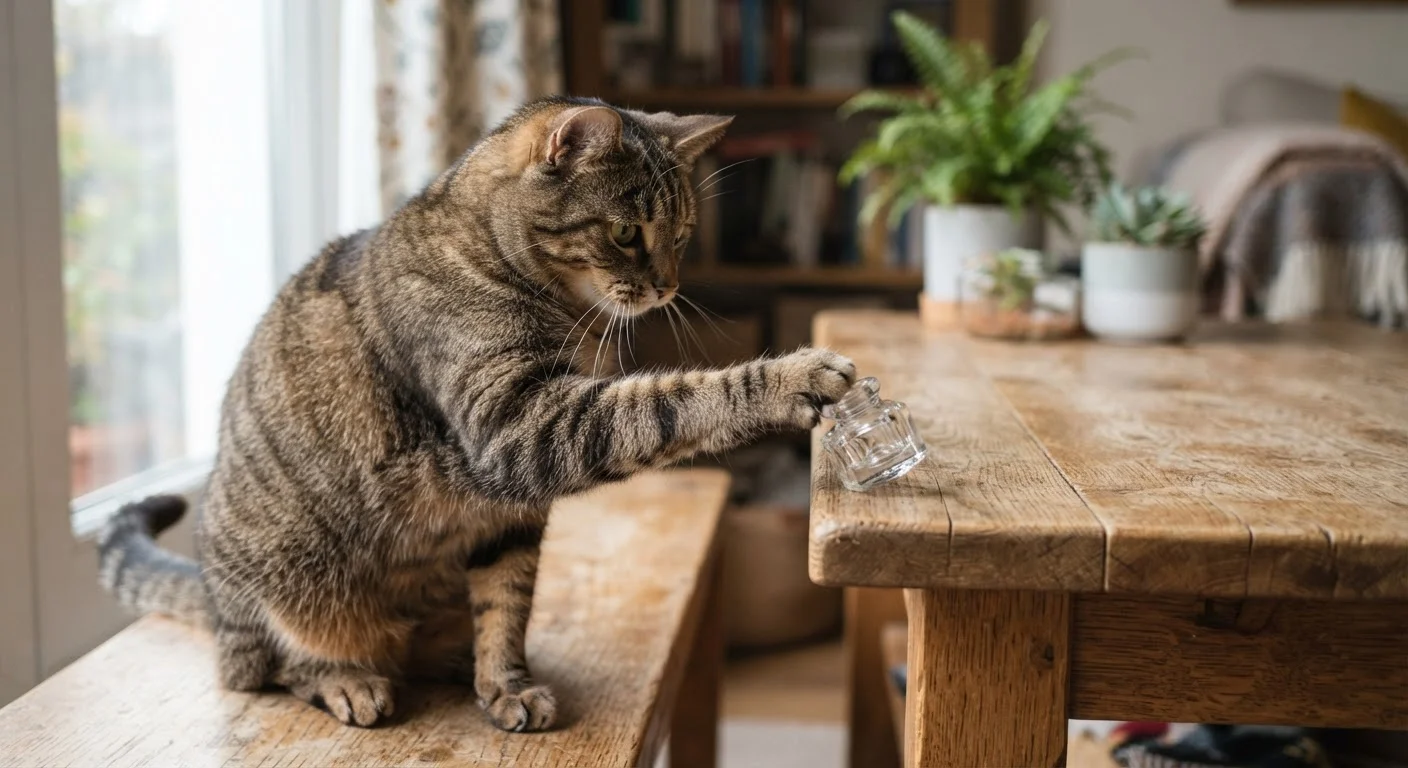
When cats use their paws to push objects off surfaces, they are engaging in an instinct-driven behavior tied to hunting, sensory exploration, and attention-seeking. It is not random mischief or revenge - it reflects how cats interact with and make sense of their environment. Understanding the motivation behind this behavior helps owners respond more effectively.
Behaviorally, the action is linked to the predatory motor sequence common in felids: stalk, chase, bat, and capture. The paw-batting phase mimics the disabling strike a cat would deliver to small prey.
The Hunting Instinct Behind the Bat
Domestic cats are obligate carnivores descended from solitary hunters, and their nervous systems are wired for the predatory sequence: locate, stalk, pounce, and capture. Even well-fed indoor cats carry this programming intact. When your cat bats a pen off your desk, it is running a compressed version of that same sequence.
The paw-swipe is not random. It closely mirrors the disabling strike cats use on small prey - a quick, controlled hit to assess whether something is moving, alive, or worth pursuing further. Objects at the edge of a surface are particularly tempting because, from the cat's perspective, they occupy the boundary between "here" and "unknown territory below," which maps neatly onto the edge of a rock ledge or branch in a more naturalistic setting.
This also explains why cats often watch intently after an object falls. They are monitoring for movement - exactly what a predator would do after striking prey.
“Cats are not broken dogs, and their behavior should never be interpreted through a human or canine lens. What looks like mischief to us is often a perfectly executed piece of natural feline behavior.”
— John Bradshaw, Anthrozoologist and author of 'Cat Sense'
Curiosity, Sensory Exploration, and Object Permanence
Cats learn about the physical world primarily through touch and movement. A stationary object tells a cat relatively little; a moving one reveals size, weight, fragility, and speed. By nudging something and watching what happens, your cat is essentially running a small physics experiment.
Interestingly, cats have a reasonably well-developed understanding of object permanence - the concept that things continue to exist after they leave sight. When an object disappears over a table's edge, a cat may peer after it not out of confusion but out of continued predatory interest. Research into feline cognition suggests cats track the expected location of hidden objects, which means the falling item remains mentally "on their radar."
For more on how cats communicate their inner states through physical behavior, see our guide to feline body language.
Boredom and Attention-Seeking - A Learned Habit
Instinct may start the behavior, but owner reactions can sustain and amplify it. If a cat pushes something off a shelf and their person immediately reacts - even with a scolding - the cat has successfully captured attention. For a social animal that may be under-stimulated, any attention is often better than none.
Over time, cats can learn that surface-sweeping reliably produces a response, reinforcing the habit. This is especially common in households where cats are left alone for long periods without adequate environmental enrichment.
Redirect, Don't React
When your cat starts eyeing something on the counter, redirect attention with a toy before the object hits the floor. Reacting after the fact - even with frustration - can inadvertently reward the behavior. Consistent redirection toward appropriate outlets is the most effective long-term strategy.
Boredom-driven behaviors like knocking things over, excessive vocalization, or destructive scratching often share the same root cause: insufficient mental and physical stimulation. If your cat's table-clearing happens most often when you are present and distracted, attention-seeking is likely a significant factor. Consult a veterinarian or certified cat behaviorist if redirection strategies are not working, since persistent behavioral changes can occasionally indicate underlying stress or anxiety worth addressing.
What You Can Do About It
Because the behavior is instinct-driven, outright elimination is unrealistic - and unnecessary. The goal is redirection, not suppression. Daily interactive play sessions using wand toys or feather lures allow cats to complete the predatory sequence in an appropriate way, significantly reducing their motivation to raid your countertops.
Puzzle feeders and food-dispensing toys work along similar lines: they engage a cat's problem-solving instincts and make mealtime mentally taxing in a productive sense. Window perches with views of birds or squirrels offer passive stimulation that keeps curious minds occupied.
When your cat does knock something over, the least reinforcing response is a calm, neutral reaction. Removing yourself briefly denies the reward of attention. Storing particularly fragile or irreplaceable items in closed spaces is simply practical risk management - cats are unlikely to curb the behavior out of respect for your belongings.
For context on separating feline fact from fiction, veterinarians address many common misconceptions about cat behavior that can lead owners in the wrong direction.