

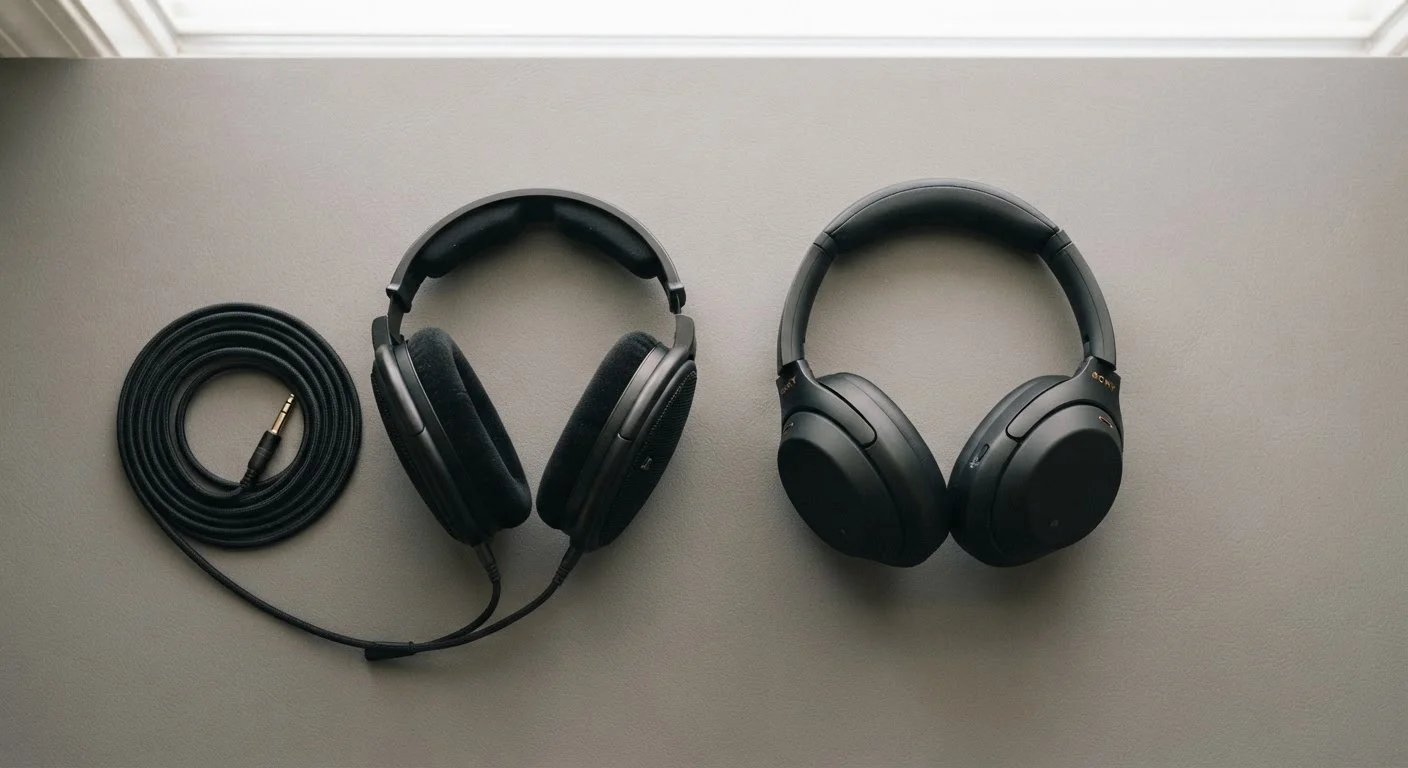
Key Takeaways
- Wired headphones deliver audio without signal compression or transmission delay, making them reliable for precise listening.
- Wireless headphones introduce Bluetooth latency and audio codec processing, which can affect syncing and sound quality.
- Battery life is a wireless-only concern - wired headphones draw power directly from the source device.
- Modern wireless codecs like aptX and AAC have narrowed the audio quality gap, but not fully closed it.
- Wired connections are increasingly limited by hardware - many smartphones no longer include a headphone jack.
- Neither type is universally superior; the right choice depends on your primary use case and listening environment.
Option A
Wired Headphones
The dependable, no-compromise audio standard.
Best for: Listeners who prioritize consistent audio quality, zero latency, and no charging requirements.
Option B
Wireless Headphones
The flexible, cord-free listening experience.
Best for: Active users and commuters who value freedom of movement and device convenience over absolute signal purity.
If you work in audio production or need precise sound monitoring
Wired Headphones
Wired connections eliminate compression and latency entirely, giving you an unaltered signal path that wireless transmissions cannot fully replicate.
If you commute, exercise, or move between rooms regularly
Wireless Headphones
Freedom from a physical cable makes wireless the practical choice for active settings where a cord creates friction or safety concerns.
If you frequently use a device without a headphone jack
Wireless Headphones
As manufacturers phase out 3.5mm ports, wireless headphones avoid adapter dependency and work seamlessly with modern smartphones and tablets.
If you watch video content and notice audio sync issues
Wired Headphones
Wired connections have near-zero latency, eliminating the audio-video sync delay that Bluetooth connections can introduce even with low-latency codecs.
If you want to listen for long, uninterrupted sessions
Wired Headphones
Wired headphones never run out of battery, making them more reliable for extended listening without the interruption of recharging.
What the Cable Actually Does
A headphone cable does one job: carry an analog electrical signal from the source device directly to the drivers in your ear cups. There is no encoding, no transmission protocol, and no intermediary processing. The audio you hear is a direct translation of the electrical signal, shaped only by the headphone's own hardware.
Remove the cable and a chain of technology steps in to compensate. Wireless headphones rely on Bluetooth, a radio protocol designed for short-range data transmission. Your source device - phone, laptop, or tablet - encodes the audio into a compressed digital stream, transmits it wirelessly, and the headphone decodes it in real time. Each step introduces variables: codec choice, signal strength, interference, and battery state all play a role in what you ultimately hear.
This distinction matters more in some contexts than others. For casual listening - podcasts, playlists during a commute - most users won't notice meaningful differences. For critical listening, gaming, or video editing, the gap between a direct analog signal and a decoded wireless stream becomes more relevant.
Latency, Codecs, and Audio Quality
Latency - the delay between a sound being produced and your ears registering it - is the most practical technical difference between wired and wireless. Wired headphones have latency measured in fractions of a millisecond, essentially imperceptible. Standard Bluetooth connections, depending on the codec and device, can range from roughly 40 milliseconds to over 200 milliseconds. For music playback, this is rarely noticeable. For video or gaming, even modest delays can cause visible lip-sync issues.
Codec quality also shapes wireless audio. Common codecs include SBC (the baseline Bluetooth standard), AAC (used widely in Apple ecosystems), aptX and aptX HD (common in Android), and LDAC (developed by Sony, capable of higher bitrates). Higher-quality codecs reduce compression artifacts and preserve more of the original signal, but they require compatible hardware on both ends.
| Criterion | Wired Headphones | Wireless Headphones |
|---|---|---|
| Latency | Near-zero (~1ms) | 40-200ms depending on codec |
| Audio signal | Uncompressed analog | Compressed digital (codec-dependent) |
| Battery required | No | Yes, 20-40 hours typical |
| Active noise cancellation | Uncommon | Widely available |
| Device compatibility | Requires 3.5mm or adapter | Bluetooth, broad compatibility |
| Interference risk | None | Possible in crowded RF environments |
| Freedom of movement | Limited by cable length | Up to ~30 feet range |
The quality gap between wired and wireless has genuinely narrowed with high-bitrate codecs. However, wired connections still provide an uncompressed signal path that no wireless standard currently matches at equivalent hardware levels. For most everyday listeners, this difference is subtle. For audiophiles or professionals, it remains meaningful.
Battery, Hardware, and Real-World Tradeoffs
Battery life is a constraint unique to wireless headphones. A pair of wireless over-ear headphones typically offers anywhere from 20 to 40 hours of playback per charge, depending on features like active noise cancellation (ANC). ANC - which uses microphones and processing to reduce ambient noise - draws additional power and can noticeably shorten battery life. Wired headphones carry no such overhead; they run on the source device's power indefinitely.
Hardware compatibility adds another layer of consideration. Many current smartphones and tablets have removed the 3.5mm headphone jack, meaning wired headphones require a USB-C or Lightning adapter. These adapters function reliably but add a component that can be misplaced or worn. Wireless headphones sidestep this entirely, pairing via Bluetooth with most modern devices.
Bluetooth Interference Is Real But Manageable
Wireless headphones operate on the 2.4 GHz radio band, the same frequency used by many Wi-Fi routers, microwaves, and other Bluetooth devices. In dense environments - crowded offices, busy transit - signal dropouts or audio stuttering can occur. Most modern Bluetooth 5.0+ devices handle interference better than earlier versions, but it remains a factor wired connections avoid entirely.
For a broader look at how your devices manage different types of connections and signal routing, see our comparison of Wi-Fi vs. mobile data - a similar tradeoff logic applies to wireless connectivity decisions across devices.
Neither format dominates in every category. Wired headphones offer reliability and signal purity without power management concerns. Wireless headphones offer freedom of movement and modern device compatibility. Understanding which tradeoffs matter to your specific listening habits - not which type ranks highest on a spec sheet - is the more useful frame for this decision.