

Key Takeaways
- Solid hardwood is milled from a single piece of wood and can be sanded and refinished multiple times over decades.
- Engineered wood uses a real wood veneer over a plywood or HDF core, making it more stable under moisture and temperature changes.
- Neither option is universally superior - the right choice depends heavily on room conditions, subfloor type, and budget.
- Engineered wood can be installed below grade (basements); solid hardwood generally cannot.
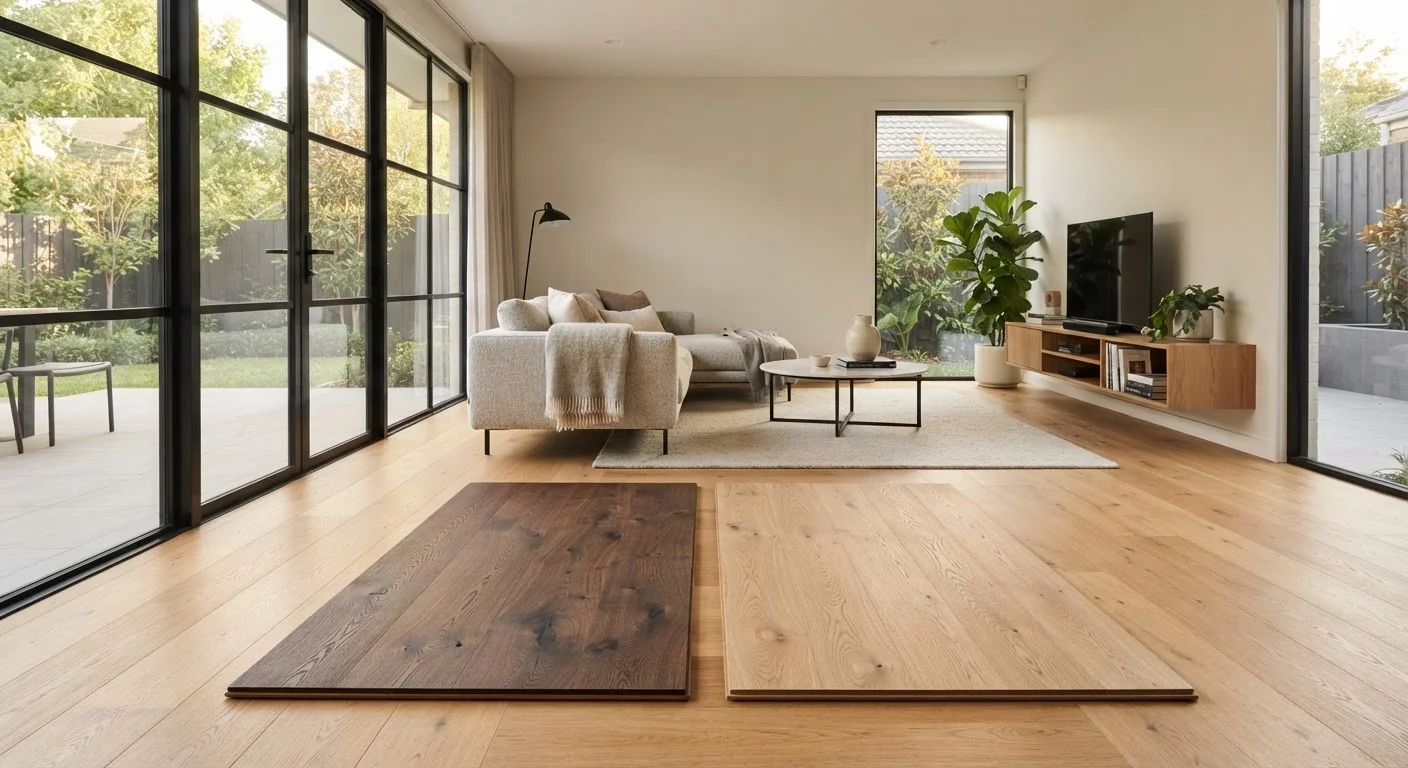
- Both types carry a real wood surface layer, so appearance alone rarely settles the comparison.
Option A
Solid Hardwood Flooring
The time-tested, all-natural classic.
Best for: Dry, climate-controlled rooms where long-term refinishing and maximum longevity are priorities.
Option B
Engineered Wood Flooring
The moisture-resilient, versatile modern alternative.
Best for: Basements, kitchens, and other areas prone to humidity fluctuations or slab-on-grade installation.
If you want a floor you can refinish and restore over 50+ years
Solid Hardwood Flooring
Solid hardwood's thickness allows repeated sanding and refinishing, so surface scratches and wear can be erased rather than replaced.
If you're installing in a basement, kitchen, or over radiant heat
Engineered Wood Flooring
Its layered plywood core resists expansion and contraction far better than solid wood in high-moisture or temperature-variable environments.
If you're working with a tighter renovation budget
Engineered Wood Flooring
Engineered wood generally costs less per square foot and is easier to install as a floating floor, reducing labor costs.
If resale value and property prestige are primary goals
Solid Hardwood Flooring
Real solid hardwood is widely recognized by buyers and appraisers as a premium feature that can support home value.
How Each Floor Is Actually Built
The most important difference between these two flooring types isn't what you see - it's what's underneath the surface.
Solid hardwood is exactly what the name suggests: a plank milled entirely from a single piece of timber, typically ¾ inch thick. Common species include oak, maple, hickory, and cherry. Because it's one continuous piece of wood, solid hardwood expands and contracts significantly as humidity and temperature change. This natural movement is why solid hardwood is generally not recommended for below-grade spaces or areas with wide moisture swings.
Engineered wood, by contrast, is a manufactured product. It consists of a real hardwood veneer - typically between 1/16 and 1/6 of an inch thick - bonded over multiple layers of cross-ply plywood or high-density fiberboard (HDF). Those alternating layers are oriented in opposing directions, which dramatically reduces the board's tendency to expand, contract, warp, or cup when exposed to moisture or temperature changes.
Both products are real wood on their surface. The distinction is structural, not cosmetic.
| Criterion | Solid Hardwood | Engineered Wood |
|---|---|---|
| Construction | Single solid timber plank | Veneer over plywood/HDF core |
| Typical thickness | ¾ inch | 3/8 to ¾ inch |
| Moisture resistance | Low - expands and contracts | Higher - dimensionally stable |
| Below-grade installation | Not recommended | Generally suitable |
| Refinishing potential | 6-8 times over lifespan | 1-2 times (veneer-dependent) |
| Installation methods | Nail or staple only | Nail, glue, or float |
| Radiant heat compatibility | Limited | Generally compatible |
| Typical lifespan | 50-100+ years with care | 25-40 years with care |
Performance: Moisture, Durability, and Installation
Where each flooring type excels comes down to three practical factors: moisture tolerance, long-term durability, and installation flexibility.
Moisture Tolerance
Solid hardwood should only be installed in climate-controlled, above-grade spaces with stable humidity. Basements, bathrooms, and laundry rooms are generally off-limits. Engineered wood's layered core makes it far more stable across a wider range of humidity conditions, and many engineered products are rated for below-grade installation - though no wood flooring is fully waterproof.
Durability and Refinishing
A solid hardwood floor can typically be sanded and refinished six to eight times over its lifespan, giving it a potential service life measured in generations. Engineered wood, by contrast, can usually be lightly sanded and refinished only once or twice, depending on the thickness of its veneer layer. Thicker veneer layers (3 mm or more) offer more refinishing opportunity than thinner ones.
Installation Methods
Solid hardwood must be nailed or stapled to a wood subfloor - it cannot float freely or be glued to concrete. Engineered wood is more versatile: it can be nailed, glued, or installed as a floating floor directly over concrete, existing tile, or plywood subfloors.
¾"
Standard solid hardwood plank thickness
This thickness is what allows solid hardwood to be sanded and refinished multiple times throughout its lifetime.
3 mm+
Veneer thickness enabling refinishing
Engineered wood planks with a veneer layer of 3 mm or more can generally withstand at least one professional sanding and refinish.
50-100 yrs
Potential lifespan of solid hardwood
With proper installation, climate control, and periodic refinishing, well-maintained solid hardwood floors can last generations.
Cost, Maintenance, and Making Your Decision
Both flooring types require regular sweeping or vacuuming and occasional damp mopping with a wood-safe cleaner. Avoid standing water on either surface.
In terms of upfront cost, solid hardwood generally runs higher per square foot than engineered wood, though pricing varies considerably by species, grade, and finish. Installation labor tends to cost more for solid hardwood given the nailing process and subfloor requirements.
When choosing between the two, consider these questions:
- Where is the room located? Below grade or high-humidity areas favor engineered wood.
- What type of subfloor do you have? Concrete slabs require engineered wood or a floating installation method.
- How long do you plan to stay in the home? If you intend to remain for decades and want to refinish the floor multiple times, solid hardwood may be worth the investment.
- Is radiant heat involved? Engineered wood handles under-floor heating systems more reliably due to its dimensional stability.
Neither option is objectively better - they solve different problems. Understanding your room's conditions and long-term goals will consistently lead to a smarter flooring decision than appearance or price alone.