

Key Takeaways
- Processing exists on a spectrum - canned beans and packaged chips are not nutritionally equivalent.
- Ultra-processed foods are consistently associated with poorer health outcomes in large observational studies.
- Whole foods tend to deliver more fiber, vitamins, and minerals relative to their calorie content.
- Most people can benefit from shifting the balance toward whole foods without eliminating all processed items.
- Always consult a qualified healthcare professional or registered dietitian for personalized dietary guidance.
Option A
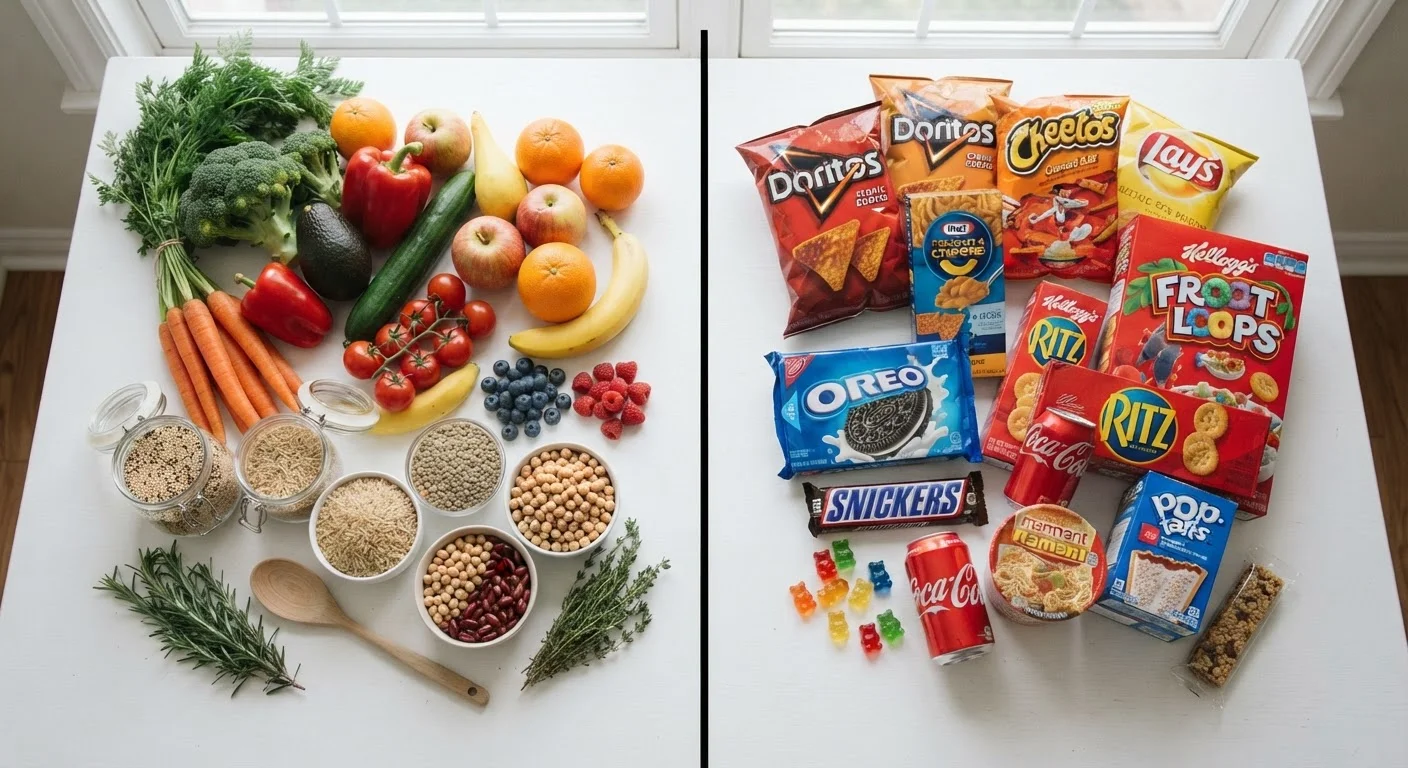
Whole Foods
Foods in their natural or minimally altered state.
Best for: Readers looking to maximize nutrient density and minimize additives in their everyday diet.
Option B
Processed Foods
Foods that have been industrially altered, often with added ingredients.
Best for: Understanding what's actually in convenience foods and how different degrees of processing affect nutrition.
If you want to maximize nutrient density in your meals
Whole Foods
Whole foods deliver fiber, vitamins, and minerals with minimal additives, supporting overall nutritional quality.
If convenience and shelf life are practical priorities for your household
Processed Foods
Minimally processed options like canned tomatoes or frozen vegetables offer genuine nutritional value with added practicality.
If you're managing a chronic condition or specific dietary concern
Whole Foods
Research generally associates diets rich in whole foods with better long-term metabolic and cardiovascular markers, though individual needs vary.
If you're working with a tight food budget
Processed Foods
Frozen and canned whole-food options are often affordable and nutritionally sound - not all processing diminishes quality.
Defining the Terms: It's a Spectrum, Not a Binary
The phrase "processed food" tends to conjure images of neon-orange snacks and fast food, but processing actually describes any change made to a food from its raw state - including washing, freezing, cooking, or fermenting. That makes the term surprisingly broad.
Researchers frequently use the NOVA classification system, developed by nutrition epidemiologists, to categorize foods into four groups based on the degree and purpose of industrial processing. At one end sit unprocessed or minimally processed foods: fresh fruits, vegetables, eggs, plain meats, and legumes. At the other end are ultra-processed foods (UPFs) - products formulated from industrial ingredients like hydrogenated oils, modified starches, flavor enhancers, and synthetic additives, typically assembled to be hyper-palatable and shelf-stable.
In between are processed culinary ingredients (salt, oil, flour) and conventionally processed foods (canned fish, pasteurized cheese, frozen vegetables). Understanding where a food falls on this spectrum matters far more than applying a blanket good/bad label. Nutrition research is more nuanced than headlines suggest, and that nuance starts here.
How Whole and Ultra-Processed Foods Compare
When researchers compare dietary patterns, the differences between whole-food-heavy diets and ultra-processed-food-heavy diets are notable across several dimensions.
| Criterion | Whole Foods | Ultra-Processed Foods |
|---|---|---|
| Fiber content | Naturally intact, higher | Often removed or degraded |
| Micronutrient density | Naturally occurring vitamins and minerals | Nutrients often added back artificially |
| Added sugars | Minimal to none | Frequently high |
| Sodium | Low in natural form | Often elevated for flavor and preservation |
| Additives and preservatives | Absent or minimal | Common industrial ingredients |
| Shelf life | Shorter, requires refrigeration | Extended, often room-temperature stable |
| Satiety signaling | Tends to promote fullness | May be engineered to reduce satiety cues |
Whole foods typically contain fiber in its intact form, which slows digestion, supports gut microbiota, and contributes to satiety. Ultra-processed foods often have their fiber removed or degraded during manufacturing, and what fiber remains may not behave the same way physiologically. Similarly, vitamins and minerals that are naturally present in whole grains or vegetables are sometimes added back into processed products after refining - a less efficient nutritional exchange.
Sodium and added sugars are frequent additions in ultra-processed products, and consistent overconsumption of both is associated with elevated blood pressure and metabolic disruption in population-level research.
57%
Share of US calorie intake from ultra-processed foods
A 2016 analysis published in BMJ Open estimated that ultra-processed foods accounted for roughly 57% of daily calorie consumption among US adults.
14-32%
Elevated risk range associated with high UPF intake
Multiple large cohort studies have found associations between high ultra-processed food consumption and elevated cardiovascular and all-cause mortality risk in that range, though causation is not established.
10.9g
Average daily fiber intake for US adults
According to dietary survey data, most American adults consume well below the recommended 25-38 grams of fiber per day, a gap closely tied to low whole-food consumption.
What Research Generally Shows
A substantial body of large-scale observational research - including cohort studies conducted across multiple countries - has found associations between high ultra-processed food consumption and elevated risks of obesity, type 2 diabetes, cardiovascular disease, and all-cause mortality. These findings are consistent enough across populations to be taken seriously, though they do not establish direct causation on their own.
Whole-food dietary patterns, including plant-based and omnivore approaches rich in whole ingredients, are broadly associated with better long-term health markers in both observational and interventional research. The mechanisms likely involve multiple overlapping factors: fiber intake, micronutrient density, reduced additive exposure, and eating behaviors influenced by food texture and satiety signaling.
It's important to note that most people in high-income countries consume some processed foods regularly - and that an occasional ultra-processed item is unlikely to determine long-term health outcomes on its own. Dietary patterns over time, rather than individual foods, are what researchers consistently identify as meaningful.
This article is for general informational purposes only and does not constitute medical or dietary advice. Consult a registered dietitian or qualified healthcare professional for guidance tailored to your individual health needs.