

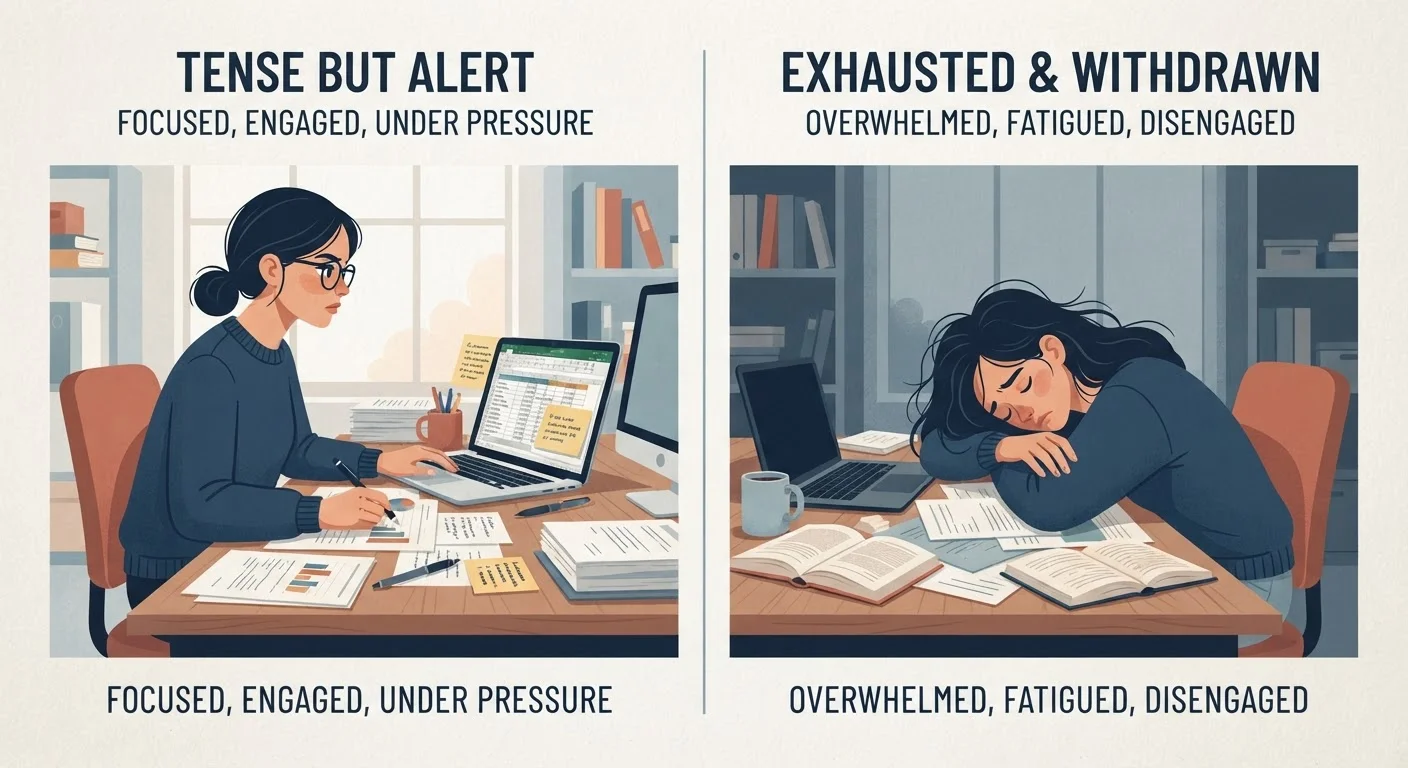
Key Takeaways
- Stress involves too much pressure; burnout involves running out of the internal resources to cope.
- Stress is often acute and reversible; burnout develops gradually and takes longer to recover from.
- Both states exist on a continuum - catching stress early can help prevent it from becoming burnout.
- Burnout is recognized by the World Health Organization as an occupational phenomenon, not a personal weakness.
- Recovery strategies differ: stress responds to rest and relief; burnout often requires deeper structural changes.
- Consulting a mental health professional is a valuable step when symptoms persist or worsen.
Option A
Stress
The body's short-term alarm system - demanding but recoverable.
Best for: Understanding acute, temporary overwhelm that typically resolves with rest and reduced demand.
Option B
Burnout
Chronic depletion that goes beyond tiredness - requiring more than a good night's sleep.
Best for: Recognizing a longer-term pattern of emotional, physical, and motivational exhaustion that needs structured recovery.
If you feel overwhelmed but still motivated and hopeful
Stress
Preserved drive and optimism are hallmarks of stress rather than burnout. Prioritizing rest and workload management is likely your most effective immediate strategy.
If you feel emotionally numb, cynical, and disconnected from work or relationships
Burnout
Detachment and cynicism are core features of burnout. Recovery typically requires more than a weekend off - consider speaking with a healthcare professional.
If your symptoms have persisted for weeks or months without improvement
Burnout
Duration is a key distinguishing factor. Prolonged exhaustion that doesn't resolve with ordinary rest warrants professional evaluation.
If you can identify a clear, temporary source of pressure
Stress
Stress is often traceable to a specific trigger - an upcoming deadline, a life event. Addressing or enduring that stressor usually allows recovery.
What Separates Stress from Burnout?
Stress and burnout are frequently used interchangeably, but they describe meaningfully different states. Understanding that difference is the first step toward responding appropriately - and preventing one from becoming the other.
Stress is the body and mind's response to external demands exceeding available resources. It typically feels urgent - racing thoughts, muscle tension, difficulty sleeping. Crucially, stress usually carries an undercurrent of emotion and engagement: you care deeply, perhaps too much. Remove or reduce the stressor, and most people begin to recover.
Burnout, by contrast, is what chronic, unrelieved stress can eventually produce. The World Health Organization classifies burnout as an occupational phenomenon characterized by three dimensions: feelings of energy depletion or exhaustion, increased mental distance or negativism toward one's work, and reduced professional efficacy. Unlike stress, burnout often presents not as too much feeling, but as too little - a hollowed-out numbness that rest alone may not fix.
For a broader foundation on mental health concepts, see our beginner's guide to mental wellness.
| Criterion | Stress | Burnout |
|---|---|---|
| Core experience | Too much to handle | Too little left to give |
| Emotional tone | Anxious, urgent, overwhelmed | Numb, detached, cynical |
| Motivation | Usually preserved | Significantly diminished |
| Onset | Often tied to a specific trigger | Gradual accumulation over time |
| Recovery timeline | Days to weeks with relief | Weeks to months; may need support |
| Primary response | Rest, load reduction, self-care | Structural change, professional guidance |
How Each State Progresses Over Time
Stress and burnout are not static categories - they exist on a spectrum, and people can move along it in either direction. Recognizing where you are matters because early-stage stress responds well to relatively modest interventions, while established burnout may require more deliberate, longer-term recovery.
Researchers have proposed several models of burnout progression. A widely referenced framework by Herbert Freudenberger and Gail North describes a cycle that can begin with excessive ambition and gradually move through declining self-care, social withdrawal, depersonalization, and eventually inner emptiness. Not everyone follows this exact path, but the trajectory - from engaged yet overwhelmed to depleted and detached - reflects what many people report.
77%
Workers reporting workplace burnout
A survey by Deloitte found that 77% of respondents had experienced burnout at their current job, with more than half citing it as occurring more than once.
3 dimensions
WHO's definition of burnout
The World Health Organization's ICD-11 defines burnout across three dimensions: exhaustion, cynicism or depersonalization, and reduced efficacy - distinguishing it from general stress.
It's also worth noting that burnout is not limited to high-pressure careers. Caregivers, parents, students, and anyone managing chronic, low-control situations can experience it. And if stress is being pushed through without support, it can accelerate that journey. Our article on why pushing through isn't always the right approach explores this dynamic in more depth.
Recovery Looks Different for Each
One of the most practical reasons to distinguish between stress and burnout is that their recovery pathways diverge significantly.
For stress, effective strategies typically involve reducing or temporarily stepping back from the source of pressure, improving sleep quality, physical activity, and social connection. These interventions work because the underlying capacity to function remains intact - it just needs breathing room. Building a balanced weekly movement routine can support stress resilience without adding to your load.
For burnout, recovery generally requires more than a vacation. Because burnout involves a depletion of internal resources and often entrenched patterns of thinking and working, meaningful recovery frequently involves:
- Structural changes to workload, role expectations, or environment
- Rebuilding boundaries and a sense of autonomy
- Re-establishing sources of meaning and connection
- In many cases, professional support from a therapist, counselor, or physician
If you're uncertain whether what you're experiencing rises to the level of needing professional support, our piece on signs you might benefit from talking to a mental health professional offers a useful reflection framework.
It's also worth separating burnout from anxiety and other mental health conditions, which can present similarly. Our guide on understanding anxiety and its relationship to worry helps clarify those distinctions.
This article is for general informational and educational purposes only. It is not a substitute for professional medical or mental health advice, diagnosis, or treatment. If you are experiencing persistent or distressing symptoms, please consult a qualified healthcare professional.