

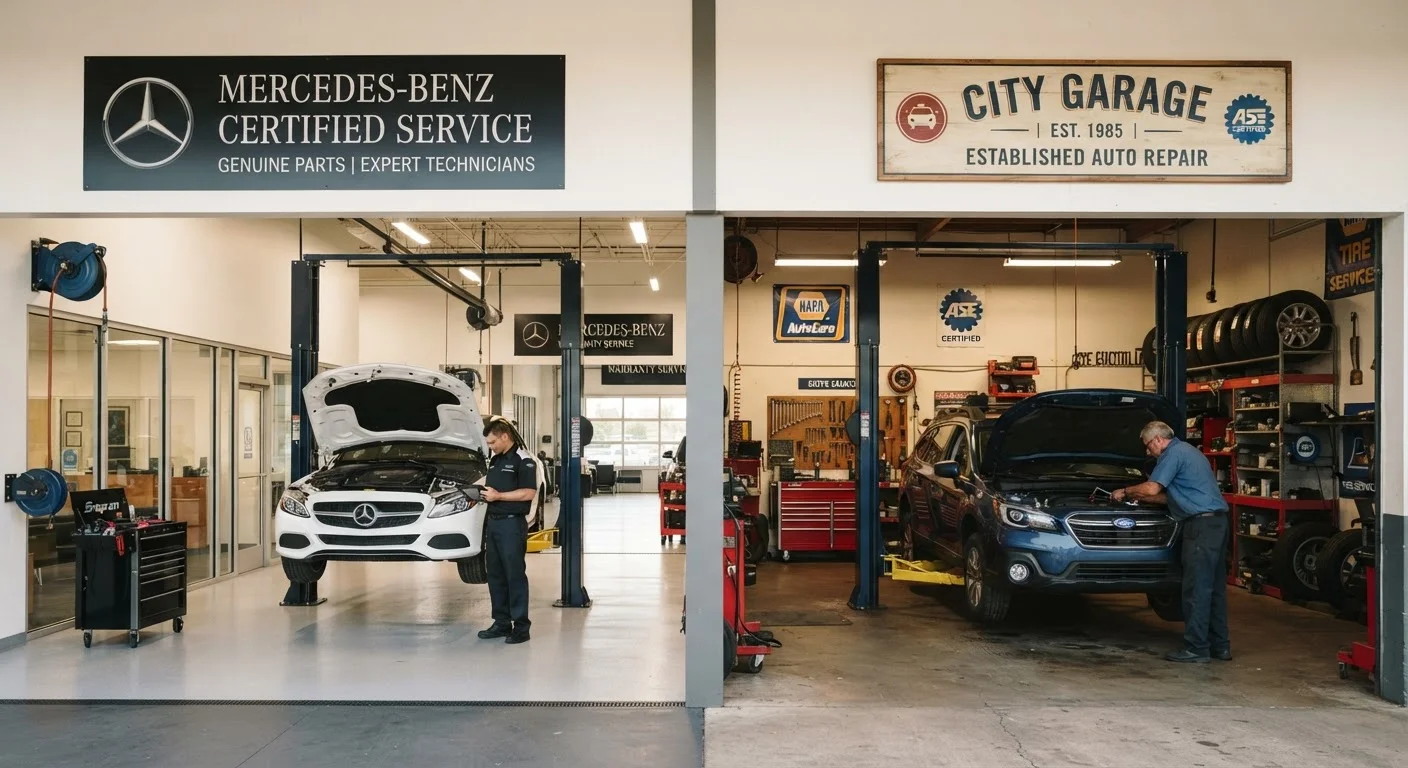
Key Takeaways
- Dealership service centers offer manufacturer-trained technicians and OEM parts, but typically charge higher labor rates.
- Independent shops often cost less and may provide more personalized service, but quality varies widely by shop.
- Using an independent mechanic for routine maintenance generally does not void a factory warranty under federal law.
- For complex, model-specific repairs or recalls, a dealership's specialized tools and software access can be a real advantage.
- Verifying certifications - such as ASE - helps identify qualified technicians at any type of shop.
Our Verdict
Neither dealership service centers nor independent mechanics are universally superior. Dealerships excel for warranty work, recalls, and model-specific diagnostics, while independent shops often deliver competitive pricing and flexible service for routine maintenance. The right choice depends on your vehicle's age, warranty status, and the complexity of the work needed.
| Best for | Recommended |
|---|---|
| Vehicles under manufacturer warranty or requiring recall service | Dealer Service Center |
| Routine maintenance and general repairs on older or out-of-warranty vehicles | Independent Mechanic |
| Complex, model-specific diagnostics requiring proprietary software | Dealer Service Center |
| Drivers prioritizing lower labor costs and a long-term shop relationship | Independent Mechanic |
Why This Decision Matters More Than Most Drivers Realize
Every time your vehicle needs service - whether it's an oil change, a brake job, or a check-engine diagnostic - you face a quiet fork in the road: dealership service center or independent mechanic. The choice affects your wallet, your warranty, and the long-term health of your vehicle. Understanding the structural differences between these two options is a key part of responsible ownership. For a broader look at scheduled service intervals and what's involved, see our complete owner's maintenance reference.
Neither option is automatically better. Each carries genuine advantages and real trade-offs depending on the situation.
Dealership Service Centers: Strengths and Limitations
Dealership service departments employ factory-trained technicians who specialize in the brand they represent. They have direct access to proprietary diagnostic software, technical service bulletins (TSBs), and original equipment manufacturer (OEM) parts - components built to the same specifications as those installed at the factory.
This specialization matters most in specific scenarios:
- Warranty and recall work: Manufacturers require warranty repairs to be performed at authorized dealerships. Recall services are handled exclusively at dealer locations and are completed at no cost to the owner.
- Advanced diagnostics: Some vehicles - particularly newer models with complex electronic systems - require brand-specific software that independent shops may not have licensed access to.
- TSB compliance: Dealers receive manufacturer updates on known issues and corrective procedures; independent shops must purchase access to this data separately.
The trade-offs are significant, however. Dealership labor rates tend to run higher than independent shops, often ranging from $100 to $200 or more per hour depending on the region and brand. Service advisors also operate within a business environment that may prioritize upsells. Appointments can be harder to schedule quickly, and the personal relationship that many drivers value with a trusted mechanic is rarely present at larger service departments.
| Dealer Service Center | Independent Mechanic | |
|---|---|---|
| Technician training | Factory-trained, brand-specific | Varies; ASE certification available |
| Parts used | OEM parts standard | OEM, OEM-equivalent, or aftermarket |
| Labor rates | Typically higher ($100-$200+/hr) | Often lower ($75-$130/hr) |
| Warranty work | Required for factory warranty repairs | Not authorized for warranty claims |
| Recall service | Handled exclusively at dealers | Not available |
| Diagnostic software | Full proprietary access | May have limited brand-specific access |
| Personalized service | Often limited; high staff turnover | Frequently stronger, owner-operated |
| Convenience features | Loaner cars, shuttle often available | Varies by shop size |
Independent Mechanics: What They Offer and Where to Be Cautious
Independent repair shops make up the majority of automotive service businesses in the United States. Many are owner-operated, which can translate into more personalized attention and accountability. Labor rates are typically lower - often between $75 and $130 per hour - and they work on vehicles across all makes and models.
Look for shops whose technicians hold ASE certification, an industry-recognized credential that indicates tested competence across specific repair categories. A shop displaying ASE signage or employing multiple certified technicians is a meaningful signal of professional standards.
How to Vet an Independent Shop
Before leaving your vehicle, ask whether technicians hold current ASE certification and whether the shop has experience with your specific make. Request a written estimate before any work begins, and confirm whether parts used are OEM or aftermarket. A reputable shop will welcome these questions - hesitation or vagueness is worth noting.
One concern drivers often raise is whether using an independent shop voids a factory warranty. Under the federal Magnuson-Moss Warranty Act, manufacturers generally cannot void a warranty simply because you had routine maintenance performed elsewhere - provided the work meets manufacturer specifications and is documented. Keep all service records and receipts.
The caution with independent shops is variability. Without manufacturer oversight, quality depends heavily on the individual shop's standards, equipment, and staff. Researching reviews and asking about certifications before committing is worth the time.
Cost, Convenience, and Parts: A Practical Breakdown
Beyond labor rates, consider the cost of parts. Dealerships typically use OEM parts and charge accordingly. Independent shops often have flexibility to offer OEM, OEM-equivalent, or aftermarket parts - each with different price points and quality considerations. For non-critical components, quality aftermarket parts from reputable suppliers can be a reasonable choice; for safety-critical systems, many mechanics recommend OEM or OEM-equivalent specifications.
Convenience varies by location and shop size. Dealerships often offer amenities like loaner vehicles and shuttle services, which smaller independent shops may not. However, independent shops may offer faster turnaround on routine jobs simply due to lower volume or a more direct scheduling process.
If you purchased your vehicle from a dealership and are evaluating your full ownership cost picture, it's also worth understanding how dealership fee structures work more broadly - our article on dealer fees and which ones are negotiable provides useful context on how dealerships structure their revenue.
Making the Right Call for Your Situation
A practical framework: if your vehicle is under factory warranty, bring recall work and warranty-covered repairs to the dealer - that's non-negotiable. For routine maintenance like oil changes, tire rotations, and filter replacements on a vehicle no longer under warranty, a well-credentialed independent shop is often a cost-effective choice.
As vehicles age and accumulate mileage, the calculus shifts further toward independent mechanics for general upkeep, while dealers retain an edge for brand-specific electronic diagnostics or software-dependent systems.
Documenting all service regardless of where it's performed - keeping receipts, mileage logs, and part details - protects your ownership record and supports any future warranty claims or resale discussions. For more on the full picture of vehicle ownership decisions, explore our car buying and ownership hub.