

Key Takeaways
- A clean driving record does not guarantee your premium stays the same at renewal.
- Local claim trends and weather events can raise rates for every driver in a region.
- Rising costs for vehicle repairs and medical care push premiums higher industry-wide.
- Credit-based insurance scores affect pricing in most U.S. states.
- Reviewing your policy before renewing - not after - gives you the most options.
Insurance Premium at Renewal
Your auto insurance premium is the amount you pay - monthly or annually - for your coverage. At renewal, insurers recalculate this amount based on a wide range of factors, not just your personal driving history. Even if you filed no claims and received no tickets, your rate can still rise because of changes in the broader insurance market, local conditions, or data the insurer uses to assess risk.
Insurers must file rate changes with each state's department of insurance before applying them. Approved increases apply to entire risk pools, meaning individual policyholders can see higher rates even without any personal change in behavior.
The Renewal Surprise Most Drivers Don't Expect
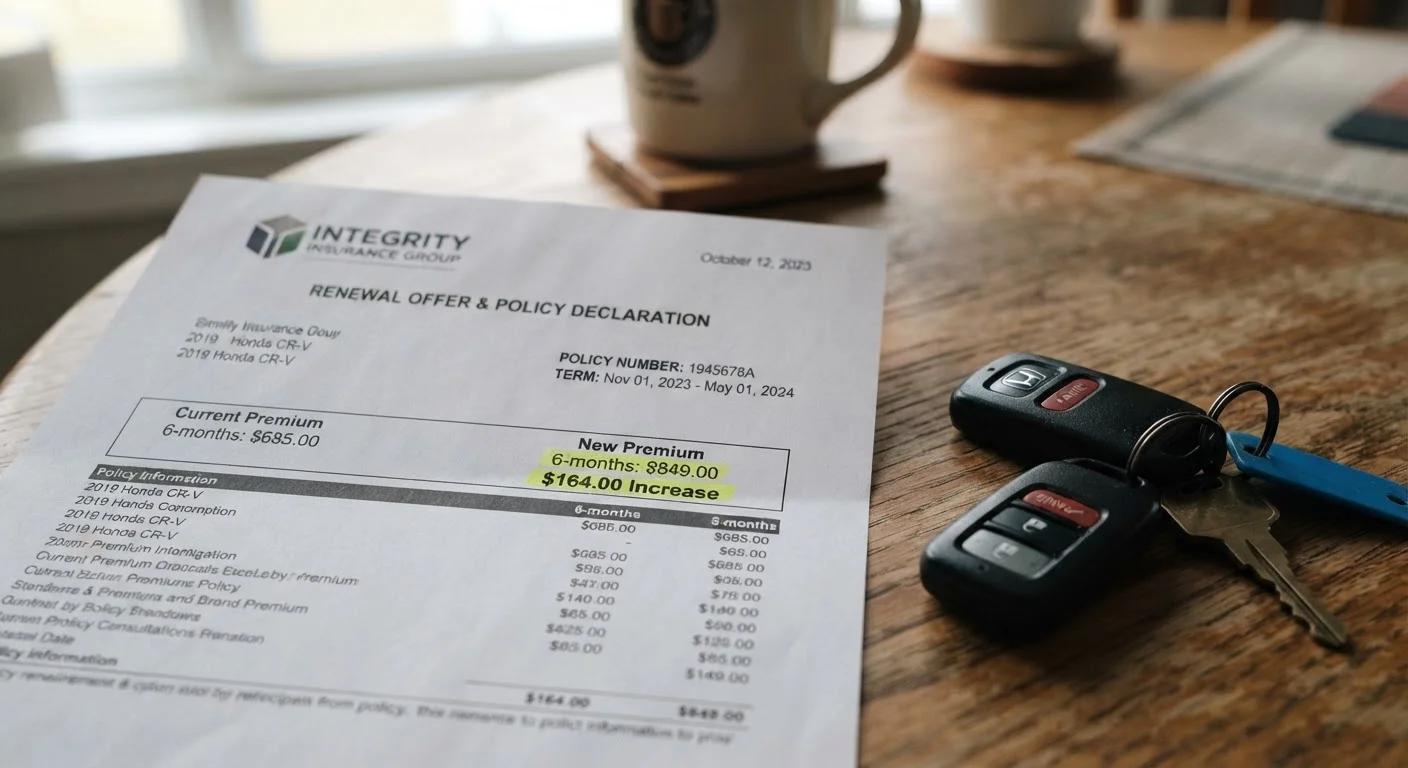
You drive carefully, avoid accidents, and renew your policy without a second thought - then the new declaration page arrives showing a meaningfully higher premium. No claims. No violations. Yet the number went up.
This experience is common, and the explanation lies in how auto insurance is actually priced. Your premium reflects not only your personal risk profile but also the collective risk of everyone your insurer covers in your area, the current cost of settling claims, and a set of regulatory and economic variables that shift constantly. Understanding each driver of change puts you in a better position to evaluate your options.
Before your next renewal arrives, it's worth reviewing what your policy actually covers. Our guide on common car insurance misunderstandings explains coverage gaps that surprise drivers at claim time.
Regional Claim Trends and Catastrophe Loss
Insurers group policyholders into geographic risk pools. When claims increase across your area - from a surge in auto thefts, a major hailstorm, or a spike in distracted-driving accidents - the insurer's costs rise for the entire pool. To stay financially solvent, the company adjusts rates for all policyholders in that pool, including those who filed nothing.
Severe weather events have become a notable driver of this dynamic. Hail, flooding, and windstorms generate large numbers of comprehensive claims in concentrated areas. After significant weather losses, regional rate adjustments are common.
~$3,300
Average U.S. annual auto insurance premium
According to the Insurance Information Institute's most recently published estimates, average annual auto insurance expenditures have risen significantly as claims costs have increased.
40%+
Increase in vehicle repair costs since 2019
Industry data from the Bureau of Labor Statistics shows motor vehicle maintenance and repair costs have risen sharply, driven by parts scarcity and advanced vehicle technology.
45 states
States permitting credit-based insurance scoring
The majority of U.S. states allow insurers to factor credit-based insurance scores into auto premium calculations, according to the National Conference of State Legislatures.
This is why two drivers with identical records can pay very different premiums simply because they live in different ZIP codes or states.
Inflation in Repair Costs and Medical Expenses
The cost of settling an auto claim has risen substantially in recent years, driven by two persistent pressures. First, vehicle repair costs have increased because modern cars contain more sensors, cameras, and advanced components. Even minor collisions can involve calibrating driver-assistance systems, which adds labor and parts costs that didn't exist a decade ago.
Second, medical costs tied to bodily injury claims - the expenses your liability coverage pays when you injure someone - have risen alongside broader healthcare inflation. Because insurers pay these costs when claims occur, higher settlement amounts translate into higher premiums across the board.
Ask About Available Discounts
When your premium rises, it's a good time to ask your insurer whether you qualify for discounts you may not be receiving - such as low-mileage, multi-policy, or defensive driving course discounts. These don't offset systemic rate increases, but they can reduce your total out-of-pocket cost. Eligibility criteria vary by insurer and state.
Your Credit-Based Insurance Score
In the majority of U.S. states, insurers use a credit-based insurance score - a metric derived from credit data but calculated differently from a standard FICO score - as a pricing input. Research cited by industry groups suggests a statistical correlation between certain credit characteristics and the likelihood of filing a claim.
If your credit profile changed between policy terms - due to higher balances, a missed payment, or a new hard inquiry - your insurance score may have shifted, contributing to a higher renewal premium. California, Hawaii, Massachusetts, and Michigan are among the states that restrict or prohibit this practice. Check your state's rules if you're uncertain whether this factor applies to you.
“Insurance pricing is not a personal judgment about a driver's character. It's a statistical process that weighs dozens of variables - and many of those variables have nothing to do with what that driver did last year.”
— J. Robert Hunter, Former Director of Insurance, Consumer Federation of America
What You Can Actually Do About It
A premium increase doesn't mean you must simply accept the new rate. Here are constructive steps to consider:
- Request a breakdown. Ask your insurer which specific factors drove the increase. Some companies will identify whether it was a rate-level change, a credit score change, or a surcharge from a policy event.
- Review your coverage levels. Your life circumstances may have changed since the policy was written. Our guide on what to review before renewing your policy walks through key checkpoints.
- Reconsider your deductible. Raising your deductible can lower your premium, though it increases your out-of-pocket cost after a claim. Understand the trade-off fully - see our explainer on how deductibles affect what you pay.
- Compare quotes. Each insurer uses its own rating model. Equivalent coverage may be priced differently across carriers. Compare on coverage terms, not just price.
This article is for general informational purposes only and does not constitute insurance, financial, or legal advice. Coverage terms, pricing factors, and regulations vary by insurer and by state. Consult a licensed insurance professional for guidance specific to your situation.