

Key Takeaways
- APR is a more complete cost measure than the base interest rate because it includes lender fees.
- Your credit score is one of the strongest factors lenders use to set your rate.
- Longer loan terms lower monthly payments but increase the total interest paid.
- The loan-to-value ratio and down payment size both influence what rate you're offered.
- Shopping multiple lenders before visiting a dealership gives you a useful comparison benchmark.
Auto Loan Interest Rate
An auto loan interest rate is the percentage a lender charges you to borrow money to purchase a vehicle. It determines how much extra you pay on top of the amount you borrowed. Lenders express this as either a simple interest rate or an Annual Percentage Rate (APR), which also factors in certain fees.
Most U.S. auto loans use simple interest, meaning interest accrues daily on your remaining principal balance - not on the original loan amount. APR is the broader cost metric required by the federal Truth in Lending Act (TILA) to be disclosed to borrowers.
The Core Mechanics: How Interest Adds to Your Cost
When a lender finances your vehicle purchase, they're extending you a sum of money - called the principal - and charging a fee for that service expressed as an interest rate. On most U.S. auto loans, interest accrues daily based on your outstanding balance. This means every payment you make reduces the principal, which in turn lowers the interest owed on subsequent days.
The formula lenders use is straightforward: your annual rate is divided by 365 to get a daily rate, which is then multiplied by your current balance. Early in a loan, a larger share of each payment goes toward interest because the balance is still high. As the balance shrinks, more of each payment chips away at the principal itself. This pattern is called amortization.
For a fuller explanation of loan and financing terminology, see the Car Buying Glossary - it covers terms like amortization, principal, and APR in plain language.
~60%
New vehicle purchases financed
According to Experian's State of the Automotive Finance Market reports, roughly six in ten new vehicle transactions in the U.S. involve some form of financing.
6-8%
Percentage point rate spread by credit tier
Industry data consistently shows that borrowers in the lowest credit tiers pay rates that are several percentage points higher than those in the highest tiers, reflecting lender-assessed risk.
72 months
Most common new car loan term
Experian data has shown that 72-month terms are among the most frequently chosen for new vehicle loans in the U.S., though longer terms come with higher total interest costs.
APR vs. Interest Rate: Why the Distinction Matters
The base interest rate tells you one part of the story. The Annual Percentage Rate (APR) tells you more. APR folds in certain lender fees - such as origination charges - alongside the base rate and expresses the combined cost as a yearly percentage. Federal law under the Truth in Lending Act requires lenders to disclose APR, specifically to give borrowers a standardized number for comparison.
In practice, auto loan APRs and stated rates are often close together because lenders don't always charge heavy origination fees on vehicle loans. But it's still worth comparing offers using APR rather than the headline rate, since that's the number that most accurately reflects your total borrowing cost. A financing offer with a slightly higher base rate but no fees could end up cheaper than a lower-rate offer loaded with charges.
Compare Offers Using APR, Not Rate Alone
When reviewing multiple financing offers, use APR as your primary comparison metric rather than the stated interest rate. APR accounts for fees that the base rate doesn't reflect, giving you a more accurate side-by-side comparison. Even a small APR difference - say, 0.5% - can add up to hundreds of dollars over a multi-year loan.
What Shapes the Rate You're Offered
Lenders weigh several variables when setting your rate:
- Credit score and history: This is typically the most influential factor. A strong payment history and low credit utilization generally translate to a lower offered rate.
- Loan term: Longer terms (72 or 84 months) often carry higher rates than shorter ones (36 or 48 months) because the lender's money is at risk for longer.
- New vs. used vehicle: Used vehicle loans frequently carry higher rates than new-vehicle loans, partly because used cars are harder to value and depreciate less predictably.
- Loan-to-value (LTV) ratio: A larger down payment reduces how much you're borrowing relative to the car's value. Lower LTV is generally seen as lower risk.
- Lender type: Rates vary between banks, credit unions, and captive finance arms (a manufacturer's own lending division). Credit unions, in particular, are known to offer competitive rates to their members.
Understanding these levers helps you see why two buyers purchasing identical vehicles on the same day can walk out with very different loan costs.
Loan Term Length and Its Real Cost
Stretching a loan over more months reduces your monthly payment - but it increases the total amount of interest you pay. Consider a $25,000 loan at 7% APR: over 48 months, total interest paid would be roughly $3,700. The same loan over 72 months would accumulate closer to $5,600 in interest, even though the monthly payment feels more manageable.
There's also the issue of negative equity - also called being "upside down." Vehicles depreciate, often sharply in the first few years. With a long loan term, there's a window where your outstanding loan balance exceeds what the car is actually worth. If you need to sell or the vehicle is totaled during that period, you could owe more than you receive. This is one reason many financial advisors caution against very long loan terms unless your specific situation warrants it. For a broader look at the financial trade-offs involved in how you pay for a car, see Financing vs. Paying Cash for a Car.
Reading a Financing Offer Without Getting Lost
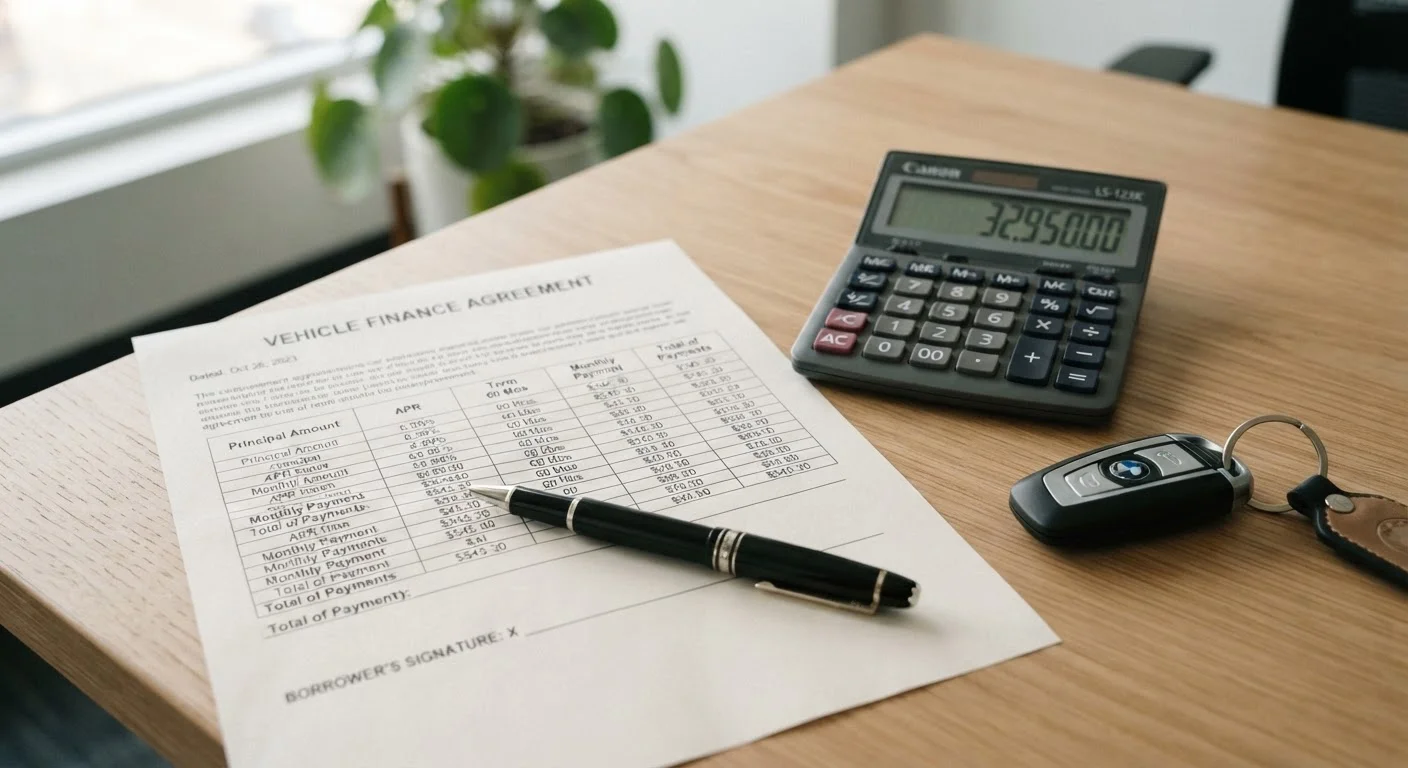
When a lender or dealership presents a financing offer, a few numbers deserve your close attention: the APR, the loan term in months, the monthly payment, and the total amount financed. Multiplying the monthly payment by the number of payments gives you the total you'll pay back - subtracting the amount financed reveals your total interest cost in dollar terms.
Dealers sometimes present financing in terms of monthly payment only, which can obscure the full picture. A lower payment achieved by extending the term may cost you more overall than a slightly higher payment on a shorter loan. Ask for - and compare - the full repayment cost, not just the monthly figure.
It also helps to arrive at the dealership with at least one pre-approval from a bank or credit union. This gives you a concrete benchmark and strengthens your position when discussing terms. Auto financing, like other forms of lending, is often negotiable. Your overall financial picture - including your car insurance obligations - is also worth considering as a total ownership cost. Car Insurance Decoded is a useful companion read for understanding that side of vehicle costs.
This article is for general informational purposes only and does not constitute financial or legal advice. Loan terms, rates, and eligibility vary by lender, credit profile, and market conditions. Consult a licensed financial professional for guidance specific to your situation.